Australia is pursuing a more Indigenous-focused foreign policy. But does it miss the bigger picture?
- Written by James Blackwell, Research Fellow (Indigenous Policy), UNSW
Foreign policy is an expression of a state’s fundamental values. It’s the outward face of every government, representing its aspirations in the international system. A state’s foreign policy can often convey strength, but also reveal weakness.
While Australia has enjoyed a strong international standing in recent decades, there has been no real recognition within our foreign policy of the diverse First Nations that have long inhabited this land.
First Nations people are excluded from this external dialogue, and it is well past time this changed.
A history of exclusion
As a proud Wiradjuri man, I know all too well this feeling of exclusion for First Nations people, both here and overseas. Our views on foreign policy are routinely considered irrelevant, our contributions not valued, and our issues ignored.
Yet, First Nations people have so much to offer. We have 80,000 years of diplomatic practice on this continent, conducting effective foreign policies long before there were states or even the concept of foreign policies. We have a strong value system centred in country, community, and culture.
This is why Australia should consider a foreign policy approach centred on Indigenous people and perspectives. It would reset the tired approach we currently take on the world stage and give weight to First Nations desires and aspirations.
These desires are the same ones that guided the Uluru Statement From the Heart four years ago today, and the call for a constitutionally enshrined Voice to Parliament — the desire to be heard and for our ideas and views to help shape the overall direction of this nation.
Read more: The Voice to Parliament isn't a new idea - Indigenous activists called for it nearly a century ago
Moving towards an Indigenous foreign policy
In a step forward, the Department of Foreign Affairs has launched a new Indigenous Diplomacy Agenda, which represents one of the first examples of Australia attempting to increase the First Nations presence within our foreign policy.
The agenda, unveiled by DFAT Secretary Frances Adamson, soon to be governor of South Australia, has the broad goal of “elevating Indigenous issues in our foreign policy” and taking a more systematic approach to doing better globally by “doing better at home”.
To achieve this, the agenda focuses its practical steps and recommendations around four main pillars:
shaping international norms and standards to benefit Indigenous peoples
maximising opportunities for Indigenous Australians and Indigenous peoples in a globalised world
promoting sustainable development for all Indigenous peoples
deploying Indigenous Australian diplomats to advance our national interests.
These broad themes are consistent with what we hope to see within an Indigenous foreign policy approach. The agenda is highly pragmatic, and there is much to be touted here as steps in the right direction.
The dual focus on specific goals for First Nations people, as well as broader aims across the portfolio, is particularly commendable. The focus on the diplomatic strengths of First Nations people is also worthwhile and long overdue.
In many regards, this document represents a strong move in the right direction for Australian foreign policy.
Examples from our neighbours
Looking at the approach our neighbour New Zealand has taken, however, shows how we could be viewing things differently.
Earlier this year, New Zealand launched a new foreign policy centred around Indigenous values. By strongly embedding Maori worldviews, tirohanga Maori, in its outlook, the government articulated a much larger and more encompassing proposal of an Indigenous foreign policy than Australia has put forth with this agenda.
As I said at the time, New Zealand’s approach was an
expression of the interconnectedness and purposefulness to which all Indigenous foreign policy aspires.
New Zealand’s new foreign minister, Nanaia Mahuta, has talked both about her own “base of lived experience” as a proud Maori woman, as well as how her goal was to
not only contribute to building a better society [within New Zealand], but a global community.
It is this kind of overall vision which Australia should aspire to, but which is somewhat lacking from its Indigenous Diplomatic Agenda.
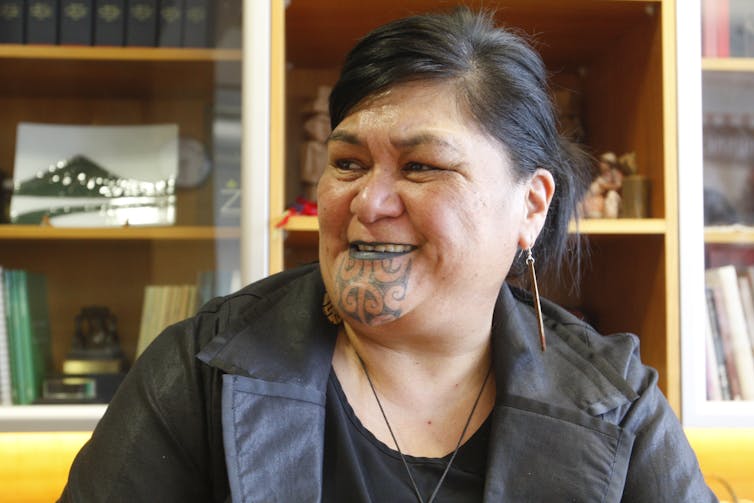 Nanaia Mahuta is New Zealand’s first Māori female foreign minister.
Nick Perry/AP
Nanaia Mahuta is New Zealand’s first Māori female foreign minister.
Nick Perry/AP
The way forward
There is indeed a failure of ambition with Australia’s plan. The focus is mostly around increasing the involvement of Indigenous people and strengthening specific Indigenous areas within the portfolio.
But this is mostly a continuation of good practices in existing policy. The claim to be a “systematic approach” for change is somewhat unfulfilled. There’s a lack of vision that misses the bigger picture.
First Nations people and perspectives appear mostly confined to areas related to our Indigeneity. Unlike in New Zealand, there is no recognition of Indigenous worldviews having something to offer our broader foreign policy outside of Indigenous-specific work. We are only useful when leveraging our identity.
The real potential of an Indigenous foreign policy approach is to create new dynamics in how Australia sees the world and new perspectives on how we act within the international system. We need to transform our overall thinking, rather than just seeking to place First Nations people within existing structures.
Of course, the research on this is still very much out. Without tangible goals, it remains to be seen whether New Zealand is seriously committed to substantial change, or whether its new approach is merely an idealistic aspiration.
It also remains to be seen if Australia can use its new departmental reforms to work from the ground up and create a truly ambitious foreign policy.
New Zealand may have kick-started an “Indigenous moment” in foreign policy, but Australia has a chance to truly embrace it and transform our place in the world. We have concrete plans from our government, now we need vision.
Authors: James Blackwell, Research Fellow (Indigenous Policy), UNSW