

As the world surges ahead on electric vehicle policy, the Morrison government's new strategy leaves Australia idling in the garage
- Written by: Jake Whitehead, Tritum E-Mobility Fellow & Advance Queensland Industry Research Fellow, The University of Queensland
The Morrison government will today announce its long-awaited electric vehicle strategy, coinciding with COP26 climate change talks underway in Glasgow. The new policy contains some welcome new funding, but is largely notable for what it omits.
In a welcome move, the government has allocated an additional A$250 million for electric vehicles, primarily aimed at charging infrastructure. But unlike every leading electric vehicle market globally, the plan delivers no financial or tax support to help Australian motorists make the switch to a cleaner car.
And the government has failed to explain how the policy will help Australia achieve net-zero emissions by 2050, just as it failed to do when releasing its economy-wide emissions reduction plan last month.
It’s encouraging to see the Morrison government move past its claim of a few years ago that electric vehicles would “end the weekend”. But the new plan is not the national electric vehicle strategy Australia deserves, and badly needs.
Falling short
Transport produces almost 20% of Australia’s greenhouse gas emissions – 60% of which is from cars. And the rate of transport emissions is fast increasing.
The government says the policy, titled the Future Fuels and Vehicles Strategy, will lead to 30% of all new car sales being electric by 2030 – which would mean 1.7 million electric cars on Australian roads.
But in 2019, government modelling predicted electric vehicles would comprise 27% of new sales by 2030. So the new measures announced will lead only to a 3% increase in what would have happened anyway.
At COP26 last week, Australia signed a global agreement to make electric vehicles the “new normal” by 2030. One in three cars being electric vehicles hardly meets this goal.
Most concerningly, the government’s plan is inconsistent with global targets to achieve net zero emissions by 2050. The United States, for example, is aiming for at least 50% electric vehicle sales by 2030.
Oddly, it appears the government would prefer Australian motorists remain dependent on expensive, foreign fuel for transport. Its investment in July of $260 million to increase diesel reserves – notably more than the new electric vehicle funding – supports this theory.
Read more: Clean, green machines: the truth about electric vehicle emissions
Australia’s token effort
Globally, about 5% of all new cars sold are electric and this is rapidly increasing. Yet in Australia, the figure is about 1%.
So what measures does the new strategy contain to shift the needle? In two words, not much. It includes:
$250 million to support public charging infrastructure, fleet infrastructure, vehicle trials and smart charging infrastructure in households
continued low-interest financing support for fleets via the Clean Energy Finance Corporation
an overdue update to the Green Vehicle Guide.
It’s better than nothing. But the government has claimed electric vehicles will deliver around 15% of national emission reductions required by 2050. It’s hard to see how the measures released today will get us there.
The government has also claimed high international demand for electric vehicles could constrain global supply and slow deployment in Australia.
But as carmakers have pointed out, they have little reason to send new, cheaper electric models to Australia because it lacks the policies to stimulate electric vehicle demand.
Read more: The US jumps on board the electric vehicle revolution, leaving Australia in the dust
The plan Australia deserves
The Morrison government must go back to the drawing board and produce a national electric vehicle strategy consistent with global climate efforts.
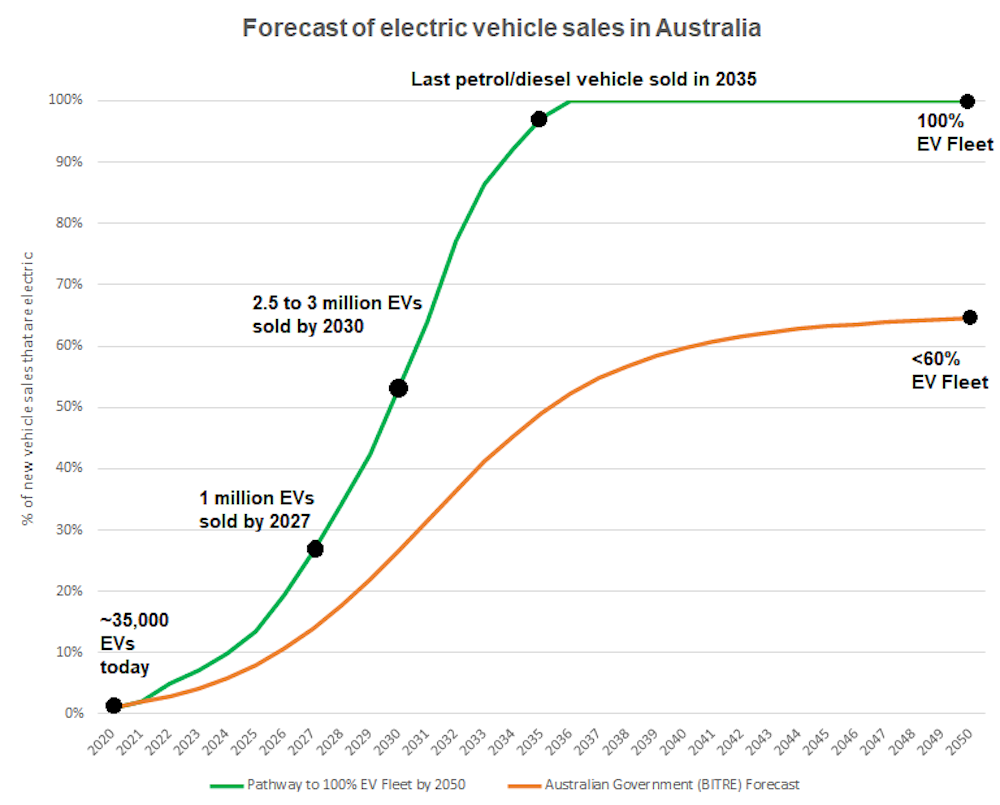
That would mean aiming for at least half of new car sales being electric by 2030, and 100% by 2035. This translates to about one million electric vehicles sold in Australia by 2027 and at least 2.5 million by 2030.
It’s a massive increase from the 30,000 or so electric vehicles sold over the past five years, and at least 50% higher than what’s forecast under today’s strategy.
Australia can learn much from overseas jurisdictions on how to boost electric vehicle sales. Until electric vehicle targets are met, the following state and federal policies are needed:
increase supply by introducing a national sales mandate for electric vehicles, and penalise manufacturers that don’t meet them
reduce upfront costs by making electric vehicles exempt from GST, stamp duty and registration fees (as is done in Norway)
support fleet adoption by making electric vehicles exempt from fringe benefits tax
fund infrastructure by committing to support the rollout of 100,000 public charging points by 2027 (in line with the European Union’s target).
Penalise states that go it alone on taxing electric vehicle usage. Instead, focus on road charges that address Australia’s multi-billion dollar city congestion problem rather than unfairly taxing rural and regional electric vehicle drivers due to the longer distances they have to drive.
Read more: Here's why electric cars have plenty of grunt, oomph and torque
Why Australia must act
The benefits of electric vehicles go far beyond tackling climate change.
We estimate Australians spend more than $30 billion each year on imported fuel. This alone should be enough to spur governments to support electric vehicle adoption and keep this money in Australia.
Recent analysis by the Australian Conservation Foundation also found maintaining the current approach to transport emissions could cost Australia up to $865 billion between 2022 and 2050.
Aside from greenhouse gas emissions, the costs were attributed to air, noise and water pollution. But better zero-emission transport policies could enable Australia to reduce these costs by up to $492 billion.
Clearly, electric vehicles deliver a net economic benefit, even after accounting for the cost of incentives and loss of fuel tax revenue.
As the rest of the world charges ahead, the Morrison government’s new strategy looks ever more foolish.
Read more: Wrong way, go back: a proposed new tax on electric vehicles is a bad idea
Authors: Jake Whitehead, Tritum E-Mobility Fellow & Advance Queensland Industry Research Fellow, The University of Queensland


















