

It may not be cute, but here’s why the humble yabby deserves your love
- Written by Paul McInerney, Research Scientist, CSIRO
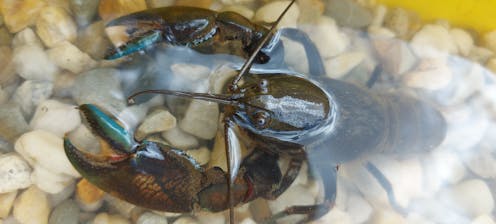
Am I not pretty enough? This article is part of The Conversation’s series introducing you to Australia’s unloved animals that need our help.
For children growing up in rural areas, going “yabbying” in farm dams is a rite of passage. The common yabby (Cherax destructor) is the most widely distributed Australian crayfish, inhabiting rivers and wetlands across southeast Australia.
And although the humble yabby is not as cute and cuddly as some better-known Australian icons, from an ecosystem perspective, we argue they may be more important.
Yabbies are a staple food for platypus, many waterbird species, and fish such as Murray cod and golden perch. And yabbies’ diet is largely made up of algae, detritus (dead organic material) and small animals. This means they link energy from the very bottom of the food chain to apex predators at the top.
And yet, little is known how their diets influence their growth and alter their quality as a food source. Our recent research starts to fill this critical gap.
We found yabbies in wetlands are better food source for fish than those in rivers, because wetland yabbies eat more foods rich in high-quality fatty acids. While more research is needed, these results show how higher quality yabby diets can increase the total biomass of predators, such as Murray cod, that riverine ecosystems can support.
Untangling the food web
Food webs describe what eats what within ecological communities and provide a useful way to illustrate how energy moves through the environment.
But it’s more complex than big fish eats little fish. Within food webs, organisms can be lumped into two groups:
- autotrophs: organisms that obtain energy from the sun via photosynthesis, such as plants
- heterotrophs: organisms that obtain energy by eating other organisms, such as bacteria, fungi, and animals.
Algae fall in to the first group, providing a high-quality energy pathway in food webs because they can synthesise so-called “long-chain polyunsaturated fatty acids”: omega 3 and omega 6.
If you grew up in the 1980s you’re probably familiar with the term “polyunsaturated fatty acids” from its association with margarine (though few probably understood its relevance back then). Today, we more often hear the term around seafood.
We’re encouraged to eat oily fish because of the omega 3 and omega 6 they provide, which the body needs for brain function and cell growth. We source these fatty acids from fish thanks to algae, which underpins many aquatic food webs. Fatty acids are essential for the growth of all animals, including yabbies.
The other primary energy source in freshwater comes from detritus – organic debris and decomposing material. In wetlands and rivers, detritus accumulates from falling leaves and branches along banks, which can be washed into rivers during high flows.
But while detritus is often abundant, it’s considered poorer quality because it’s difficult to digest and has low concentrations of some important fatty acids. And in food webs, poor quality food provides less bounce for the ounce, so to speak.
The yabby is an omniovore - algae, detritus and other animals are its food, but we know little about how these different energy sources affect yabby growth and survival – or how it might affect animals that rely on yabbies for food.
You are what you eat
Our research investigated how different quality fatty acid diets affected yabby growth, and how this might influence other animals up the food chain.
We found yabbies fed poor quality diets in the laboratory, made up of only dead plant matter, barely grew at all. These yabbies also represented a poor-quality food resource for predators.
In contrast, yabbies fed mixed diets rich in high quality polyunsaturated fatty acids grew the most – more than doubling in mass over a 70-day trial. They also retained higher concentrations of these fatty acids in their body tissue, making them a good food resource for other animals.
Yabbies are tough. They’re well adapted to Australia’s extremes, capable of surviving dry conditions by lying dormant in burrows dug in dried waterways. During wetter periods, they can travel long distances in search of a new home – usually wetlands or rivers.
So how might their environment affect their diet? We found wild yabbies that live in wetland habitats ate foods with higher concentrations of these fatty acids compared to yabbies that live in rivers.
And as with our laboratory fed yabbies, wild wetland yabbies eating high quality foods also represented a better food option for fish than riverine yabbies. This is likely due to wetlands containing a higher proportion of diatoms (single-celled algae) and green algae, which both synthesise long-chain polyunsaturated fatty acids.
What does this mean for freshwater ecosystems?
Australia’s floodplain rivers are dynamic. Wet periods with high flows connect rivers to wetlands that lie on the floodplain. In dry periods with low flows, this connection is interrupted, leaving wetlands on floodplains isolated, sometimes even drying out completely.
Connectivity between rivers and their floodplain is important for many reasons. It provides habitat and breeding opportunities for birds and fish, revitalises plants, and an exchange of nutrients.
Water in the Murray-Darling Basin is shared between irrigators, municipal water supply and the environment, and is largley regulated with infrastructure such as dams and weirs.
Read more: We looked at 35 years of rainfall and learnt how droughts start in the Murray-Darling Basin
Our research is an example of the many benefits that come with ensuring we have adequate water for the environment. Our work shows that an important aspect of connection is to allow riverine predators access to high quality food resources – yabbies – in floodplain wetlands.
If yabbies are thriving and passing essential fatty acids up the food chain, populations of popular recreational fish, such as Murray cod and golden perch, will benefit accordingly.
It’s critical we improve our understanding of these complex relationships. This includes recognising other drivers of riverine population success such as competition, habitat, life history traits and spawning cues, to ensure Australia’s riverine animals can thrive.
Read more: Leaf oysters: the unsung heroes of estuaries are disappearing, and we know almost nothing about them
Authors: Paul McInerney, Research Scientist, CSIRO

















