Workers' compensation doesn't cover gig workers – here's a way to protect them
- Written by David Peetz, Professor of Employment Relations, Centre for Work, Organisation and Wellbeing, Griffith University
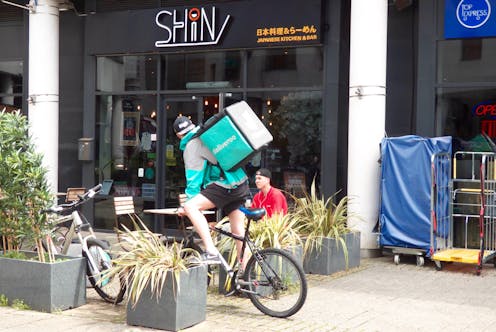
The rise in digital platforms supporting the gig economy is the most significant recent change to the nature of work. Concern is growing that some of these platforms can shift costs and risk to gig workers and enable them to be exploited. In particular, these often low-paid and vulnerable workers are not covered by workers’ compensation schemes for injuries or illness they suffer due to their work.
The ability of state governments to protect these workers is currently limited. Most states passed their lawmaking responsibilities for industrial relations to the Commonwealth. This followed the use of the Commonwealth’s corporations power to regulate industrial relations in the 2000s.
Read more: Why gig workers may be worse off after the Fair Work Ombudsman's action against Foodora
One area where states can act, however, is in workers’ compensation. This article suggests a way to extend cover to gig workers and pay for it.
While the platform economy is a small part of the overall workforce, at least judging by estimates of work through online intermediaries in the United States, it has the potential to grow. Its emergence reflects several factors.
Managerial desire for greater flexibility has grown. New models of management structure have developed. And some new digital technologies enable “algorithmic management” in response to consumer “demands”, to substitute for control via the employment relationship.
This means the common law “control” test to establish whether an employment relationship exists is problematic.
Many full-time workers in the platform economy are vulnerable. They receive low pay below what would normally apply under the relevant award or legislated minimum. And they are often not classed as employees, so workers’ compensation systems don’t cover them.
Internationally, though, there is much uncertainty about their treatment. Interpretations vary in different jurisdictions as to whether these workers are employees or contractors.
Employment law lags behind changing practices
The uncertainty in the law is created in part by the way traditional legal conceptions of control and indicators of employment have failed to keep up with practices of corporate control and public understanding of what they mean.
Read more: A new definition of 'worker' could protect many from exploitation
There are two major types of platform economy work.
“Crowdwork” refers to completing a series of tasks through online platforms. It is very difficult for national governments to regulate.
By contrast, “work on demand via apps” involves traditional working activities being channelled through apps. The firms that manage these apps also intervene in setting minimum standards of service and in selecting and managing the workforce.
Firms like Uber, Deliveroo, Foodora and Airtasker provide work on demand via apps. It occurs in areas such as transport, cleaning, running errands and clerical work.
A financial transaction occurs between a client located in a particular state and another person (a driver, rider, gutter cleaner, disability worker, etc.) in that state. Payment occurs via the intermediary. The intermediary in turn must interact with both parties in that state. These financial transactions can be regulated, and this is relevant to workers’ compensation.
Arguments in favour of protecting platform economy workers include:
- their vulnerability
- the low likelihood they would adopt voluntary methods of compensation coverage even if available to them
- the way injury costs are put onto injured workers rather than, as is usually the case, the employer
- the likely illegality of the pay and conditions of many gig workers were it not for possible contrivances to avoid their being classed as employees
- the flow-on effects to other workers
- the conceptual similarity to labour hire, which is regulated or about to be regulated in some states (the main difference being that labour hire uses employees whereas platform work uses people classed as contractors)
- the likely spread of on-demand work via apps to many other industries.
Read more: Being exploited and breaching your visa: the limited choices of the food delivery worker
So how could gig workers be protected?
There are several possible options for achieving coverage of gig economy workers in workers’ compensation systems. Most have drawbacks, especially for a state that operates in a federal system of employment law.
One viable action, however, is to redefine the coverage of workers’ compensation laws and responsibilities to include those who work under agency arrangements and to require the intermediaries or agencies to pay premiums.
That is, if a platform economy firm supplies a worker who delivers a passenger or a meal, or undertakes some other task for a third person, it would pay a workers’ compensation premium to cover that worker, based on a percentage of their take. After all, these intermediary organisations gain their income by taking a proportion of the income paid to the worker by the client – they take a “commission” (for example, Airtasker’s portion was 15% for a while).
So the premiums would be set as a proportion of this commission. The net cost to the insurers themselves would be zero, as premiums would cover outlays.
Such reforms would exclude labour hire businesses where these employ the gig worker, and exclude employees of firms that engage contractors. Other exemptions, if needed, could be made by regulation.
There should also be a program to help with the return to work of injured gig workers. Both gig workers and platform firms will need to be made aware of new arrangements, rights and responsibilities.
State governments can act on this front. However, the changing nature of work and what it means for the law of “employment” fundamentally requires national attention. Only through the Commonwealth parliament can legal reform of the broader range of employment issues happen.
This article is based on chapter 10 of a report, tabled in the Queensland parliament, on the operation of the workers’ compensation system.
Authors: David Peetz, Professor of Employment Relations, Centre for Work, Organisation and Wellbeing, Griffith University