

Modern Australian
Men's Weekly

.

stop the endless expansion and work with what our cities already have

  • Written by Kate Shaw, Honorary Senior Fellow in Urban Geography and Planning, The University of Melbourne
stop the endless expansion and work with what our cities already have

Australian cities are good at growing – for decades their states have relied on it. The need to house more people is used to justify expansion out and up, but it is the rates, taxes and duties that flow from land transfers and construction that drive the endless development of Melbourne and Sydney in particular. Property development is the single largest contributor to Victorian and New South Wales government revenues.

For example, the City of Melbourne’s draft spatial plan proposes new suburbs to the west and north. It’s continuing on a course mapped out in the post-recession 1990s, when Australian governments focused on building on or digging up our great expanses. The plan neither questions the rationale for growth nor, apparently, the deeper effects of the pandemic.

The city council is understandably anxious to attract people back to the centre. The city plan presumes a return to Australia’s high population growth of the 2000s. Expectations of a renewed influx of students, workers and tourists from overseas are based more on hope, however, than reason.

Read more: COVID halved international student numbers in Australia. The risk now is we lose future skilled workers and citizens

The drivers of population growth are more uncertain and we can no longer depend on global mobility at pre-pandemic levels. Birth rates are falling across the developed world, online international education is improving, and research suggests pandemics will persist while cities encroach on the habitats of so many other species.

Meanwhile, the towers thrown up in the heady years of growth are half-empty and cracking, poorly ventilated, reliant on central air conditioning and not built for more extreme weather or low energy consumption. Melbourne and Sydney’s showcase regeneration projects at Docklands and Barangaroo are more dismal and deserted than ever.

Better needn’t mean bigger

Now is not the time for anyone to announce that their city will become “bigger and better”. Cities don’t have to get bigger to evolve, and sooner or later all will have to reckon with the concept of degrowth.

Australia must become less reliant on imports of skilled workers, students, tourists and materials. We can make better use of local resources and produce much more of what we need here.

Australian cities have very good bones. They have amazing cultural scenes. Their biomedical capabilities are among the world’s best. Our education sector remains eminently exportable online and via existing overseas campuses. The manufacturing sector still has a base to build on and provide many more of the products Australians need. And our renewable energy capacity is unlimited.

We can support our local hospitality and cultural venues better, and increase intercity and interstate patronage. We can invest in research and development and maintain wealth through innovation and production, rather than the eternal consumption of land.

Read more: To really address climate change, Australia could make 27 times as much electricity and make it renewable

Rethink what we build and why

Adapting to global environmental conditions means rethinking not just what and how we build, but why. Before designating land for yet more housing estates, for example, let’s consider that a million homes – 10% of Australia’s housing stock – were empty on census night last year. Nearly 600,000 were in Victoria and New South Wales.
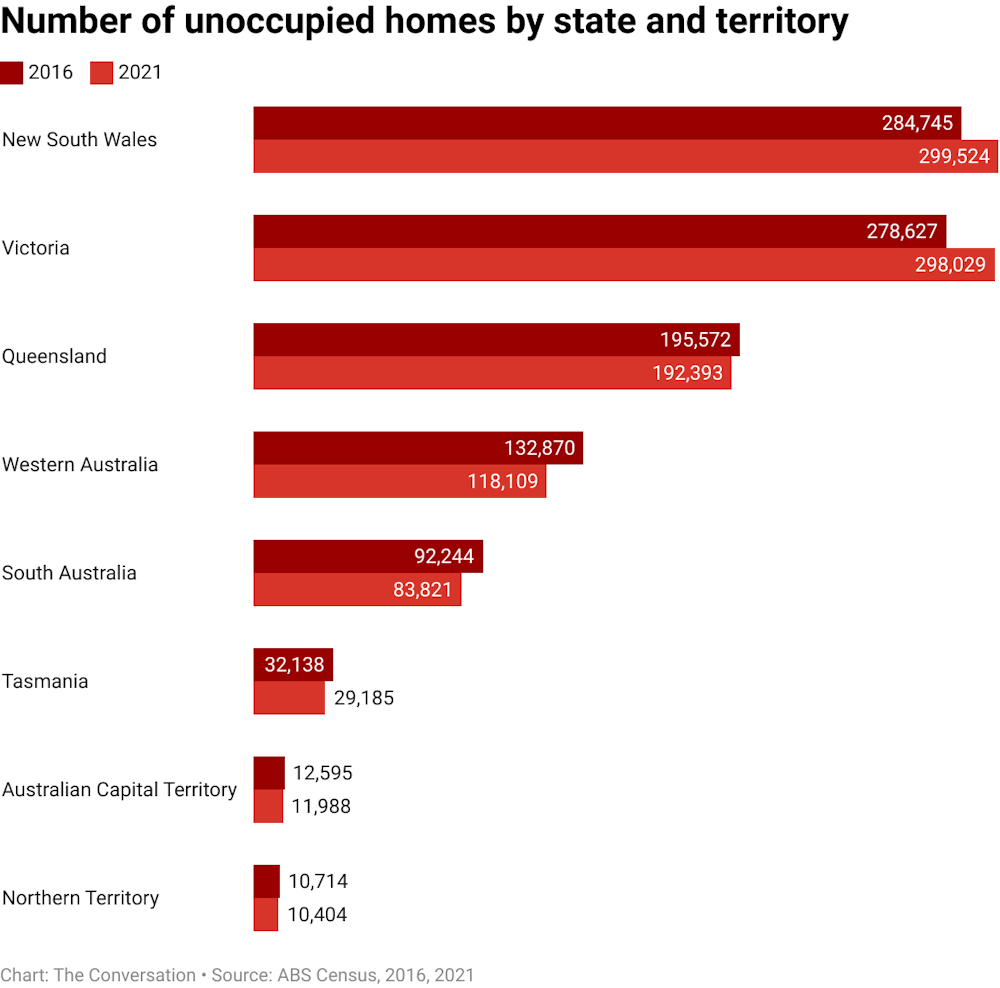
Horizontal bar chart showing number of unoccupied homes in each state and territory on census night in 2016 and 2021
CC BY Think tank Prosper Australia has for years demonstrated shocking numbers of vacant dwellings unavailable for rent. A hefty vacancy tax – much greater than the Victorian rate of 1% of property value, while NSW still has none for Australian owners – would lead to many more homes being released onto the market. The property developers’ argument that we have to build more because that’s the only way to make housing more affordable has been repeatedly refuted by years of careful research. Read more: Affordable housing policy failure still being fuelled by flawed analysis Tens of thousands of upmarket dwellings have been added to the inner cities of Melbourne and Sydney over the past 20 years, with no reduction in prices across the board. While upmarket unit prices might drop a little when vacancy rates in that submarket increase, their developers are keenly alert to any dip in profits. At the slightest hint of surplus they just stop building. If housing affordability is the object of urban expansion, let’s grasp that nettle: the only way to achieve it is to build affordable housing, it’s that simple. More than enough land is available within the urban growth boundaries for residential development. Recent research from Prosper shows there are 84,000 undeveloped housing lots on nine Australian master-planned estates alone. This does not include the many inner-city regeneration projects already under way. Social housing in these areas should be the focus of urban planning before any more land is released. What about ‘under-developed’ urban lands? Further expansion of the inner cities of Melbourne and Sydney can only encroach onto low-lying, flood-prone industrial lands that were long ago deemed unsuitable for residential development. It would be folly, or very expensive, to build housing there. These areas are and still can be used for manufacturing, however, and not just the new niche urban manufacturers that gentrifying councils so love to love. Older industries that are even now being displaced from Fishermans Bend in Melbourne and Blackwattle Bay in Sydney can easily coexist with artisanal bakeries and coffee roasters. The imperative to promote sustainable local production is stronger than ever now that the pandemic and war have exposed the vulnerabilities of global supply lines. Our diminishing industrial lands really should be kept for industry, until such time as sea-level rise claims them as wetlands. Read more: 'Building too close to the water. It's ridiculous!' Talk of buyouts after floods shows need to get serious about climate adaptation This is not an argument for decreasing construction activity: there is much work to be done retrofitting existing buildings. These need to be re-clad, better ventilated, opened to passive cooling and adapted to a warming climate. The ongoing regeneration projects in Melbourne and Sydney need a lot more attention. Docklands, Darling Harbour and Barangaroo could become useful with some serious interventions. The emerging Fishermans Bend and Blackwattle Bay developments have already released more land than their planners know what to do with. A forward-looking city plan would consolidate and advance what that city already has. That’s the way to build revenue streams that are environmentally, socially and politically sustainable. Authors: Kate Shaw, Honorary Senior Fellow in Urban Geography and Planning, The University of Melbourne

Read more https://theconversation.com/the-case-for-degrowth-stop-the-endless-expansion-and-work-with-what-our-cities-already-have-187929

Long Weekend Camping in the Yarra Ranges: Three Weekends of High Country Adventure

Yarra Ranges National Park, Victoria. Image by Mattinbgn (talk · contribs), CC BY 3.0, via Wikimedia CommonsVictoria’s Yarra Ranges offer keen trav...

Why Waste Management Solutions Are Essential For Modern Businesses

Managing waste responsibly has become a critical priority for organisations of all sizes, which is why waste management solutions play such an impo...

The Importance and Varieties of Ride-On Mower Tyres

Ride-on mowers are built to manage larger lawns with consistency and control. The quality and design of ride on mower tyres play a critical role in ...

Gain Peace Of Mind: The Undeniable Benefits Of A Ready First Aid Kit

Life in our vibrant communities, whether it's the bustling city or the quiet country town, is full of unexpected moments. From a scraped knee on the...

The Most Common Conveyor System Issues in Manufacturing

In modern manufacturing, conveyor systems play a central role in keeping production lines efficient, consistent, and cost-effective. When they operate...

How to Secure a Long-Term Rental in a Competitive Market

The rental market can be unpredictable and may present challenges if you’re not prepared. Initially, you might submit numerous applications and stil...

What Smart Investors Know About Real Estate

Many people think investing in property is just about buying a house and waiting for it to get expensive. While that can happen, the people who actual...

The Benefits of Seeking Help for Anxiety and Stress

Anxiety and stress have become common experiences in today’s fast-paced world, affecting people across all ages and lifestyles. From work pressures ...

How to Make the Most of Fashion Wholesale Options for Your Brand

If you want to grow a fashion brand without constantly reinventing the wheel, wholesale can be one of the smartest ways to scale. The key is knowing h...

How to Add Value to Your Home Before Selling

Selling a home is not just about putting up a sign and waiting for offers. It is about presenting a property that buyers instantly connect with and ar...

How Outdoor Play Enhances Learning and Wellbeing

You don’t need to be an expert to conclude that play is an essential part of growing up. When children aren’t restricted and kept indoors, they de...

How to Build Passive Income Through Real Estate

Building passive income is one of the most effective ways to create long-term financial security. While there are many investment opportunities availa...

DIY Guide to Replacing Small Parts in Your Laundry Machine

Finding a puddle or a broken washer is frustrating, but you don’t always need a professional. Many common issues are caused by tiny parts that are c...

Best Practices for Managing Your Warehouse Partner Relationships

Your warehouse partner is an important part of your business. They sit in the middle of your promises to customers. Yet, when they deliver what’s pr...

Benefits of Solar-Based Water Circulation Systems

Imagine your water system running all day without touching your electricity bill. No noise, no heavy cables, no stress when prices go up. Fantastic, r...

Benefits of Using an Outrigger Crane for Complex Lifts

Complex lifts aren’t the kind of jobs you improvise. You’re dealing with awkward shapes, serious weight, and sites that never seem designed for wh...

A Beginner's Guide to Website Ranking

If you have a website, you probably want people to find it. But building a website alone does not guarantee visitors. Millions of websites compete for...

How to Prepare Your Home for Holiday Guests

Welcoming holiday guests into your home is one of life’s great pleasures. Whether it’s Christmas lunch, a long weekend reunion, or interstate re...

















