

Backyard hens' eggs contain 40 times more lead on average than shop eggs, research finds
- Written by: Mark Patrick Taylor, Chief Environmental Scientist, EPA Victoria; Honorary Professor, Macquarie University
There’s nothing like the fresh eggs from your own hens, the more than 400,000 Australians who keep backyard chooks will tell you. Unfortunately, it’s often not just freshness and flavour that set their eggs apart from those in the shops.
Our newly published research found backyard hens’ eggs contain, on average, more than 40 times the lead levels of commercially produced eggs. Almost one in two hens in our Sydney study had significant lead levels in their blood. Similarly, about half the eggs analysed contained lead at levels that may pose a health concern for consumers.
Even low levels of lead exposure are considered harmful to human health, including among other effects cardiovascular disease and decreased IQ and kidney function. Indeed, the World Health Organization has stated there is no safe level of lead exposure.
So how do you know whether this is a likely problem in the eggs you’re getting from backyard hens? It depends on lead levels in your soil, which vary across our cities. We mapped the areas of high and low risk for hens and their eggs in our biggest cities – Sydney, Melbourne and Brisbane – and present these maps here.
Our research details lead poisoning of backyard chickens and explains what this means for urban gardening and food production. In older homes close to city centres, contaminated soils can greatly increase people’s exposure to lead through eating eggs from backyard hens.
What did the study find?
Most lead gets into the hens as they scratch in the dirt and peck food from the ground.
We assessed trace metal contamination in backyard chickens and their eggs from garden soils across 55 Sydney homes. We also explored other possible sources of contamination such as animal drinking water and chicken feed.
Our data confirmed what we had anticipated from our analysis of more than 25,000 garden samples from Australia gardens collected via the VegeSafe program. Lead is the contaminant of most concern.
The amount of lead in the soil was significantly associated with lead concentrations in chicken blood and eggs. We found potential contamination from drinking water and commercial feed supplies in some samples but it is not a significant source of exposure.
Unlike for humans, there are no guidelines for blood lead levels for chickens or other birds. Veterinary assessments and research indicate levels of 20 micrograms per decilitre (µg/dL) or more may harm their health. Our analysis of 69 backyard chickens across the 55 participants’ homes showed 45% had blood lead levels above 20µg/dL.
We analysed eggs from the same birds. There are no food standards for trace metals in eggs in Australia or globally. However, in the 19th Australian Total Diet Study, lead levels were less than 5µg/kg in a small sample of shop-bought eggs.
The average level of lead in eggs from the backyard chickens in our study was 301µg/kg. By comparison, it was 7.2µg/kg in the nine commercial free-range eggs we analysed.
International research indicates that eating one egg a day with a lead level of less than 100µg/kg would result in an estimated blood lead increase of less than 1μg/dL in children. That’s around the level found in Australian children not living in areas affected by lead mines or smelters. The level of concern used in Australia for investigating exposure sources is 5µg/dL.
Some 51% of the eggs we analysed exceeded the 100µg/kg “food safety” threshold. To keep egg lead below 100μg/kg, our modelling of the relationship between lead in soil, chickens and eggs showed soil lead needs to be under 117mg/kg. This is much lower than the Australian residential guideline for soils of 300mg/kg.
To protect chicken health and keep their blood lead below 20µg/kg, soil concentrations need to be under 166mg/kg. Again, this is much lower than the guideline.
How did we map the risks across cities?
We used our garden soil trace metal database (more than 7,000 homes and 25,000 samples) to map the locations in Sydney, Brisbane and Melbourne most at risk from high lead values.

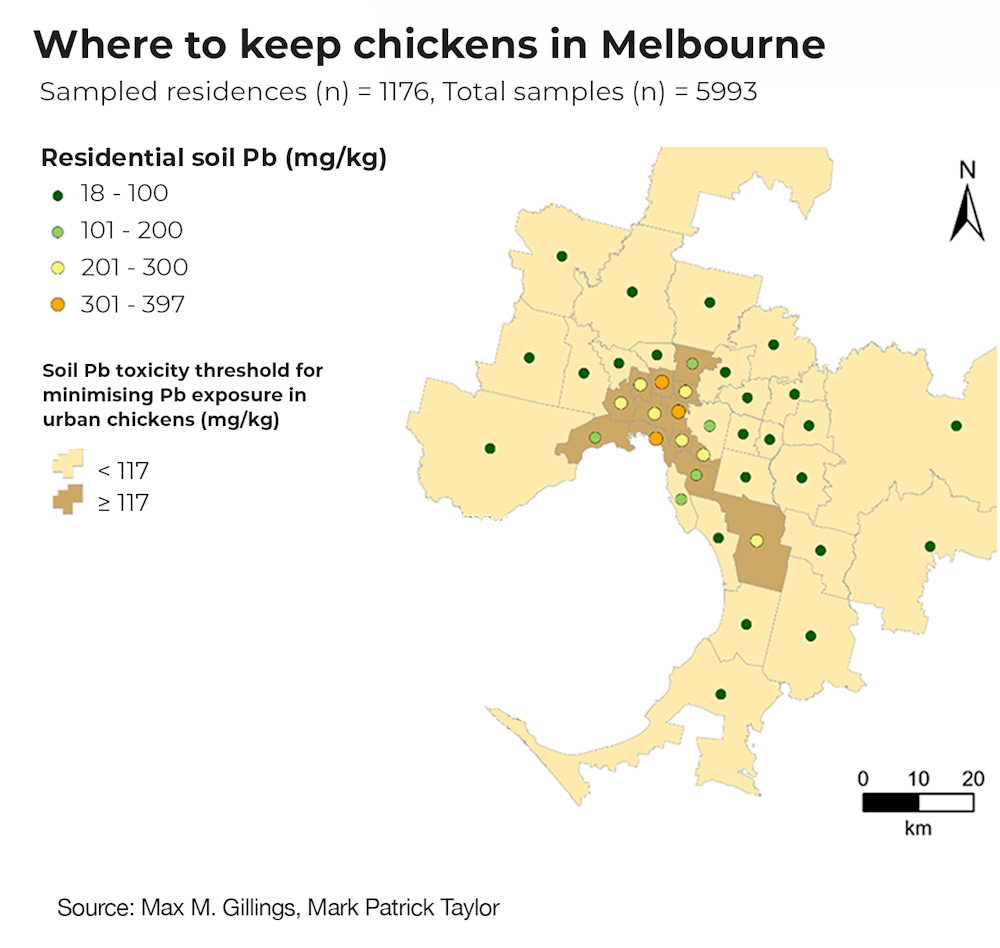 Map of Melbourne showing levels of lead risk for backyard chickens. Dark green dots indicate areas with safe lead levels. Light green and yellow dots are areas over the safe lead level. Orange and red dots indicate areas with high levels.
Map: Max M. Gillings, Mark Patrick Taylor, Author provided
Map of Melbourne showing levels of lead risk for backyard chickens. Dark green dots indicate areas with safe lead levels. Light green and yellow dots are areas over the safe lead level. Orange and red dots indicate areas with high levels.
Map: Max M. Gillings, Mark Patrick Taylor, Author provided
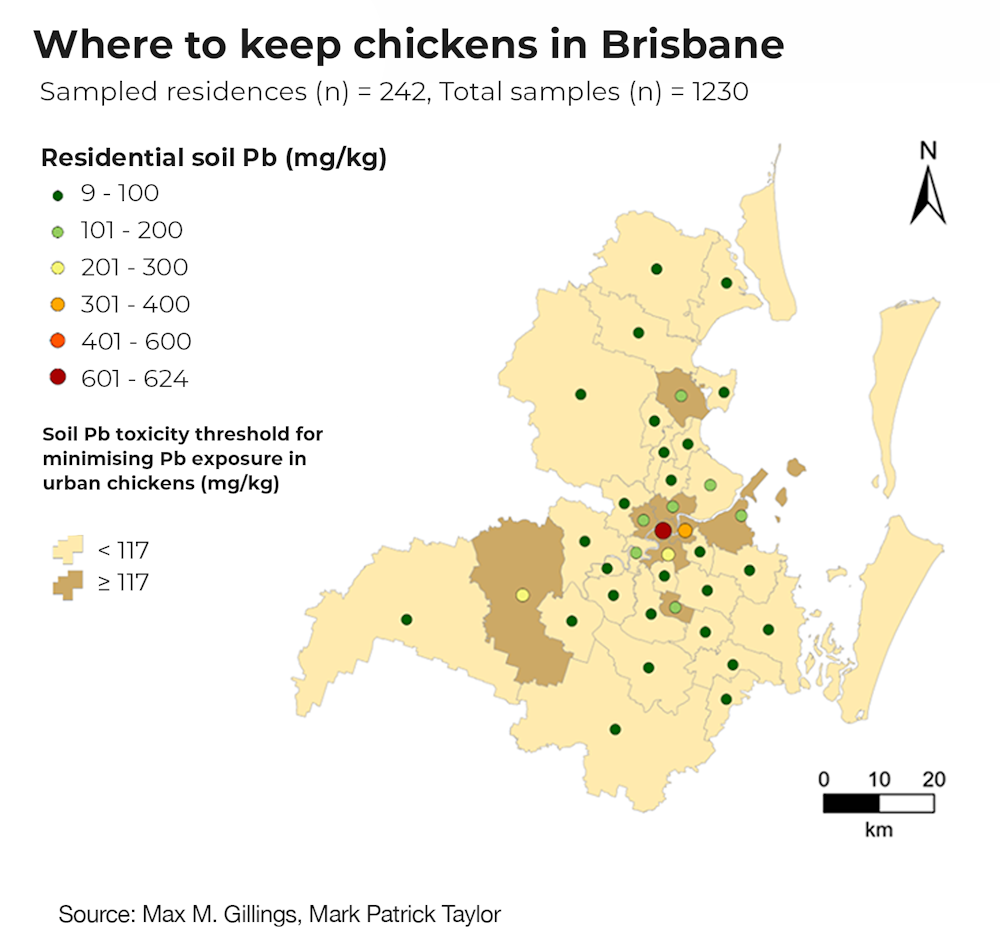 Map of Brisbane showing levels of lead risk for backyard chickens. Dark green dots indicate areas with safe lead levels. Light green and yellow dots are areas over the safe lead level. Orange and red dots indicate areas with high levels.
Map: Max M. Gillings, Mark Patrick Taylor, Author provided
Map of Brisbane showing levels of lead risk for backyard chickens. Dark green dots indicate areas with safe lead levels. Light green and yellow dots are areas over the safe lead level. Orange and red dots indicate areas with high levels.
Map: Max M. Gillings, Mark Patrick Taylor, Author provided
Deeper analysis of the data showed older homes were much more likely to have high lead levels across soils, chickens and their eggs. This finding matches other studies that found older homes are most at risk of legacy contamination from the former use of lead-based paints, leaded petrol and lead pipes.
What can backyard producers do about it?
These findings will come as a shock to many people who have turned to backyard food production. It has been on the rise over the past decade, spurred on recently by soaring grocery prices.
People are turning to home-grown produce for other reasons, too. They want to know where their food came from, enjoy the security of producing food with no added chemicals, and feel the closer connection to nature.
While urban gardening is a hugely important activity and should be encouraged, previous studies of contamination of Australian home garden soils and trace metal uptake into plants show it needs to be undertaken with caution.
Contaminants have built up in soils over the many years of our cities’ history. These legacy contaminants can enter our food chain via vegetables, honey bees and chickens.
Urban gardening exposure risks have typically focused on vegetables and fruits. Limited attention has been paid to backyard chickens. The challenge of sampling and finding participants meant many previous studies have been smaller and have not always analysed all possible exposure routes.
Mapping the risks of contamination in soils enables backyard gardeners and chicken keepers to consider what the findings may mean for them.
Particularly in older, inner-city locations, it would be prudent to get their soils tested. People can do this at VegeSafe or through a commercial laboratory. Soils identified as a problem can be replaced and chickens kept to areas of known clean soil.
Authors: Mark Patrick Taylor, Chief Environmental Scientist, EPA Victoria; Honorary Professor, Macquarie University


















