

Could the Nationals' refusal to support a Voice to Parliament derail the referendum?
- Written by: Gregory Melleuish, Professor, School of Humanities and Social Inquiry, University of Wollongong
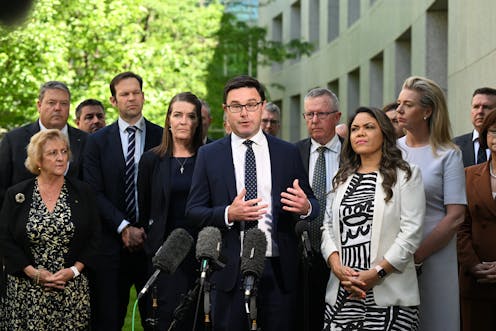
The Nationals have declared they will support the No case for the Voice referendum. This position has not been endorsed by all the Nationals, with the Western Australian Nationals and federal MP Andrew Gee confirming their support for the Voice.
The Nationals’ move is unusual, as we do not know yet know what specific constitutional changes will be proposed by the referendum. It seems to be an “in principle” opposition to the general idea of the Voice, and it would appear to be largely driven by Northern Territory Senator Jacinta Nampijinpa Price.
What is the significance of this early decision? And what does it say about the National Party and its relationship to the Liberal Party, which has yet to declare its position on this matter?
The National Party is an independent party that forms a coalition with the Liberal Party. When the two parties are in government together, they would normally agree on policy matters.
In opposition, the Nationals are much freer to diverge from the Liberals on policy. This would seem to be an issue on which they are seeking to assert their independence.
Of course, support by a major political party for a particular case in a referendum matters, because so few referendums have been successful (8 out of 44). It is generally acknowledged that a referendum requires bipartisan support if it is to succeed. This move could be seen as a sort of preemptive strike to bury the referendum.
The reason why it is extremely difficult for a referendum to be successful is because of the double majority; this means both an overall majority of voters and a majority of voters in a majority of states (that is, at least four).
Read more: Albanese insists Voice will help 'close the gap', as divisions flare in Nationals
There have been cases in the past where a constitutional amendment received a majority of the votes but majorities in only three, and in one case two, states. This meant it failed.
Referendums are more likely to succeed if they do not have a major impact on the majority of the people voting for them. The major exception to this rule was the 1946 social services referendum that has had an enormous impact, allowing, for example, Commonwealth intervention in educational matters.
The 1967 referendum, when Australians voted 90% in favour of changing the Constitution to allow Aboriginal people to be counted in the census and the government to make decisions for them, falls into this pattern. It did not directly affect most Australians, but was overwhelmingly successful because most people believe it to be the right thing to do.
The referendum that attracted the next highest approval rating was the 1977 referendum that made High Court judges retire at 70. It attracted 80% of the popular vote, thereby embedding a form of age discrimination into the Constitution.
The 1967 parliament referendum on breaking the “nexus” between the size of the House of Representatives and the Senate indicates how difficult getting a referendum up is, even with bipartisan support. The Constitution states that the size of the Senate should be half that of the House of Representatives.
It had been mooted by Robert Menzies in the early 1960s, but ended up being put to the people by the Holt government in 1967. By this stage, the Country Party (which later changed its name to the National Party) Federal Council had decided the referendum was unnecessary. But as a member of the ruling coalition, the Country Party fell into line supporting the Yes case, with perhaps diminished enthusiasm.
Read more: Changing the Australian Constitution is not easy. But we need to stop thinking it's impossible
Despite massive support from both the government and the opposition, there was a campaign against the change led largely by the Democratic Labor Party and several dissident Liberal and Country Party members. This small group ran an effective populist campaign based on the need to contain costs and stop an increase in the number of politicians.
The referendum failed miserably, only achieving a majority in New South Wales.
The 1967 Parliament referendum indicates the effect that even a small amount of dissidence in the political class can have on the outcome of a referendum. Initially, the Country Party had supported this referendum, then changed its mind as political circumstances changed.
Moreover, the outcome of the referendum indicates how vulnerable any Yes case is to a strongly argued and populist No case.
All referendums in Australia face considerable obstacles because of the double majority. Significant opposition, especially if it can appeal to populist instincts in the Australian population, can easily derail a Yes case.
The crucial factor in the Voice referendum may not be so much that the National Party has come out in opposition to it, but that that opposition has found a passionate voice in Jacinta Nampijinpa Price. She will no doubt run a strong a No case campaign.
Will this cause problems for the Liberal-Nationals relationship? As they are in opposition the relationship is not as close as it would be if they were in government. Certainly, there are strong supporters of the Voice in the Liberal Party such as Julian Leeser. But he may well have his work cut out countering Price.
Authors: Gregory Melleuish, Professor, School of Humanities and Social Inquiry, University of Wollongong


















