

There could be alien life on Mars, but will our rovers be able to find it?
- Written by: Belinda Ferrari, Professor of Microbiology, UNSW Sydney
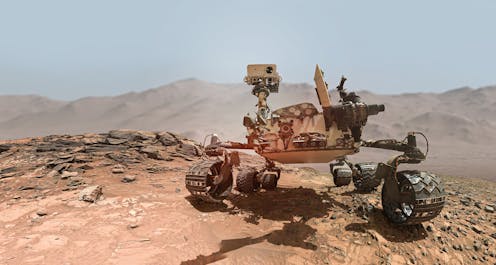
Robotic rovers are currently exploring the surface of Mars. Part of a rover’s mission is to survey the planet for signs of life. There might be nothing to find – but what if there is, and the rovers just can’t “see” it?
New research published today in Nature Communications suggests the rovers’ current equipment might not actually be up to the task of finding evidence of life.
As an extreme environment microbiologist, the challenges of searching for life where it seems near-impossible are familiar to me.
In astrobiology, we study the diversity of life in sites on Earth with environmental or physical features that resemble regions already described on Mars. We call these terrestrial environments “Mars analogue” sites.
Limits of detection
The new research, led by Armando Azua-Bustos at the Center for Astrobiology in Madrid, tested the sophisticated instruments currently in use by NASA’s Curiosity and Perseverance rovers – as well as some newer lab equipment planned for future analysis – in the Mars analogue of the Atacama Desert.
Azua-Bustos and colleagues found the rovers’ testbed equipment – tools for analysing samples in the field – had limited ability to detect the traces of life we might expect to find on the red planet. They were able to detect the mineral components of the samples, but were not always able to detect organic molecules.
In my team’s case, our Mars analogue sites are the cold and hyper-arid deserts of the Dry Valleys and Windmill Islands in Antarctica.
In both of these sites, life exists despite extreme pressures. Finding evidence of life is challenging, given the harsh conditions and the scarcity of microbial life present.
First, we must define the biological and physical boundaries of life existing (and being detected) in analogue “extreme” environments. Then we need to develop tools to identify the “biosignatures” for life. These include organic molecules like lipids, nucleic acids and proteins. Finally, we determine how sensitive tools need to be to detect those biosignatures, on Earth and also Mars. This tells us the limits of our detection.
Traces of life are scarce in the Atacama Desert.The search for a dark microbiome
In my field of extreme microbiology, “microbial dark matter” is when the majority of microscopic organisms in a sample have not been isolated and/or characterised. To identify them, we require next-generation sequencing need to define. Azua-Bustos’s team go one step further, proposing a “dark microbiome” which contains potentially relic, extinct Earth species.
Azua-Bustos’s team found sophisticated laboratory techniques could detect a dark microbiome in the Atacama Desert’s Martian-like hyper-arid soil samples. However, the rovers’ current equipment wouldn’t be able to detect it on Mars.
In samples with such scarce biomass, we use highly sensitive laboratory methods to detect microbial life, including gene sequencing and visualising cells using microscopic analysis. Prototypes for genome sequencing in the field are being developed, but they do not have the sensitivity needed for low biomass samples – yet.
Read more: There is water on Mars, but what does this mean for life?
Different planet, different rules
The search for life on other planets also relies on our understanding of what life would need to exist, with the simplest list being energy, carbon and liquid water.
On Earth, most organisms use photosynthesis to harness energy from sunlight. This process requires water, which is almost totally unavailable in dry desert environments like Antarctica and the Atacama Desert – and, most likely, Mars. We think a process we dubbed “atmospheric chemosynthesis” could be filling this gap.
My team first discovered atmospheric chemosynthesis in the cold desert soils of Antarctica. In this overlooked metabolic process, bacteria literally “live on thin air” by consuming trace levels of hydrogen and carbon monoxide gas from the atmosphere.
We think dry desert microbiomes may rely on this process for energy as well as water, which is a byproduct of the process. Ecosystems like the ones we’ve found in Antarctica now offer one of the most promising ecological models in the search for Martian life.
We now believe there is potential for life in the ice-cemented subsurface of Mars. My team – alongside collaborators at NASA and the University of Pretoria – plan to investigate this in Antarctica’s University Valley, by defining the environmental limits to energy, metabolic water and carbon production via trace gas consumption.
Read more: Discovery of microbe-rich groundwater in Antarctica guides search for life in space
We won’t find what we can’t define
Our new knowledge of target biosignatures and the level of sensitivity needed to detect them will be critical when designing or optimising future instrumentation to be deployed on missions aimed at finding life.
The goal of future missions to Mars, including the Icebreaker Life mission planned for 2026, is to search for evidence of life. The Icebreaker Life will sample ice-cemented ground, similar to Antarctic dry permafrost, and if it detects signs of life, a Mars Sample Return mission would be a high priority.
Returning samples to Earth for laboratory analysis is risky. As we found with our Antarctic soil samples, challenges can include contamination, preservation of cold temperatures during transport, and the need for specialist quarantine laboratories, to analyse samples without destroying them.
But as Asua-Bustos suggests, bringing samples to Earth for detailed lab analyses may be the only sure way to detect – or rule out – the presence (or past presence) of life.
Authors: Belinda Ferrari, Professor of Microbiology, UNSW Sydney


















