

Progress in detection tech could render submarines useless by the 2050s. What does it mean for the AUKUS pact?
- Written by: Roger Bradbury, Emeritus Professor of Complex Systems Science, Crawford School of Public Policy, Australian National University
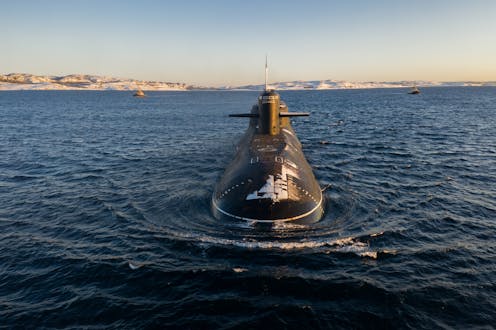
Speaking at a summit in San Diego on Monday, Prime Minister Anthony Albanese has announced a decades-long strategy to deliver the most costly defence project in Australia’s history.
New details of the AUKUS defence and security pact have revealed Australia will buy three second-hand US Virginia-class submarines early next decade (and potentially two more), subject to approval by US Congress.
Australia will also build a fleet of eight nuclear-powered SSN-AUKUS boats at Adelaide’s Osborne Naval Shipyard. The first will be delivered by 2042, with five completed by the 2050s, and construction of the remaining three going into the 2060s.
It’s estimated the program will cost between A$268 billion and A$368 billion over the next three decades.
Make no mistake. Modern submarines, especially nuclear-powered ones, are one of the most potent and effective weapon systems in today’s world. That is, until they aren’t.
Our analysis shows they might soon be so easily detected they could become billion-dollar coffins.
The rise in detection technologies
Both the greatest strength and greatest weakness of subs is their stealth. The best are fiendishly difficult to detect. They can be nearly anywhere in the vast expanse of the world’s oceans, so adversaries must protect against them everywhere.
But if subs can be detected, they become easy targets: large, slow-moving and vulnerable to attack from the surface.
Historically, submarines have provided a distinct advantage: their stealth is the result of steady improvements in counter-detection technologies throughout the Cold War. Western submarines in particular are extremely quiet. Detection technologies, which mostly focused on sound, broadly struggled to keep up.
But this tide is turning. Subs in the ocean are large, metallic anomalies that move in the upper portion of the water column. They produce more than sound. As they pass through the water, they disturb it and change its physical, chemical and biological signatures. They even disturb Earth’s magnetic field – and nuclear subs unavoidably emit radiation.
Science is learning to detect all these changes, to the point where the oceans of tomorrow may become “transparent”. The submarine era could follow the battleship era and fade into history.
Read more: Why is southeast Asia so concerned about AUKUS and Australia's plans for nuclear submarines?
Cast forward three decades
In 2020 we undertook a first principles assessment to try to understand when that tomorrow might come, and what it might look like.
To do this we had to choose a point in the future to forecast to. We decided on the decade of the 2050s. We examined broad areas of science and technology in which progress might affect that future in terms of detection (that is, ocean sensing) and counter-detection.
In particular, we examined the potential impact of developments in artificial intelligence, sensor technology and underwater communication.
Our analysis used a software tool called Intelfuze which is often used in the intelligence community. It provides probabilistic assessments that are rigorous, transparent, defensible and able to be updated.
It’s particularly suited for issues where data are poor, uncertain and perhaps even speculative, and where there may be strongly divergent opinions on the quality and significance of those data (as in the submarine detection debate).
Our key result was that the oceans are, in most circumstances, at least likely (probability 75%) – and from some perspectives very likely (probability 90%) – to become transparent by the 2050s. Our certainty of these estimates, which the software evaluated independently, was high (above 70%).
This suggests that, regardless of progress in stealth technologies, submarines – including nuclear-powered submarines – will be able to be detected in the world’s oceans as a result of progress in science and technology.
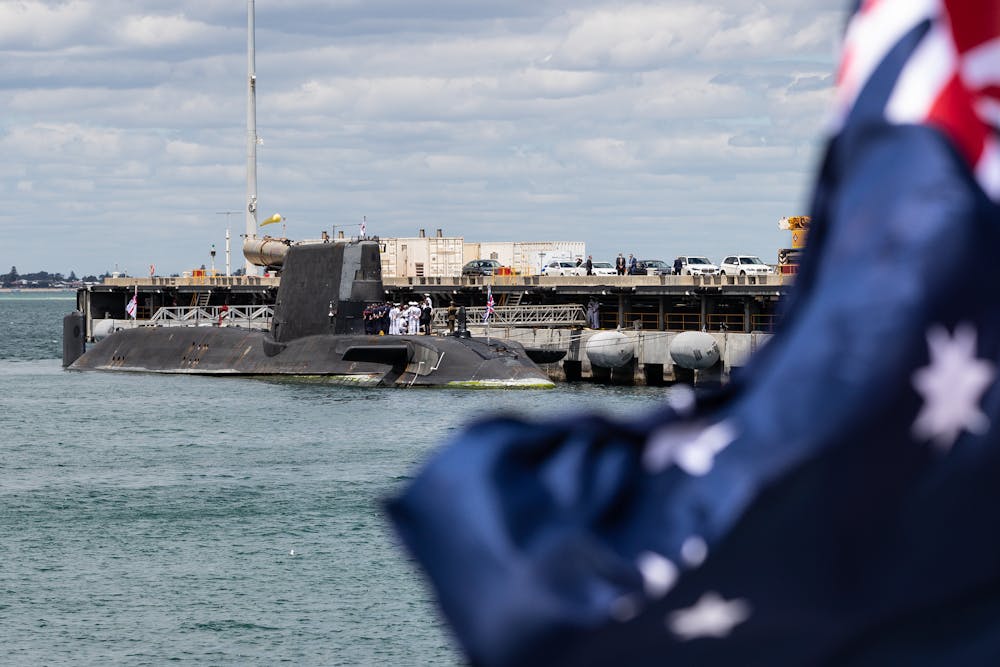
The results should ring alarm bells for the AUKUS program to equip Australia with nuclear-powered submarines. Our assessment suggests there will only be a brief window of time between the deployment of the first SSN-AUKUS boats and the onset of transparent oceans.
Having made the decision to build nuclear submarines, Australia needs to approach the task with a new urgency, lest we acquire these powerful deterrents just as their potency begins to fade.
Planning for obsolescence
Of course, there is a chance the predictions from our assessment are wrong; even highly probable outcomes are not certainties. Our model is a series of educated guesses based on trends in scientific and technological development. But it’s nonetheless an important consideration in light of AUKUS developments.
Australia is at a crossroads as it deals with a complex but deteriorating geostrategic environment. On one hand, we need to respond by committing to long-term investments. On the other, there’s a high degree of uncertainty about how effective these investments will be.
We argue there is evidence submarines could dramatically reduce in effectiveness in the coming decades. In other words, Australia risks investing in a nuclear ecosystem whose use-by date may be much earlier than we’d like. If we are to invest, we need to do so now.
It’s not just the science and technology workforce that needs to be built up, but also supply chains, precision manufacturing, skilled craftspeople and context-specific policies and laws.
We’ll also need a secure, sensible and environmentally appropriate way to deal with all that comes with a nuclear submarine program.
We don’t have the luxury of our AUKUS partners. Both the United Kingdom and United States have had decades to build not only nuclear submarines, but also supporting national ecosystems.
If the clock is ticking, and we think it is, time may be the only factor we have to play with.
Authors: Roger Bradbury, Emeritus Professor of Complex Systems Science, Crawford School of Public Policy, Australian National University


















