

The post-COVID crisis hit Queensland hardest. With 100,000 households needing low-cost housing, here's how it can recover
- Written by: Hal Pawson, Professor of Housing Research and Policy, and Associate Director, City Futures Research Centre, UNSW Sydney
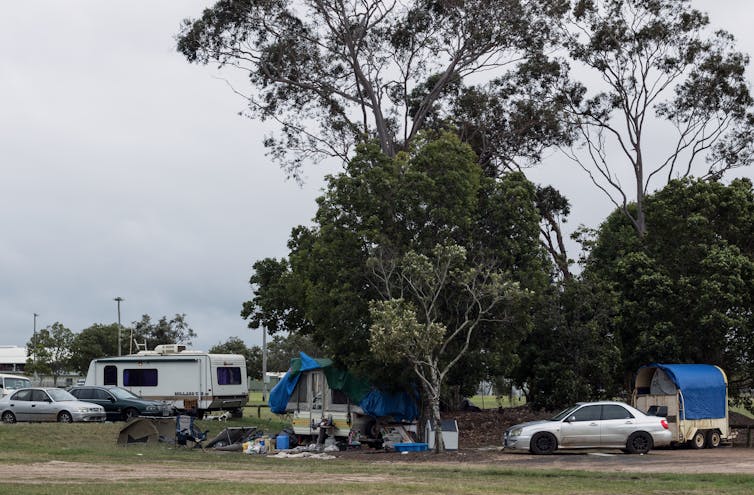
Pandemic-generated pressures have left our rental housing market reeling. Australia-wide, vacancy rates are at rock-bottom levels. Rents are soaring at record rates.
Queensland has been at the epicentre of the post-COVID housing storm. Since the pandemic began, house rents have surged by 23% nationally, but by a punishing (for tenants) 34% in Brisbane. The state’s recent increases in homelessness have likewise outpaced all other states and territories.
Our report for Queensland Council of Social Service (QCOSS), released today, outlines the huge scale of the state’s housing challenge. Our analysis shows that unmet need for social housing in Queensland now exceeds 100,000 households. That’s five times the official waiting list number.
Little wonder Premier Annastacia Palaszczuk convened an extraordinary housing summit in October 2022. Yet, while partly primed by the pandemic, many current housing policy challenges, for both Queensland and Australia, have been building for decades. Perhaps the most important of these have been the ongoing fall in home ownership rates, especially among younger adults, and our increasingly inadequate social housing system.
Recent policies fall far short
None of this is to say that Queensland’s current situation can simply be blamed on state government inaction in the immediate past. Our report recognises the state government has made progress, for example, on significant rental reforms in its current term.
The Queensland treasurer also announced substantial new funding for social housing as part of the state’s 2021 post-pandemic economic recovery package. This investment built on commitments made before the public health crisis.
Then, at the 2022 housing summit, Palaszczuk pledged to double the government’s Housing Investment Fund to $2 billion. This will generate a flow of investment subsidies for social and affordable house-building. This is housing available at subsidised rents to very low-income households and workers on modest incomes respectively.
The 2022 change of government in Canberra means there is also now a prospect of renewed Commonwealth investment in such housing. Some of this funding will flow to Queensland.
But such initiatives follow a decade of generally intensifying housing stress. Only recently have federal and (some) state governments woken up to this policy challenge.
For example, social housing construction in Queensland averaged only around 500 dwellings a year in the decade to 2020. While the state’s population grew by 17% in the decade to 2021, social housing stock expanded by just 2%. So, effectively there has been a big cut in capacity.
Recently-promised Queensland and Commonwealth investments in social housing signal a welcome supply boost in coming years. But there’s a vast amount of ground to make up.
The Queensland government’s expanded use of private rental assistance products, such as bond loans and rental grants, is unlikely to greatly reduce housing need in current market conditions.
Likewise, recently-pledged social housing investment is only a start. By our calculations, even to prevent an increase in the current scale of need, at least 1,500 new units per year – and possibly as many as 2,700 – are needed. Either way, that’s well above annual output expected under existing state commitments.
Read more: Australia's social housing system is critically stressed. Many eligible applicants simply give up
How can we make up so much lost ground?
Our report argues that the scale, intricacy and deep-rootedness of Australia’s housing problems demand radical, wide-ranging and sustained action by both levels of government.
In some cases, it’s mainly a matter of building on recent or ongoing state initiatives. For example, Queensland could – and should – further expand the Housing Investment Fund to ramp up social housing construction. It should also extend rental reform.
Some other recommended measures partially echo proposals by construction and real estate industry bodies. The government could, for example, encourage purpose-built – “build to rent” – rental housing. While not directly contributing to low-cost housing, these projects will expand overall housing supply and broaden consumer choice.
Another recommended measure is for Queensland to follow the ACT by phasing in a broad-based land tax to replace stamp duty. Overwhelmingly backed by mainstream economists, this change would remove a barrier to moving house. It would also promote more efficient use of existing housing stock and discourage speculative investment.
We also urge, in line with most of Australia’s top economists, the phasing out of private landlord tax concessions. The budget savings could enable the government to invest more directly in meeting housing need. Such reform would also support a gradual recovery in young adult home ownership rates, as investor landlord advantages over aspiring first home buyers are reduced.
Importantly, many desirable measures would benefit the housing system, yet at little or no cost to government. For example, regulatory reforms are needed to better protect hard-pressed private renters by reducing insecurity and limiting rent increases. The state could also use its supervisory powers more purposefully to reduce underlying pressure on rents resulting from unchecked flows of long-term rental properties into short-term Airbnb lets.
Another important but near-costless measure for the Queensland government would be to mandate affordable housing contributions by private developers. This is routine practice in the City of Sydney. It’s also applied on a large scale in countries such as the UK and in many American cities. Contrary to the way this approach is sometimes portrayed, it is landowners who bear the cost of such contributions, not builders or consumers.
Read more: England expects 40% of new housing developments will be affordable, why can't Australia?
In tackling the complexities of Australia’s housing crisis, governments must recognise that one-off, cherry-picked initiatives are liable to be ineffective or even counter-productive. If they are serious about tackling the problem, they must commit to a coherent package of reforms within a meaningful overarching strategy.
We can only hope the Commonwealth’s National Housing and Homelessness Plan – the first of its kind in Australia – opens up a pathway to rebalancing our housing system. Mobilising all of the many tools at its disposal, Queensland must act in concert.
Authors: Hal Pawson, Professor of Housing Research and Policy, and Associate Director, City Futures Research Centre, UNSW Sydney

















