

World politics explainer: The twin-tower bombings (9/11)
- Written by: Barbara Keys, Associate Professor of US and International History, University of Melbourne
This article is part of our series of explainers on key moments in the past 100 years of world political history. In it, our authors examine how and why an event unfolded, its impact at the time, and its relevance to politics today.
At 8:46am on a sunny Tuesday morning in New York City, a commercial jet plane flew into the North Tower of the World Trade Centre, cutting through floors 93 to 99.
As the news was beamed around the world, shaken reporters wondered whether the crash had been an accident or an act of terrorism. At 9:03am, viewers watching the smoke billowing from the gash in the building were stunned to see a second jet plane dart into view and fly directly into the South Tower. Suddenly, it was clear that the United States was under attack.
The scale of the assault became apparent about 40 minutes later, when a third jet crashed into the Pentagon. Not long after, in the fourth shock of the morning, the South Tower of the World Trade Centre unexpectedly crumbled to the ground in a few seconds, its structural integrity destroyed by the inferno set off by the plane’s thousands of gallons of jet fuel. Its twin soon succumbed to the same fate.
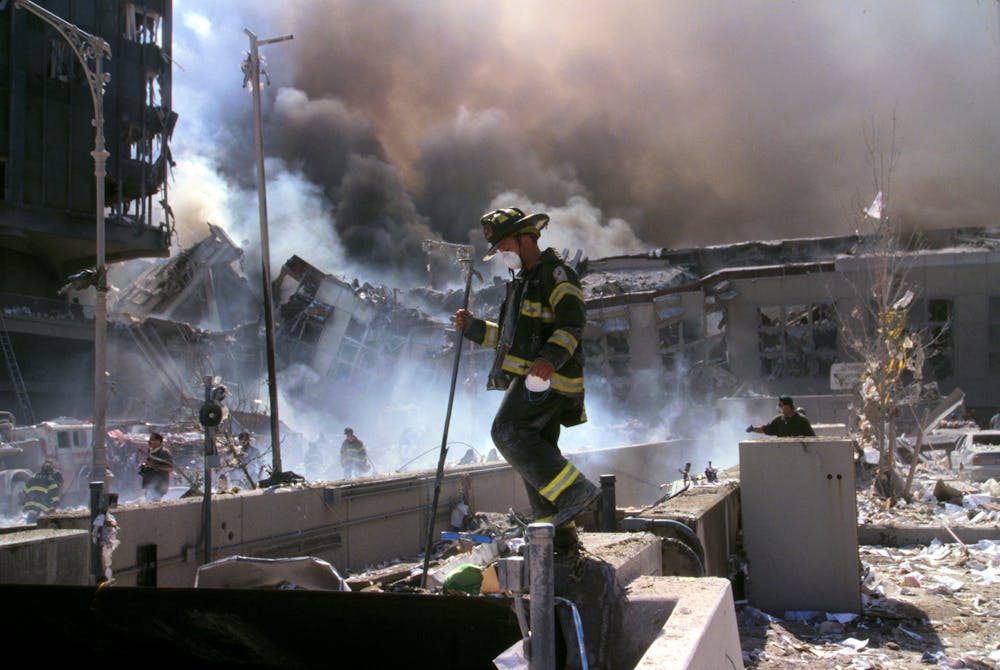 Fire fighters on scene after the 9/11 attack.
Mike Goad/Wikicommons
Fire fighters on scene after the 9/11 attack.
Mike Goad/Wikicommons
What happened?
Over the next days and weeks, the world learned that 19 militants belonging to the Islamic terrorist group, al Qaeda, armed with box cutters and knives missed by airport security, had hijacked four planes.
Three hit their targets. The fourth, intended for the White House or the Capitol, crashed in a field in Pennsylvania when passengers, who had learned of the other attacks, struggled for control of the plane. All told, close to 3,000 people were killed and 6,000 were injured.
Immediate impact of the attacks
The events of 9/11 seared the American psyche. A country whose continental states had not seen a major attack in nearly 200 years was stunned to find that its financial and military centres had been hit by a small terrorist group based thousands of miles away. More mass attacks suddenly seemed not just probable but inevitable.
Read more: How the pain of 9/11 still stays with a generation
The catastrophe set in motion a sequence of reactions and unintended consequences that continue to reverberate today. Its most lasting and consequential effects are interlinked: a massively expensive and unending “war on terror”, heightened suspicion of government and the media in many democratic countries, a sharp uptick in Western antagonism toward Muslims, and the decline of US power alongside rising international disorder – developments that aided the rise of Donald Trump and leaders like him.
War without end?
Just weeks after 9/11, the administration of US President George W. Bush invaded Afghanistan with the aim of destroying al Qaeda, which had been granted safe haven by the extremist Taliban regime. With the support of dozens of allies, the invasion quickly toppled the Taliban government and crippled al Qaeda. But it was not until 2011, under President Barack Obama, that US forces found and killed al Qaeda’s leader and 9/11 mastermind – Osama bin Laden.
 American soldiers in Afghanistan, 2001.
Marine Corps New York/Flickr, CC BY
American soldiers in Afghanistan, 2001.
Marine Corps New York/Flickr, CC BY
Though there have been efforts to end formal combat operations since then, over 10,000 US troops remain in Afghanistan today, fighting an intensifying Taliban insurgency. It is now the longest war the United States has fought. Far from being eradicated, the Taliban is active in most of the country. Even though the war’s price tag is nearing a trillion dollars, domestic pressure to end the war is minimal, thanks to an all volunteer army and relatively low casualties that make the war seem remote and abstract to most Americans.
Even more consequential has been the second major armed conflict triggered by 9/11: the US-led invasion of Iraq in 2003. Although Iraqi dictator Saddam Hussein was not linked to 9/11, officials in the administration of George W. Bush were convinced his brutal regime was a major threat to world order. This is largely due to Saddam Hussein’s past aggression, his willingness to defy the United States, and his aspirations to build or expand nuclear, chemical, and biological weapons programs, making it seem likely that he would help groups planning terrorist attacks on the West.
The invading forces quickly ousted Saddam, but the poorly executed, error-ridden occupation destabilised the entire region.
In Iraq, it triggered a massive, long-running insurgency. In the Middle East more broadly, it boosted Iran’s regional influence, fostered the rise of the Islamic State, and created lasting disorder that has led to civil wars, countless terrorist attacks, and radicalisation.
In many parts of the world, the war fuelled anti-Americanism; in Europe, public opinion about the war set in motion a widening estrangement between the United States and its key European allies.
Monetary and social costs
Today, the United States spends US$32 million every hour on the wars fought since 9/11. The total cost is over US$5,600,000,000,000. (5.6 trillion dollars). The so-called war on terror has spread into 76 countries where the US military is now conducting counter-terror activities, ranging from drone strikes to surveillance operations.
The mind-boggling sums have been financed by borrowing, which has increased social inequality in the United States. Some observers have suggested that government war spending was even more important than financial deregulation in causing the 2007-2008 Global Financial Crisis.
Eroding democracy
The post-9/11 era has eroded civil liberties across the world. Many governments have cited the urgent need to prevent future attacks as justification for increased surveillance of citizens, curbing of dissent, and enhanced capacity to detain suspects without charge.
The well publicised missteps of the FBI and the CIA in failing to detect and prevent the 9/11 plot, despite ample warnings, fed public distrust of intelligence and law enforcement agencies. Faulty intelligence about what turned out to be nonexistent Iraqi “weapons of mass destruction” (WMDs) undermined public confidence not only in the governments that touted those claims but also in the media for purveying false information.
The result has been a climate of widespread distrust of the voices of authority. In the United States and in other countries, citizens are increasingly suspicious of government sources and the media — at times even questioning whether truth is knowable. The consequences for democracy are dire.
Increasing Islamophobia
Across the West, 9/11 also set off a wave of Islamophobia. Having fought a decades-long Cold War not long before, Americans framed the attack as a struggle of good versus evil, casting radical Islam as the latest enemy. In many countries, voices in the media and in politics used the extremist views and actions of Islamic terrorists to castigate Muslims in general. Since 9/11, Muslims in the United States and elsewhere have experienced harassment and violence.
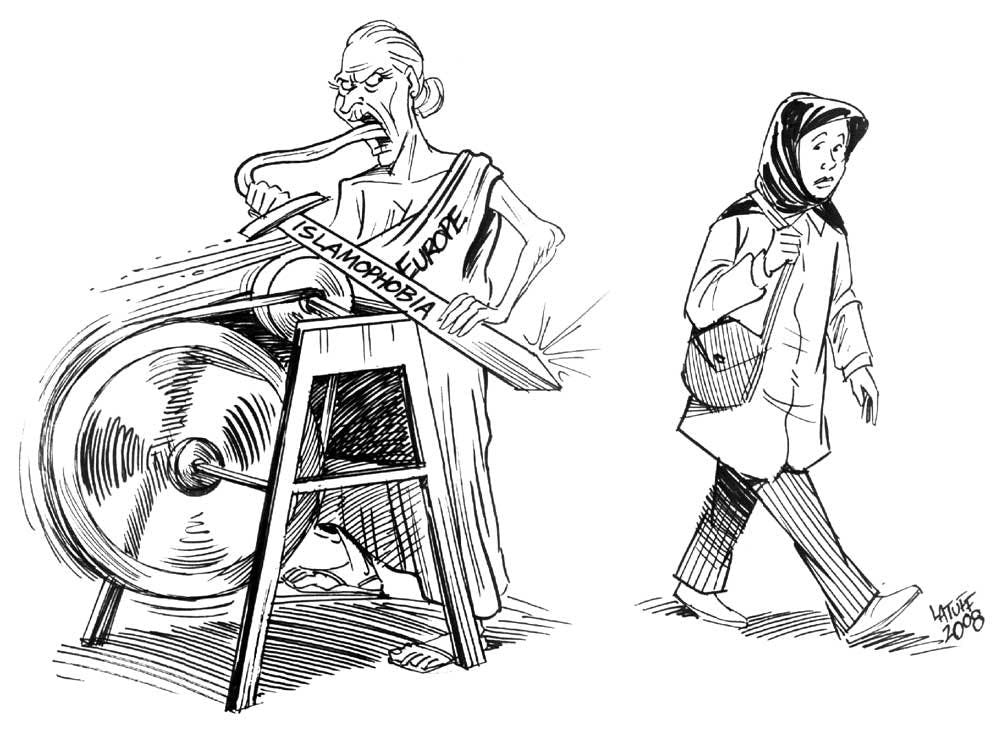 Cartoon highlighting Islamophobia in Europe.
Carlos Latuff/Flickr, CC BY-SA
Cartoon highlighting Islamophobia in Europe.
Carlos Latuff/Flickr, CC BY-SA
In Western countries, Muslims are now often treated as the most significant public enemy. European populists have risen to power by denouncing refugees from Muslim majority countries like Syria, and the willingness and ability of Muslims to assimilate is viewed with increasing scepticism.
A week after his inauguration, US President Donald Trump kept a campaign promise by signing the so-called “Muslim ban”, designed to prevent citizens of six Muslim-majority countries from entering the United States.
Following attacks
One of the most widely expected consequences of 9/11 has so far been averted. Though Islamic terrorists have engaged in successful attacks in the West since 9/11, including the 2002 Bali bombings, the 2004 Madrid train bombings, and the 2015 attacks in Paris, there has been no attack on the scale of 9/11. Instead, it is countries with large Muslim populations that have seen a rise in terrorist attacks.
Yet the West still pays the price for its militant and militarised response to terrorism through the weakening of democratic norms and values. The unleashing of US military power that was supposed to intimidate terrorists has diminished America’s might, creating a key precondition for Donald Trump’s promise to restore American greatness.
Although many of the issues confronting us today have very long roots, the world we live in has been indelibly shaped by 9/11 and its aftermath.
Authors: Barbara Keys, Associate Professor of US and International History, University of Melbourne
Read more http://theconversation.com/world-politics-explainer-the-twin-tower-bombings-9-11-101443
&media=https://www.modernaustralian.com/https://images.theconversation.com/files/234737/original/file-20180904-41729-ai02ak.jpg?ixlib=rb-1.1.0&q=45&auto=format&w=754&fit=clip&description=World%20politics%20explainer:%20The%20twin-tower%20bombings%20(9/11) "Pin It")


















.jpg)