What octopus DNA tells us about Antarctic ice sheet collapse
- Written by Sally Lau, Postdoctoral Research Fellow, James Cook University
If we want to understand the future, it’s often useful to look at the past. And even more useful if you use octopus DNA to peer into worlds long gone.
About 125,000 years ago, the Earth was in its last warm period between ice ages. Global average temperatures during this interglacial period were about 0.5–1.5°C warmer than pre-industrial levels.
This has strong parallels with our time. For a third of 2023, the Earth’s temperature has been 1.5°C warmer than the pre-industrial era, driven by climate change.
For almost 50 years physical scientists have sought the answer to whether or not the vast West Antarctic Ice Sheet collapsed the last time global temperatures were this high. Rather than relying only on geological sampling, we turned to the DNA of a small Antarctic octopus for clues to the deep past.
The DNA had an answer. Our new research shows yes, it most likely collapsed.
The West Antarctic Ice Sheet is very susceptible to warming. If it melts, it has enough water to raise global sea levels by 3.3 to 5 metres.
Of octopuses and giant ice sheets
Sediment records and other ice cores show us that the ice sheet retreated at some point during the last ~1 million years in the late Pleistocene, but the exact timing and extent of any collapse remain ambiguous.
To get a more precise answer, we looked to cephalopod genetics.
Every organism’s DNA is a history book, and we now have the technology to read it. We can use DNA to look back in time and pinpoint when different populations of animals were interbreeding.
Turquet’s octopus (Pareledone turqueti) is fairly small, weighing up to 600 grams. They live on the seafloor all around Antarctica, but individuals don’t move far from home. Antarctica is so vast that populations in different regions cannot usually interbreed.
Deep under West Antarctica lies gaps in the rocks. At present, these are filled by the ice sheet, making the Weddell, Amundsen and Ross seas separate from each other.
If the ice melted, seaways would open up and connect these isolated basins. Octopuses could directly migrate into these regions and the evidence of their breeding would be laid down in DNA.
But if the ice sheet didn’t melt, we would only see evidence of breeding between octopus populations along the circumference of the continent.

We compared DNA patterns in Turquet octopus genomes all around Antarctica to see if there were direct and unique connections between octopus populations in the Weddell, Amundsen and Ross seas. We used statistical models to figure out if these connections could be explained by their present day connections around the Antarctic coastline.
The story was clear in the DNA: yes, there had been direct connections between these three octopus populations. Their connections could not be statistically explained by interbreeding around the present day Antarctic coastline. These populations could only come into contact through seaways now blocked by the West Antarctic Ice Sheet.
Even more interesting, we first found direct connections between the three populations during the mid-Pliocene, 3 million to 3.6 million years ago when temperatures were 2–3°C hotter and sea levels 25m higher than today. This supports existing geological evidence that the West Antarctic Ice Sheet collapsed during that era.
The most recent DNA signatures of direct connections between the octopuses of these three seas was during the last interglacial period around 125,000 years ago. That suggests the ice sheet collapsed when the global average temperature was around 1.5°C hotter than pre-industrial levels.
Our work provides the first empirical evidence the West Antarctic Ice Sheet could begin to collapse if we exceed the Paris Agreement goal of limiting warming to 1.5°C or even 2°C.
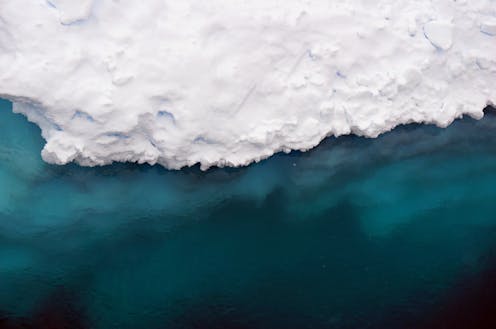
 If the West Antarctic ice sheet melted, seaways would open up – and octopuses would mingle.
Ted Scambos/AP
If the West Antarctic ice sheet melted, seaways would open up – and octopuses would mingle.
Ted Scambos/AP
This discovery took effort across disciplines and countries
To use animal DNA as a proxy for changes in the ice sheet, we had to work across disciplines and countries. Bringing together physical scientists and biologists gave rise to new ways to answer long standing questions of vital importance to all of us.
We also turned to museum collections for samples. Some dated back three decades – well before the genetic sequencing and analytical techniques we used were available. This demonstrates the vital importance of careful sample preservation, linked with metadata, with specimens protected for future access.
Interdisciplinary science is hard. It requires time, effort, and an open mind to appreciate new terminologies, scales and approaches. Journal editors and scientists can be reluctant to review such papers, as some aspects of the research will necessarily be outside the area of their expertise. But we hope our results show the value of this approach.
The Antarctic seafloor is covered in marine life. Many of their ancestors also lived through climate changes in the past.What’s next?
We hope to continue using DNA as a proxy to explore other parts of Antarctica with poorly understood climate histories.
There is a wealth of information on Antarctica’s recent and distant past also hidden in other types of biological data in moss beds and peat profiles, vertebrate animal colonies and living terrestrial and marine invertebrates. To date, very few of these biological archives have been brought into our understanding of Antarctica’s past climates.
As the world heats up at an unprecedented rate, we need to use these types of approaches to understand what else is likely to happen down on the ice.
Read more: Increasing melting of West Antarctic ice shelves may be unavoidable – new research
Authors: Sally Lau, Postdoctoral Research Fellow, James Cook University
Read more https://theconversation.com/what-octopus-dna-tells-us-about-antarctic-ice-sheet-collapse-218810