Crocs love feral pigs and quolls have a taste for rabbit – but it doesn't solve the invasive species problem
- Written by Euan Ritchie, Professor in Wildlife Ecology and Conservation, School of Life & Environmental Sciences, Deakin University
Across the vast Australian continent, feral pigs, feral deer and European rabbits roam in their millions. By different names – wild boar, venison and lapin – these could all be served in a Michelin star restaurant.
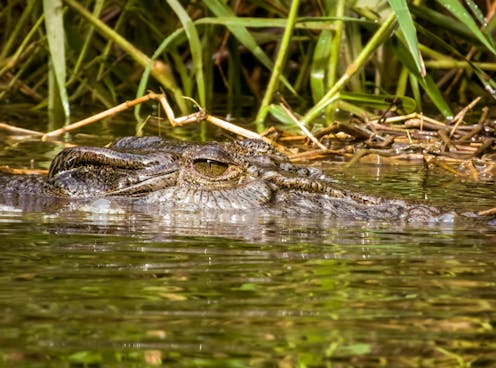
Feral and invasive species are becoming popular meals for native wildlife too. For species like the saltwater crocodile and spotted-tailed quoll, the menu is expanding and changing due to the arrival of invasive alien species – one of the greatest threats to biodiversity globally.
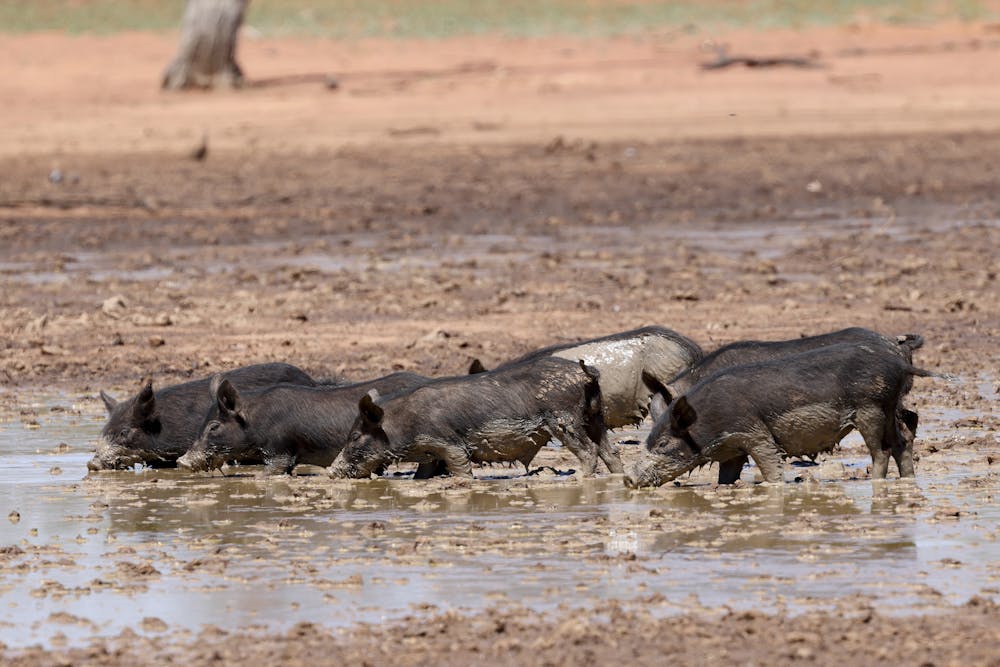
The good news is, many invasive alien species make good tucker. Around the world, native wildlife are dining on increasing numbers of exotic prey. In the United States, endangered snail kites — a wetland raptor — crunch through invasive apple snails, red-banded snakes swallow North American bullfrogs in China, dingoes devour feral sambar deer and goats in Australia, Sulawesian toads gobble up introduced yellow crazy ants in Indonesia, and golden eagles and saltwater crocodiles both love eating feral pigs on opposite sides of the Pacific.
Of crocs and pigs
So can we say these invasives are useful in some sense? Exotic prey can help boost numbers of some native predators. Saltwater crocodiles in the Northern Territory are rapidly bouncing back after widespread, severe culling.
Using the bones of crocodiles collected through time, researchers have shown that over roughly half a century, salties have shifted from a diet largely based on fish to a more terrestrial diet, including feral water buffalo and pigs.
This seems like a much-needed good news story for the environment – a natural way to limit feral pigs, one of Australia’s most widespread and damaging invasive species. At present, though, we don’t know for sure that crocs keep pig numbers down.
Pigs and crocodiles live in the fast and slow lanes, respectively. Feral pigs feed and breed, and few things are off the menu. Sows can give birth from around 6 months of age, and produce ten or more piglets in litters once or twice every 12 or so months.
On the other hand, female estuarine crocodiles begin reproducing at around 12 years of age, and do so once a year under the right conditions. Crocodiles cut back on hunting and other activity during cooler months. Together, this means feral pigs can endure relatively high predation rates and still persist in ecosystems in large numbers.
Read more: Eat locals: swapping sheep and cows for kangaroos and camels could help our environment
Of quolls and rabbits
The largest of Australia’s four predatory marsupial quoll species, the spotted-tailed quoll, is known to enjoy rabbit even when there is a diverse and abundant selection of native mammals within the same area.
Unfortunately, quolls are now absent or still declining in many places, due likely to competition or predation with the bigger, heavier predators Europeans introduced: feral cats and foxes. In the bush, male cats can be sizeable – exceeding 6 kilos, roughly double the size of your average spotted-tailed quoll.
As quolls have disappeared, rabbits may have taken advantage of the predatory void and expanded. Fast-breeding rabbits are now arguably Australia’s worst invasive alien species. Their sheer numbers support cat and fox populations.
This begs the question – if cats and foxes could be eradicated or greatly reduced in some areas, could we reintroduce quolls to help manage rabbit populations or prevent their return?
Quolls also like the taste of rats.Dangerous dinners
Not all introduced prey make safe meals.
Cane toads have devastated some native species such as northern quolls, which naturally prey on native amphibians but cannot survive toad toxin.
Regrettably, a recent attempt to train quolls not to eat cane toads appears to have failed.
But other species have learnt to safely eat cane toads, including the rakali (Australian water rat), which removes and eats toad hearts and livers with surgical precision. The humble bin chicken (white ibis) has also figured out how to make toads safer by washing them.
European house mice and introduced rats can be easy prey for owls, snakes, and many other native predators. Unfortunately, these easy pickings can become their last suppers – not because the rodents are toxic, but because they may well have eaten rodenticide which makes them easier to hunt. Once a sick, dying rodent is eaten, the predator can in turn be poisoned and die. Scavengers who eat poisoned predators can also die, affecting entire food chains and ecosystems.
Sometimes predators can find themselves prey, depending on their age and size. In Australia, large pythons, goannas and monitor lizards eat foxes and cats, but these same reptiles are preyed upon by cats and foxes when younger and smaller.
 Millions of feral deer now roam Australia.
Kazredracer/Flickr
Millions of feral deer now roam Australia.
Kazredracer/Flickr
Invasive prey aren’t going away
As time goes on, invasive prey species can become regular meals for native predators – and part of the food web.
When we try to remove invasive prey species from ecosystems, we must take a big picture view and proceed with great caution.
When feral cats were killed off on New Zealand’s Little Barrier island, it was done with the best intentions: protect the seabirds nesting there. But with the cats gone, invasive rat populations surged and soon began killing the seabird chicks.
In Australia’s arid regions, we now have experimental evidence to suggest biological controls such as rabbit haemorrhagic disease do keep rabbit numbers down, alongside culling and destroying warrens. With the rabbits suppressed, plants and native herbivores can bounce back. This, in turn, pushes cat and fox populations lower, as these two predators maintain their high numbers in arid regions in part due to an abundance of rabbits.
But this doesn’t work in the wetter, more vegetated south-east. Here, there’s little evidence rabbit control greatly affects fox populations.
So should we celebrate crocs chomping on pigs and rakali eating cane toads? Of course – it’s a sign that some of our native predators can adapt to these introduced species. But it’s not true for all native wildlife. Our quolls are doing far worse with the new arrivals.
And for every native predator finding new tucker, there are far more cats and foxes eating birds, reptiles, frogs, and small marsupials, while pigs, deer, camels, horses, donkeys, and water buffalo run amok. We have already set these creatures loose – we must use all means possible to try and rein them in.
Read more: Australia’s least wanted – 8 alien species and diseases we must keep out of our island home
Authors: Euan Ritchie, Professor in Wildlife Ecology and Conservation, School of Life & Environmental Sciences, Deakin University