Why is the universe ripping itself apart? A new study of exploding stars shows dark energy may be more complicated than we thought
- Written by Brad E Tucker, Astrophysicist/Cosmologist, Australian National University
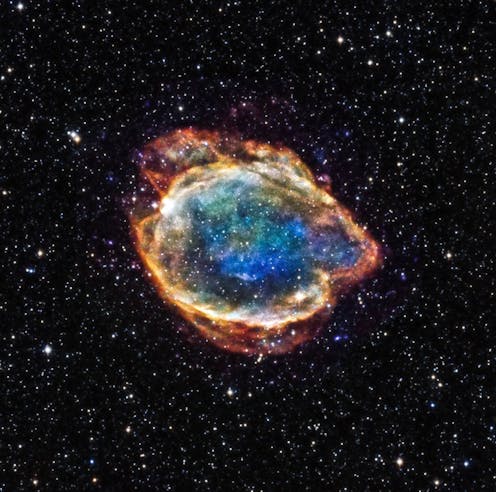
What is the universe made of? This question has driven astronomers for hundreds of years.
For the past quarter of a century, scientists have believed “normal” stuff like atoms and molecules that make up you, me, Earth, and nearly everything we can see only accounts for 5% of the universe. Another 25% is “dark matter”, an unknown substance we can’t see but which we can detect through how it affects normal matter via gravity.
The remaining 70% of the cosmos is made of “dark energy”. Discovered in 1998, this is an unknown form of energy believed to be making the universe expand at an ever-increasing rate.
In a new study soon to be published in the Astronomical Journal, we have measured the properties of dark energy in more detail than ever before. Our results show it may be a hypothetical vacuum energy first proposed by Einstein – or it may be something stranger and more complicated that changes over time.
What is dark energy?
When Einstein developed the General Theory of Relativity over a century ago, he realised his equations showed the universe should either be expanding or shrinking. This seemed wrong to him, so he added a “cosmological constant” – a kind of energy inherent in empty space – to balance out the force of gravity and keep the universe static.
Later, when the work of Henrietta Swan Leavitt and Edwin Hubble showed the universe was indeed expanding, Einstein did away with the cosmological constant, calling it his “greatest mistake”.
However, in 1998, two teams of researchers found the expansion of the universe was actually accelerating. This implies that something quite similar to Einstein’s cosmological constant may exist after all – something we now call dark energy.
Since those initial measurements, we’ve been using supernovae and other probes to measure the nature of dark energy. Until now, these results have shown the density of dark energy in the universe appears to be constant.
This means the strength of dark energy remains the same, even as the universe grows – it doesn’t seem to be spread more thinly as the universe gets bigger. We measure this with a number called w. Einstein’s cosmological constant in effect set w to –1, and earlier observations have suggested this was about right.
Exploding stars as cosmic measuring sticks
How do we measure what is in the universe and how fast it is growing? We don’t have enormous tape measures or giant scales, so instead we use “standard candles”: objects in space whose brightness we know.
Imagine it is night and you are standing on a long road with a few light poles. These poles all have the same light bulb, but the poles further away are fainter than the nearby ones.
This is because light fades proportionately to distance. If we know the power of the bulb, and can measure how bright the bulb appears to be, we can calculate the distance to the light pole.
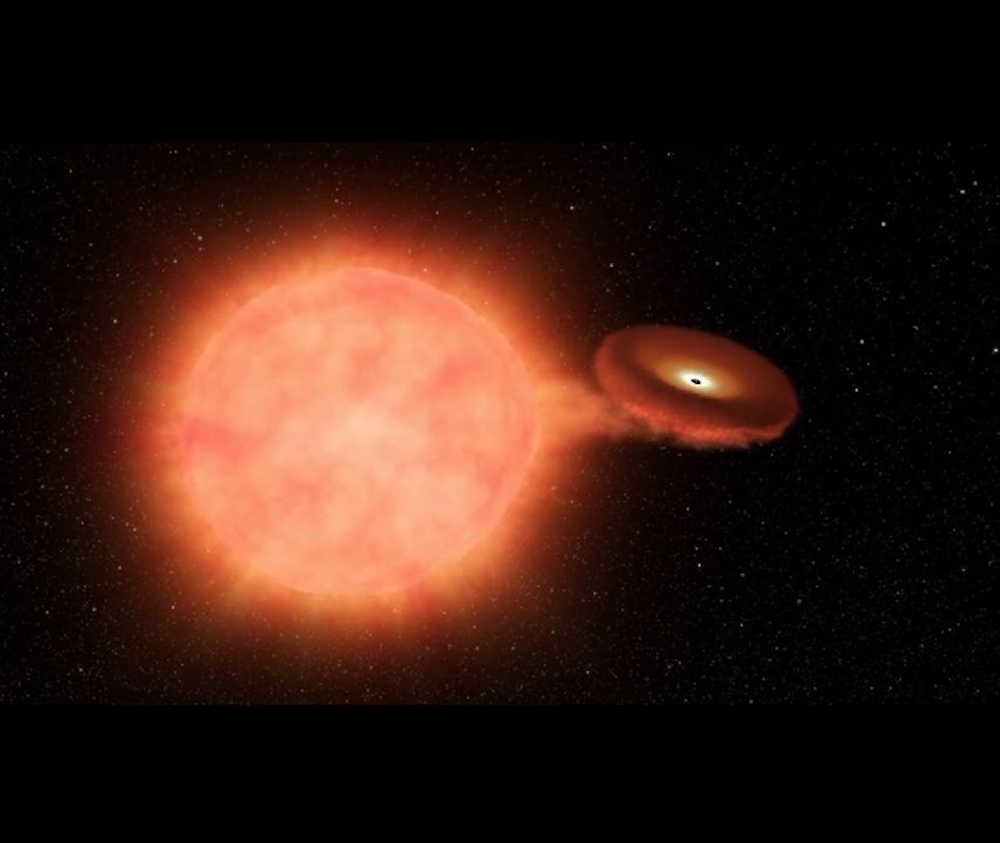
For astronomers, a common cosmic light bulb is a kind of exploding star called a Type Ia supernova. These are white dwarf stars which often suck in matter from a neighbouring star and grow until they reach 1.44 times the mass of our Sun, at which point they explode. By measuring how quickly the explosion fades, we can determine how bright it was and hence how far away from us.
The Dark Energy Survey
The Dark Energy Survey is the largest effort yet to measure dark energy. More than 400 scientists across multiple continents work together for nearly a decade to repeatedly observe parts of the southern sky.
Repeated observations let us look for changes, like new exploding stars. The more often you observe, the better you can measure these changes, and the larger the area you search, the more supernovae you can find.
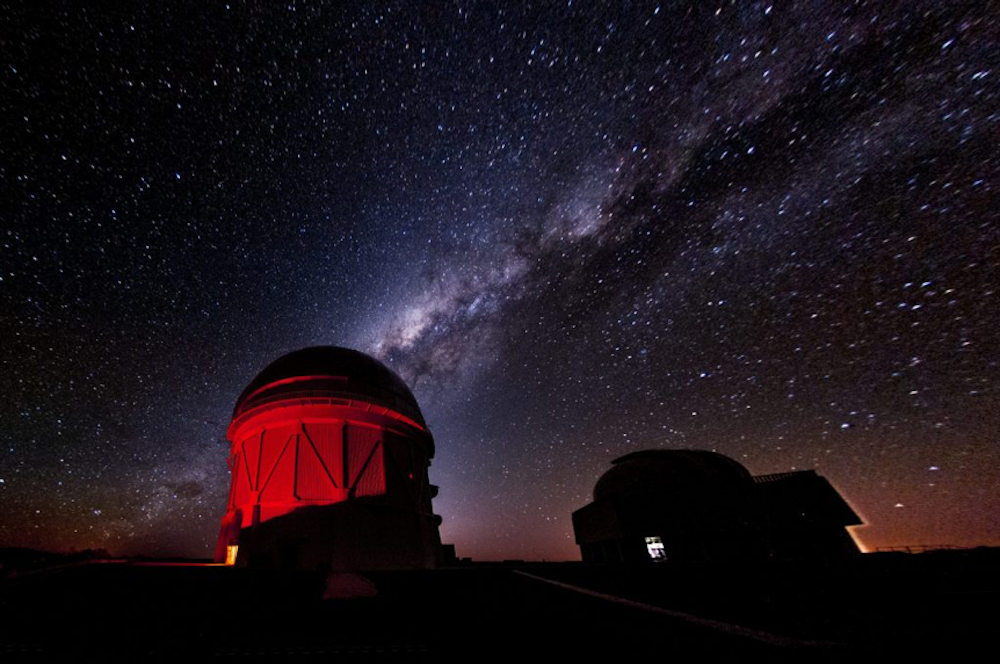 The Cerro Tololo Inter-American Observatory 4-metre telescope which was used by and the Dark Energy Survey.
Reidar Hahn / Fermilab, CC BY
The Cerro Tololo Inter-American Observatory 4-metre telescope which was used by and the Dark Energy Survey.
Reidar Hahn / Fermilab, CC BY
The first results indicating the existence of dark energy used only a couple of dozen supernovae. The latest results from the Dark Energy Survey use around 1,500 exploding stars, giving much greater precision.
Using a specially built camera installed on the 4-metre Blanco Telescope at the Cerro-Tololo Inter-American Observatory in Chile, the survey found thousands of supernovae of different types. To work out which ones were Type Ia (the kind we need for measuring distances), we used the 4-metre Anglo Australian Telescope at Siding Spring Observatory in New South Wales.
Read more: Relax, the expansion of the universe is still accelerating
The Anglo Australian Telescope took measurements which broke up the colours of light from the supernovae. This lets us see a “fingerprint” of the individual elements in the explosion.
Type Ia supernovae have some unique features, like containing no hydrogen and silicon. And with enough supernovae, machine learning allowed us to classify thousands of supernovae efficiently.
More complicated than the cosmological constant
Finally, after more than a decade of work and studying around 1,500 Type Ia supernovae, the Dark Energy Survey has produced a new best measurement of w. We found w = –0.80 ± 0.18, so it’s somewhere between –0.62 and –0.98.
This is a very interesting result. It is close to –1, but not quite exactly there. To be the cosmological constant, or the energy of empty space, it would need to be exactly –1.
Where does this leave us? With the idea that a more complex model of dark energy may be needed, perhaps one in which this mysterious energy has changed over the life of the universe.
Read more: From dark gravity to phantom energy: what's driving the expansion of the universe?
Authors: Brad E Tucker, Astrophysicist/Cosmologist, Australian National University