Modern Australian
Men's Weekly

.

What's it worth to work from home? For some, it's as much as one-third of their wage

  • Written by Lynette Washington, Research Fellow, UniSA Business, University of South Australia

What's it worth to work from home? For some, it's as much as one-third of their wage

A significant proportion of Australian workers – about one-fifth – would be prepared to sacrifice between 16% and 33% of their salaries for the right to work from home, which works out at A$12,000 to $24,000 of those workers’ salaries.

But a much larger proportion, more than one half, would be prepared to sacrifice nothing, being either not strongly convinced about the benefits of working from home or actively preferring to go into the workplace.

Surprisingly, our findings are consistent with those of other surveys conducted both during and before the pandemic, suggesting the widespread move to working from home during COVID hasn’t changed preferences.

Before COVID, on the day of the 2016 Australian census, only 2% to 8% of the workforce in major Australian cities worked from home.

During COVID, on the day of the 2021 census 21% worked from home. A Bureau of Statistics survey conducted amid lockdowns in late 2020 found 31% worked from home most days.

Our survey of 1,113 workers from Australia’s 17 largest urban areas was limited to those in jobs whose tasks could be done either remotely or in central locations.

What we found

We offered the workers surveyed a choice of eight job arrangements with different salary ranges calculated with reference to their current salaries, and different degrees of flexibility about working from home.
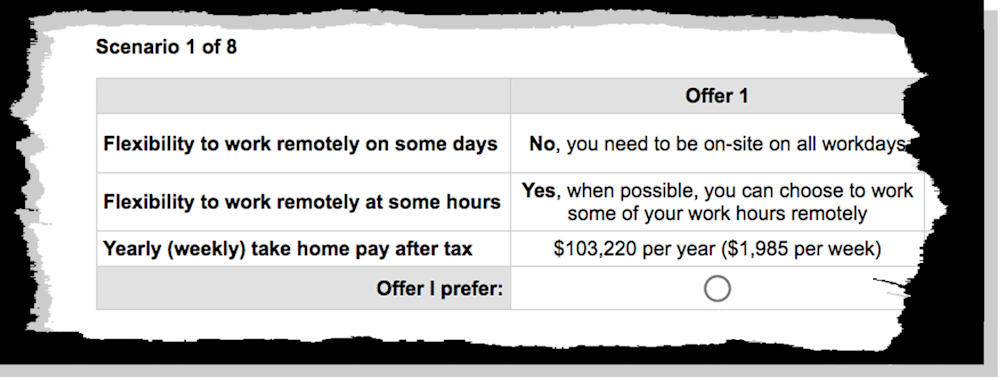

Extract from survey form We also asked about attitudes to remote working, experience with remote working, commute patterns and age, gender, education and household size. We found most workers – 55% – weren’t prepared to sacrifice salary for the right to work remotely. Most of these (31% of all workers) didn’t see significant benefits to working from home. But a substantial proportion, 23.5% of all workers, while seeing benefits to their productivity and health and wellbeing from working from home, were concerned about what it would do to their organisational relationships, learning opportunities and prospects for advancement. Interestingly, workers who had the most experience of working from home before the pandemic raised these concerns most often. Workers with the least experience of working from home pre-pandemic were the least likely to be concerned about its impact on their careers and work relationships. This might be because before the pandemic we didn’t have great work-from-home policies and procedures to support remote workers. Read more: Remote working improves the lives of female managers - but at a cost Gender matters, age matters Women valued the ability to work from home far more than men, on average 28% more. This indicates that women are more likely to make a trade-off between long-term career prospects and the benefits of flexible work. In terms of age, workers in their 30s and 50s valued the ability to work from home the most while workers in their 20s valued it the least. This might be because workers in their 20s at the start of their careers are the most likely to value direct interactions with their colleagues and supervisors. Knowledge workers value remote work the most Middle and high-income earners in white-collar “knowledge economy” jobs were the most likely to value working from home. They were willing to forgo $12,000 to $24,000 of their annual salary to have the ability to do it some of the time. Workers in low-wage clerical or administrative jobs in sectors such as retail and training were among the least likely to value working from home. They were also among the most concerned about its impacts on their relationships with colleagues and opportunities for learning and advancement. Workers in small firms also placed low values on the ability to work from home, perhaps because these firms lacked the technological capacity to fully support it. Read more: The shift to working from home will be difficult to reverse Opinions split on productivity About half of the workers surveyed thought they were less productive at home. About another quarter found no impact. The final quarter found a significant improvement in both the quality and quantity of their work. Many said that while their working from home might cut the amount they got done per hour, it didn’t cut the total amount they got done because the flexibility it offered allowed them to catch up at other times. High and medium-wage professionals were the most optimistic about their productivity at home, and workers in low and medium-wage service jobs the least optimistic – a pattern that mirrored what they were prepared to sacrifice for the right to work at home. How to become an employer of choice Our findings suggest many employers of knowledge economy workers might be able to attract and retain high-quality staff by offering the ability to work from home in lieu of higher salaries. But this will not be the answer for all employers looking to retain the best staff. With many workers wary of what could happen to their career prospects if they stayed at home, and 55% of workers placing no value on remote work, some employers will need to find other ways to attract the best workers. Many workers value both face-to-face relations and flexibility. Finding the right balance will become increasingly important now that COVID has shown us how many of our jobs can be done from home. Authors: Lynette Washington, Research Fellow, UniSA Business, University of South Australia

Read more https://theconversation.com/whats-it-worth-to-work-from-home-for-some-its-as-much-as-one-third-of-their-wage-217554

How Professional Cleaning Improves Indoor Air Quality

Indoor air quality (IAQ) plays a crucial role in our health, comfort, and overall wellbeing. Australians spend nearly 90% of their time indoors-at hom...

Solar and Solar Battery Systems: Powering Smarter Homes in Victoria

As energy prices continue to rise and sustainability becomes a priority for Australian homeowners, more families are investing in Solar and Solar Ba...

Plumbing Emergency Melbourne: What to Do When Every Minute Counts

A sudden plumbing issue can quickly turn into a major disaster if not handled promptly. From burst pipes and overflowing toilets to leaking gas line...

Why Older Melbourne Homes Require Detailed Building & Pest Inspections

Older homes make up a large part of Melbourne’s housing stock. Victorian terraces, Edwardian houses, Californian bungalows, and post-war brick hom...

7 Essential Tips for Choosing Reliable Moving Services in Perth

Moving to a new home or office can be exciting, but it also comes with stress, planning, and plenty of decisions. One of the most important choices yo...

How to Find the Best Real Estate Agent Near You on the Central Coast

Choosing the right real estate agent can make a major difference to your final sale price, days on market, and overall experience. The Central Coast...

Unlock Durability And Beauty With Burnt Timber Cladding Solutions

Imagine a home or commercial space that not only stands the test of time but also tells a story through its very facade. In the world of architectur...

Offroad Caravans: Built for Adventure Beyond the Beaten Track

Australia’s vast and varied landscapes invite travellers to explore far beyond sealed roads and crowded parks. Offroad caravans are purpose-built ...

The Expert's Guide to Understanding Large Bore Steel Pipe Specifications

When it comes to infrastructure, construction, and various industrial applications, the choice of materials is paramount. Among the options availabl...

Preparing for Your First Trip to San Francisco in 2026

San Francisco has long occupied a particular place in the Australian imagination. It is compact yet complex, progressive but historic, and visually st...

Modern Office Painting in Australia - It's the Real Game Changer

Walk into any modern Australian office today and you'll be struck by the fact it's a whole different beast from the ones we grew up with. Gone are t...

How to Choose the Right Suburb for Your Lifestyle

Choosing the right suburb is one of the most important decisions you’ll make when buying or renting a home. Beyond the property itself, the suburb...

Considering Cryolipolysis Fat Freezing? Here’s What You Need to Know

Body confidence can shift over time, and sometimes even good diet and training can still leave a stubborn area of fat that won’t budge. If you’r...

From Local Tradie to Digital Leader: The Strategy Behind Auto Gate Guys Sydney’s Growth

For many small trade businesses, digital marketing still feels like a buzzword, not a necessity. They rely on word-of-mouth referrals, repeat clients...

Electric Automation System: Smarter Control for Modern Electrical Infrastructure

Modern buildings and industrial facilities are increasingly dependent on intelligent control and efficiency. An electric automation system brings t...

The Damp Truth: Why Your Overflowing Gutters Are an Open Invitation for Termites

When it comes to protecting your home, most people think about visible threats — storm damage, cracked tiles, break-ins. But one of the most destruc...

Is Your Inventory a Sitting Duck? 2 Critical Upgrades to Protect Your Business Assets and Your Bottom Line

Imagine this: you finish a long day on the job, lock up your tools, materials, and work vehicle in the garage, and head home. But overnight, someone b...

Electrician in Melbourne: Reliable Electrical Solutions for Homes and Businesses

Finding a dependable electrician Melbourne is essential when safety, efficiency, and long-term performance matter. Electrical systems form the back...