Japan is about to land its first lunar probe. As more nations race to the Moon, how will we keep the peace?
- Written by Richard de Grijs, Professor of Astrophysics, Macquarie University
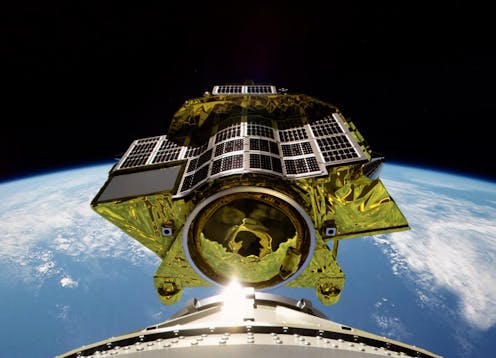
Early on Saturday, January 20 2024, Japan hopes to become the fifth country to successfully land a probe on the Moon. To date, the United States, the Soviet Union, China and India have preceded the East Asian nation.
Launched in September 2023 by the Japanese Aerospace Exploration Agency (JAXA), the Japanese Smart Lander for Investigating Moon (SLIM) is set to touch down around 02:20am AEDT. Trialling a novel landing technique with pinpoint accuracy, it is poised to settle on a gently sloped crater rim – a first in lunar exploration.
JAXA celebrates the mission as a technology demonstrator. The agency’s main aim is to practice near-real-time visual precision landing. The newly developed landing technology would allow them to touch down anywhere they want, rather than only where the terrain is favourable.
Plans for a follow-up expedition, the Lunar Polar Exploration probe (LUPEX), are well advanced. That mission will be developed jointly with the Indian Space Research Organisation (ISRO).
The Moon is a busy target
In recent years, the Moon has become a key target for exploration missions. For instance, just last year we witnessed Russia’s attempted landing of its Luna 25 probe and the first successful ISRO Moon shot, Chandrayaan-3.
Meanwhile, the US aims to return humans to the Moon through their Artemis programme while also supporting commercial companies in their quest to reestablish a viable presence there.
NASA and its international partners aim to eventually place a crewed space station in lunar orbit, the Gateway Lunar Space Station.
Simultaneously, China continues its successful, carefully planned Chang'e project. The Asian powerhouse is working towards establishing its own International Lunar Research Station. That Chinese–Russian project is promoted as “open to all interested countries and international partners”.
‘Peaceful intentions’
To date, the leading spacefaring nations have gone to great lengths to publicly assure us that their intentions in space are peaceful. Yet, last year Yury Borisov of Russia’s space agency Roscosmos bluntly stated:
This is not just about the prestige of the country and the achievement of some geopolitical goals. This is about ensuring defensive capabilities and achieving technological sovereignty.
Borisov’s comments should not be read in isolation, however. US officials have made similar assertions. In July last year, the US assistant secretary of defense for space policy, John F. Plumb, was equally blunt:
Space is in our DNA for the military. It’s absolutely essential to our way of war.
Such official commentary is clearly anathema to the purported peaceful intentions expressed by officials elsewhere in their respective national hierarchies. Similarly, to safeguard its national interests and encouraged by President Xi Jinping himself, China has been fine-tuning its own military space strategy.
The Moon is a large target, which to date is only accessible to a small number of actors. Yet, ever since evidence of water was found near the Moon’s south pole, much effort has focused on finding ways to land safely in the Moon’s southern hemisphere.
With commercial actors and national interests thrown into the mix, we ought to consider the geopolitical implications of this new space race.
Who keeps the peace in space?
The 1967 Outer Space Treaty remains the defining legal document governing strategic conduct in space. To date, its has been ratified by 114 countries and 22 other signatories, including all major spacefaring nations.
However, new technological developments and the increasing presence of private space companies have prompted some to suggest that the treaty has become outdated.
Therefore, the US has independently developed a new international agreement, which it says is focused on common principles, guidelines and best practices applicable to the safe exploration of the Moon and beyond: the Artemis Accords.
Thus far, 33 countries have signed the agreement, but neither Russia nor China have acceded. Given the prevailing political differences, there is currently no clear way forward to bring all parties to the same table.
Read more: Outer space: Rwanda and Nigeria sign an accord for more responsible exploration – why this matters
Although the Moon remains uncrowded, sustained exploration, human occupation and commercial exploitation will increase the likelihood of encounters on the lunar surface (or in orbit) between competing parties, or even between nations engaged in major conflict on Earth.
While the Outer Space Treaty envisions peaceful use of the space environment, the proliferation of military hardware in low Earth orbit implies that any such adverse encounter might result in devastating consequences.
At present, there are few safeguards to prevent wholesale conflict escalating beyond our home planet. Diplomatic efforts have been largely lacklustre.
Despite urgent recommendations from across the political spectrum to practice caution and avoid escalation, the world continues on a path towards an increasingly volatile space environment.
Fortunately, in this highly complex environment cool heads have thus far prevailed in resolving potential conflicts in space. As a case in point, we should probably be encouraged by the sustained multilateral collaboration on the International Space Station, despite the parties’ radically opposite stances on Earth.
The author gratefully acknowledges constructive criticism on an earlier draft of this article by Dr. Fabio Favata.
Authors: Richard de Grijs, Professor of Astrophysics, Macquarie University