Modern Australian
Men's Weekly

.

Emissions from households’ water use are on a par with aviation. The big cuts and savings they can make are being neglected

  • Written by Steven Kenway, Research Group Leader, Water-Energy-Carbon, The University of Queensland

Emissions from households’ water use are on a par with aviation. The big cuts and savings they can make are being neglected

Why is there such a big gap between people, industries and government agreeing we need urgent action on climate change, and actually starting? Scope 3 emissions are a great example. These are greenhouse gas emissions that organisations can influence, but don’t directly control.

Our research has identified the benefits of tackling these emissions in Australia’s urban water sector. If we consider the energy we use to heat water, water costs us far more than we think. It’s an issue of cost of living as well as water supply and energy infrastructure.

In Victoria, for example, water utilities are the largest source (about a quarter) of scope 1 and 2 emissions from the government sector. Scope 1 emissions come from activities utilities directly control, such as driving their vehicles. Scope 2 emissions are from the energy they buy.

Our research has found the gains from pursuing scope 3 emissions from the use of water that utilities supply could be about ten times bigger than their planned reductions in scope 1 and 2 emissions.

Extrapolating from Melbourne household data suggests domestic water heating accounts for 3.8% of each person’s share of Australia’s greenhouse gas emissions – on a par with the 4.1% from aviation. Our research indicates that in Melbourne alone a city-wide program to retrofit showerheads could, by reducing water and energy use, have the same impact on emissions as taking tens of thousands of cars off the road.

Such a program would cost much less than all other renewable energy investments water utilities are making. It would also save water users money.

Read more: Australian homes can be made climate-ready, reducing bills and emissions – a new report shows how

How to tackle scope 3 emissions

Water utilities don’t directly control scope 3 emissions, but they could influence what customers do. If they encourage more efficient water use, customers use less water and, in turn, less energy to heat it.

Water utilities account for 24% of scope 1 and 2 emissions from the Victorian government sector. While the sector has shown leadership in acting on these emissions, there is very little active accountability for, or even quantification of, scope 3 emissions.
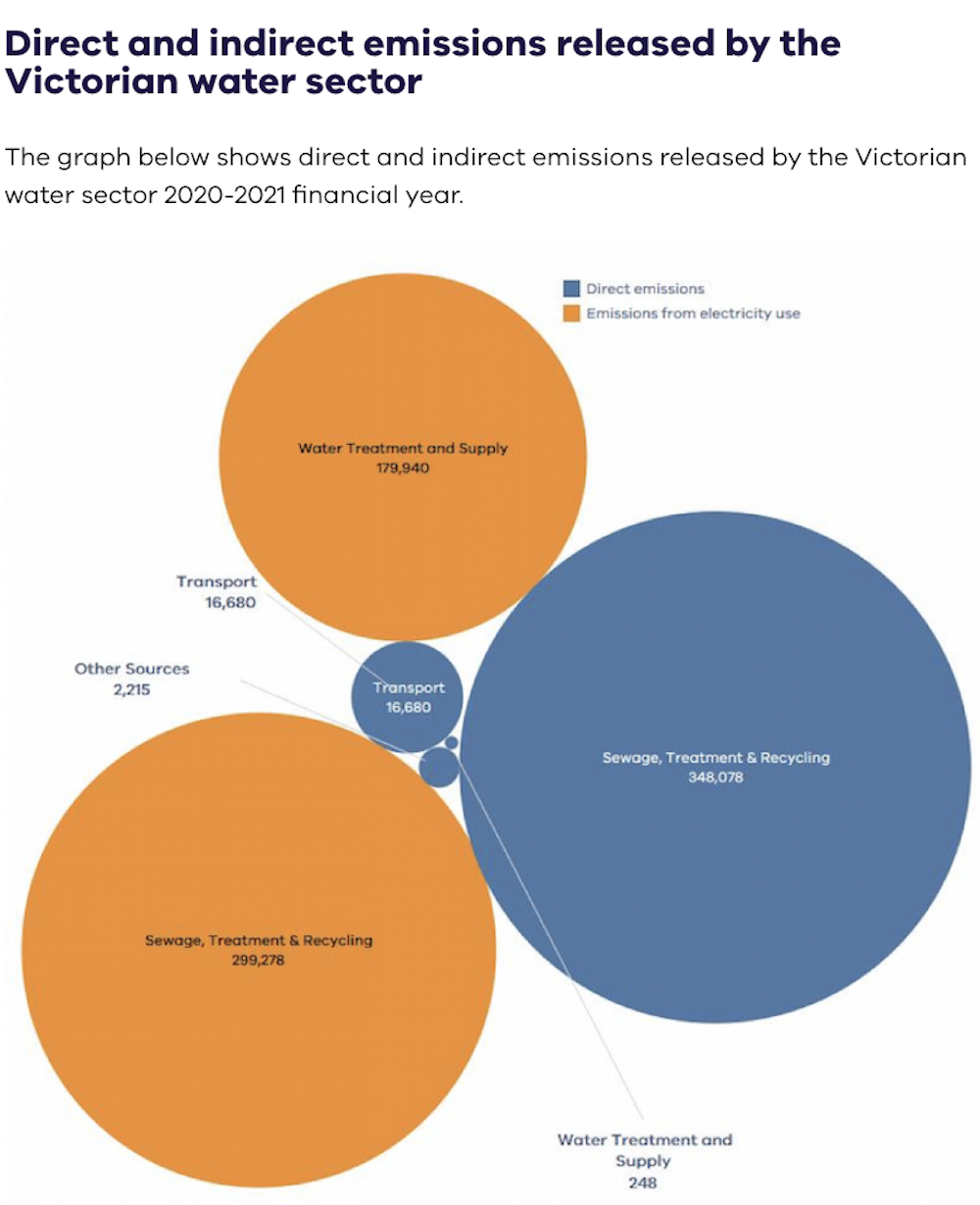
Graph showing the sources of stage 1 and 2 emissions from the Victorian water sector
Victorian Department of Energy, Environment and Climate Action, CC BY Our research has found a Melbourne-wide program to retrofit showerheads to next-generation technology could save 12-27 billion litres (GL) of water a year (about 6% of current use). The resulting energy savings would be 380-885GWh per year, cutting emissions by 98,000-226,000 tonnes. That equates to taking 21,000 to 49,000 cars off the roads. Customers would also save up to $160 a year on their bills. The full economic benefit to society is more than five times the cost of the program. Read more: How to maximise savings from your home solar system and slash your power bills Who influences water use? Everyone Helping customers adopt highly efficient showerheads could cut emissions at much lower cost than all other renewable energy investments water utilities are making. Most households don’t realise hot water systems account for around 24% of their total energy use. Their total energy use for water heating is larger as it includes appliances such as washing machines, dishwashers and kettles. An even larger percentage of household energy use is “water-related” if pool filtration, rainwater tank pumps and so on are included. Read more: Using electric water heaters to store renewable energy could do the work of 2 million home batteries – and save us billions We think only of the savings on water bills, but efficient water use also affects our power bills and emissions. But communicating the link isn’t easy. Showerhead manufacturers tell us they aren’t promoting efficient showerheads because they respond to demand. Water utilities don’t invest in them because it is a present cost for a future benefit – it doesn’t help them balance their budgets. And for policymakers it’s hard to celebrate the water and energy you don’t need to consume. The combined impact is lack of action on saving water to reduce emissions – even though it’s a great option. A ‘tragedy of the commons’ dilemma Without direct control or accountability by any one organisation, we face a “tragedy of the commons” – individuals overconsuming a shared resource at the wider expense of society. The limited resource today is the ability of our planet to process greenhouse gas emissions before they change our climate. The tragedy of the commons was used to describe externalities: costs borne by others that a decision-maker does not pay for. Examples include the future costs of increased flooding, more severe droughts and bushfires, and rising sea levels. If we fully considered the costs and benefits to consumers and society (rather than just costs to utilities), investment priorities would change towards “least cost to the community” solutions. Many water utilities will be carbon-neutral for scope 1 and 2 by 2025. This means they are at the global forefront of reducing emissions – but the water industry can do much more by tackling scope 3 emissions. Committing to a scope 3 reduction challenges a water company to move toward things it can only influence rather than control. So, does it pursue all possibilities, without knowing if it can cut emissions? Or does it take a conservative approach and commit to only scope 1 and 2 emissions? Reducing emissions from water use requires community, industry and government to act together. The stumbling block is decision-making and current legislation. A road runs along the top of the Thomson Dam wall Water utilities have focused on cutting their own emissions and costs, neglecting the much bigger gains to be had from changing water users’ behaviour. Simon Maddock/Shutterstock Read more: All-electric homes are better for your hip pocket and the planet. Here's how governments can help us get off gas So, what is the solution? First, we need to call out the problem. Second, we must find a way to ensure the reward for pursuing action is higher than the penalty for failure. A key to this will be highlighting how much cheaper and better many actions are that focus on scope 3 emissions, rather than solely “within business” strategies. We need to find solutions that are genuinely “least cost to community” rather than “least cost to individual business entities”. Third, as a “commons”, this challenge must be communicated beyond utilities and government to communities. There needs to be broad understanding of the benefits of new approaches and of the pitfalls of a “do nothing” approach. Big savings are up for grabs in the water industry. More broadly, all industries (from manufacturing to mining) need to consider scope 3 emissions from use of the products they sell. Authors: Steven Kenway, Research Group Leader, Water-Energy-Carbon, The University of Queensland

Read more https://theconversation.com/emissions-from-households-water-use-are-on-a-par-with-aviation-the-big-cuts-and-savings-they-can-make-are-being-neglected-221853

The Most Common Conveyor System Issues in Manufacturing

In modern manufacturing, conveyor systems play a central role in keeping production lines efficient, consistent, and cost-effective. When they operate...

How to Secure a Long-Term Rental in a Competitive Market

The rental market can be unpredictable and may present challenges if you’re not prepared. Initially, you might submit numerous applications and stil...

What Smart Investors Know About Real Estate

Many people think investing in property is just about buying a house and waiting for it to get expensive. While that can happen, the people who actual...

The Benefits of Seeking Help for Anxiety and Stress

Anxiety and stress have become common experiences in today’s fast-paced world, affecting people across all ages and lifestyles. From work pressures ...

How to Make the Most of Fashion Wholesale Options for Your Brand

If you want to grow a fashion brand without constantly reinventing the wheel, wholesale can be one of the smartest ways to scale. The key is knowing h...

How to Add Value to Your Home Before Selling

Selling a home is not just about putting up a sign and waiting for offers. It is about presenting a property that buyers instantly connect with and ar...

How Outdoor Play Enhances Learning and Wellbeing

You don’t need to be an expert to conclude that play is an essential part of growing up. When children aren’t restricted and kept indoors, they de...

How to Build Passive Income Through Real Estate

Building passive income is one of the most effective ways to create long-term financial security. While there are many investment opportunities availa...

DIY Guide to Replacing Small Parts in Your Laundry Machine

Finding a puddle or a broken washer is frustrating, but you don’t always need a professional. Many common issues are caused by tiny parts that are c...

Best Practices for Managing Your Warehouse Partner Relationships

Your warehouse partner is an important part of your business. They sit in the middle of your promises to customers. Yet, when they deliver what’s pr...

Benefits of Solar-Based Water Circulation Systems

Imagine your water system running all day without touching your electricity bill. No noise, no heavy cables, no stress when prices go up. Fantastic, r...

Benefits of Using an Outrigger Crane for Complex Lifts

Complex lifts aren’t the kind of jobs you improvise. You’re dealing with awkward shapes, serious weight, and sites that never seem designed for wh...

A Beginner's Guide to Website Ranking

If you have a website, you probably want people to find it. But building a website alone does not guarantee visitors. Millions of websites compete for...

How to Prepare Your Home for Holiday Guests

Welcoming holiday guests into your home is one of life’s great pleasures. Whether it’s Christmas lunch, a long weekend reunion, or interstate re...

Colour Palettes That Work Beautifully for Christmas

Christmas styling has evolved well beyond the traditional red-and-green formula. While classic tones will always have their place, today’s festive...

Interior Decorating Mistakes to Avoid

Interior decorating has the power to completely transform how a home feels, functions and flows. Done well, it elevates everyday living and creates ...

How Chiropractic Can Help with Sciatica Treatment

Sciatica can be one of the most frustrating and disruptive forms of back pain. Characterised by pain that radiates from the lower back through the h...

Common Vulnerabilities Found During Australian Pen Tests

Penetration testing has become a critical component of modern cyber security strategy across Australia. From fast-growing SaaS startups to establish...