Big businesses will this year have to report their environmental impacts – but this alone won’t drive change
- Written by Martina Linnenluecke, Professor of Environmental Finance at UTS Business School, University of Technology Sydney
This year, large businesses in Australia will likely have to begin reporting their environmental impacts, climate risks and climate opportunities.
The final draft of Australia’s new mandatory climate disclosure laws are due any day now, following consultation.
These laws are meant to increase transparency about how exposed companies are to risks from climate change, and will require companies to look into and share what impact their activities have on the environment. This, the government hopes, will accelerate change in the corporate sector.
But will it help lower emissions? I don’t think so. We don’t have a carbon tax, which means many companies have no financial incentive to actually lower their emissions. (The strengthened Safeguard Mechanism applies to about 220 big emitters, but they can simply buy offsets and avoid harder change.)
By themselves, climate disclosures will not trigger the change we need.

Why are these laws being proposed?
In June 2023, the newly formed International Sustainability Standards Board (ISSB) released a set of sustainability standards and climate disclosures.
These standards have influenced Australia’s draft laws.
In planning mandatory corporate disclosures on climate and environment, Australia is following similar efforts overseas. In 2022, the United Kingdom began to roll out mandatory reporting on climate risks and opportunities for the largest UK companies (those with more than 500 employees and A$970 million in turnover).
Once the Australian legislation comes into effect, it will require large companies and asset owners to publish their climate-related risks and opportunities.
In the draft legislation, companies would have to evaluate and report on their direct and indirect greenhouse gas emissions from sources they own or control and from sources such as purchased electricity.
From July this year, the laws would require disclosures from companies with 500 employees, $1 billion in assets or $500 million in revenue. Over time, this would expand to medium-sized companies. From July 2027, companies with 100 employees, $25 million in assets or $50 million in revenue would have to share this information.
Sustainability reports will be subject to external auditing and directors would be personally liable for the accuracy of the disclosures – with one major exception.
For many Australian companies, it’s already proving too hard to account for Scope 3 emissions – the greenhouse gas emissions upstream and downstream in a company’s operations, such as the emissions from gas burned after we export it.
As these emissions occur outside a company’s direct control, accounting for them is a complex task costing time and money. Only some companies have voluntarily started to report their Scope 3 emissions in anticipation of future regulatory change.
The draft legislation exempts companies from the need to report Scope 3 emissions for their first year of reporting and proposes limited liability for these disclosures for a fixed three-year period.
This means companies can simply come up with a best-guess estimate, rather than reporting their actual Scope 3 emissions, which can make up 65–95% of their overall emissions. In some sectors, such as the integrated oil and gas industry, Scope 3 emissions can comprise more than six times the sum of Scope 1 and 2 emissions. Woolworths’ Scope 3 emissions account for 94% of emissions.
What are disclosure laws meant to do?
You can see why the government is introducing these laws. To nudge corporate Australia towards a greener future, it helps to know what impact your business has – and what risks it is exposed to. It will also be useful for investors.
But it will not drive rapid decarbonisation. Critics have pointed out that reporting and disclosure alone will not lead to a shift away from carbon-intensive business operations. Disclosures give the appearance of action rather than real action. If there are no stronger policies accompanying, disclosures act as window dressing for global financial markets.
Our existing policies do not require organisations to make genuine changes in terms of their emissions. Unless organisations abandon their reliance on fossil fuels and substantially decarbonise their operations, we are simply not going to get any change.
These laws also come with a cost. The regulatory burden and compliance costs for Australian companies will not be trivial, especially for companies which haven’t reported on climate or sustainability before.
We already have a shortage of trained reporting, auditing and assurance professionals able to do climate and environment work, following years of minimal action on climate change in Australia. To fix this will require substantial and rapid upskilling.
These costs should give us pause. It’s worth thinking through how much emphasis we place on disclosures to drive change versus policies that would actually drive change, such as mandating that large companies have to reduce their direct emissions 10% a year.
Australian companies can only benefit from these laws if they use the data unearthed by disclosure to rethink how they operate, invest and green their supply chains towards sustainability. This may mean investing in clean technology, shifting from polluting transport fleets to electric, or reconsidering how they produce their products.
And to do that, of course, companies will need to see supportive government policies.
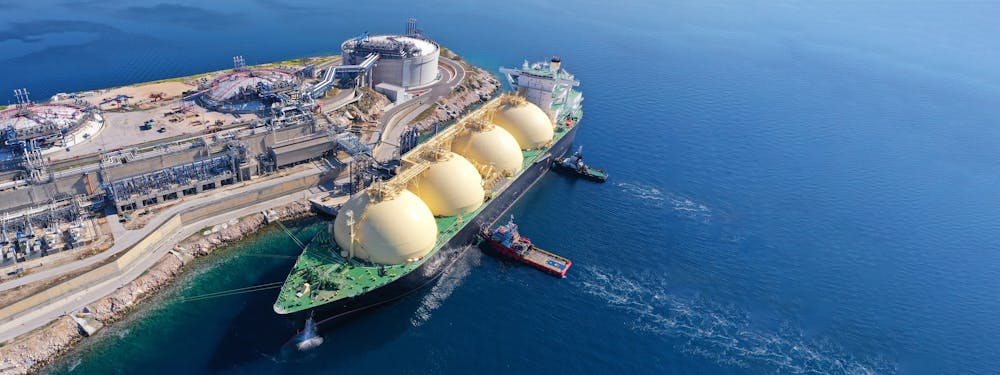 Should gas exporters track the scope 3 emissions when their product is burned for power overseas?
Aerial-motion/Shutterstock
Should gas exporters track the scope 3 emissions when their product is burned for power overseas?
Aerial-motion/Shutterstock
These laws can be useful – but not alone
Assuming the laws pass, big companies will begin assessing and reporting their emissions and environmental impact from July this year.
In doing so, Australia will align itself with international efforts for more transparency. Requiring companies to scrutinise and disclose their environmental impact will give corporate leaders the data needed to look for greener ways to run their business. But this assumes they have the interest and time to do so.
This isn’t a quick fix for climate change. To be worth the cost, Australia will need to link climate-related financial disclosures to clear policies designed to bring down emissions.
Disclosure policies produce disclosures. Emission reduction policies produce emission reductions.
Authors: Martina Linnenluecke, Professor of Environmental Finance at UTS Business School, University of Technology Sydney