

constructing the world’s tallest buildings creates high emissions
- Written by: James Helal, Assistant Dean (Sustainability), The University of Melbourne
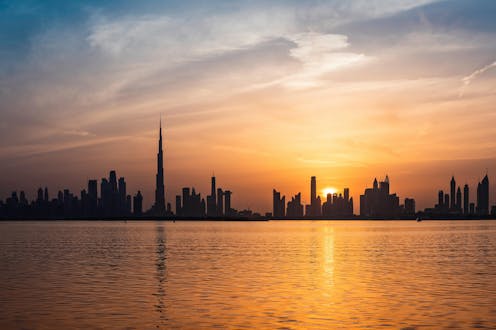
Since ancient times, people have built structures that reach for the skies – from the steep spires of medieval towers to the grand domes of ancient cathedrals and mosques. Today the quest is to build the world’s tallest skyscrapers, such as Burj Khalifa in Dubai. Soaring above the rest, its decorative spire accounts for 29% of its total height – 4,000 tonnes of structural steel just for aesthetics.
Burj Khalifa isn’t unique in this respect. “Vanity height” – the extra height from a skyscraper’s highest occupied floor to its architectural top – shapes city skylines around the globe.
In a world where environmental concerns are paramount, is such architectural vanity justifiable?
Our research shows the pursuit of “vanity height” makes this a pressing issue. Even a modest spire increases the carbon emissions from the production of materials for a skyscraper’s structure by about 15%.
Building tall is not just about architecture; it’s big business. Being ranked among the world’s tallest buildings can transform an otherwise ordinary skyscraper into a globally recognised icon. This creates an incentive to add vanity height.
Our proposed solution is to rethink the global standard for ranking the world’s tallest buildings.

A matter of measurement
The way we measure the height of skyscrapers is at the heart of this issue. The Council on Tall Buildings and Urban Habitat (CTBUH) is the ultimate authority on skyscraper heights. It bestows the coveted title of “world’s tallest building”.
Historically, there wasn’t much debate over skyscraper heights as early buildings typically had flat roofs. The first significant issue arose in 1929 when the Chrysler Building in New York City installed a last-minute spire, securing the self-proclaimed title of the “world’s tallest building” over the Bank of Manhattan.
The Council on Tall Buildings and Urban Habitat, founded in 1969, established criteria in the early 1970s that included decorative spires. This formalised a practice that would be contentious time and again.
A landmark moment in the council’s history was the 1998 showdown between Petronas Towers in Kuala Lumpur and Sears Tower in Chicago, now known as Willis Tower. Imagine these two giants side by side: the pointy spires of the Petronas Towers, with 88 floors, and the flat-topped Sears Tower, with 108 floors. But the council uses “height to architectural top”, which includes decorative spires. As a result, it declared Petronas Towers the tallest building in the world, outstripping Sears Tower for the title.
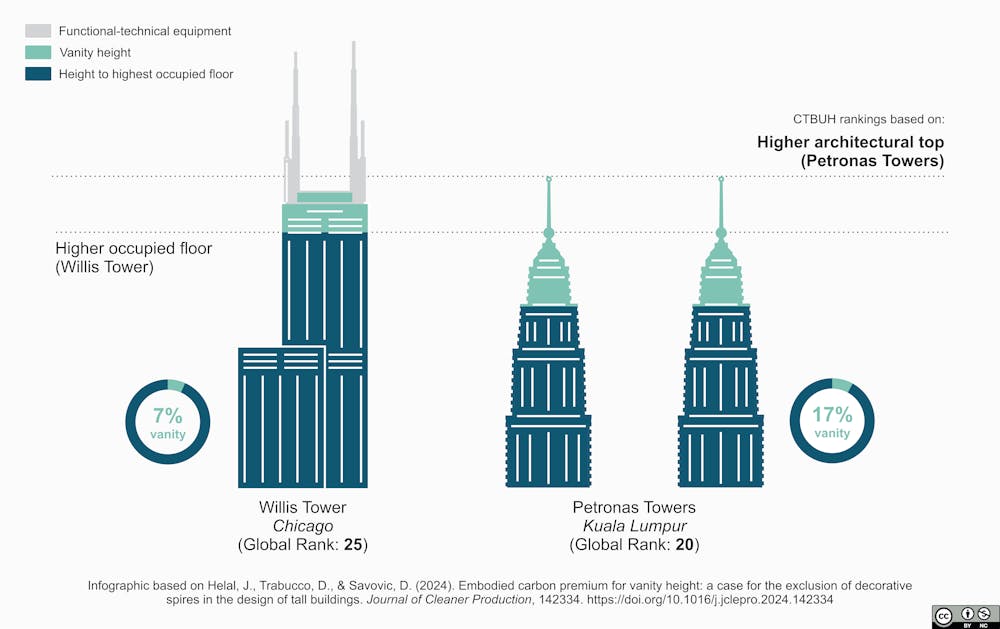 An illustration of skyscraper height categories through Willis Tower and Petronas Towers.
Adapted from Helal et al. (2024), using data from the CTBUH Skyscraper Center, CC BY
An illustration of skyscraper height categories through Willis Tower and Petronas Towers.
Adapted from Helal et al. (2024), using data from the CTBUH Skyscraper Center, CC BY
Back in Chicago, this was not a popular verdict. Picture the folks on the 108th floor of the Sears Tower looking down at the celebrations on the 88th floor of the Petronas Towers, perplexed by how those extra metres of spire made the difference. The decision even made its way into popular culture with Jay Leno joking on The Tonight Show:
All the council does is, once every ten years, they look up in the sky and say, ‘Yep, that’s the tallest!’
Even if extra height does not secure a place among the world’s top 100 tallest buildings, height still matters. Skyscrapers gain valuable prestige as the tallest in their city, region or country, or by earning use-specific accolades like “world’s highest restaurant” or “world’s highest religious space”.
The hidden cost of vanity height
Sixty years ago, the renowned Bangladeshi-American architect and engineer Fazlur Rahman Khan demonstrated the exponential impact of a building’s height on the amount of material needed to build it. Indeed, doubling the height of a building could triple the structural materials required. A stronger structure, using more materials, is needed to withstand greater wind and earthquake loads on taller buildings.
This means there’s a large “embodied carbon premium for height”. This premium is the additional greenhouse gas emissions from producing the extra materials needed for a taller skyscraper.
A telling example from our study shows that even a modest spire, making up 16% of a building’s total height, can increase the embodied carbon of a 90-storey skyscraper by 14%. In maximising the building’s height for aesthetic, status or financial reasons, designers are prioritising these concerns over environmental sustainability.
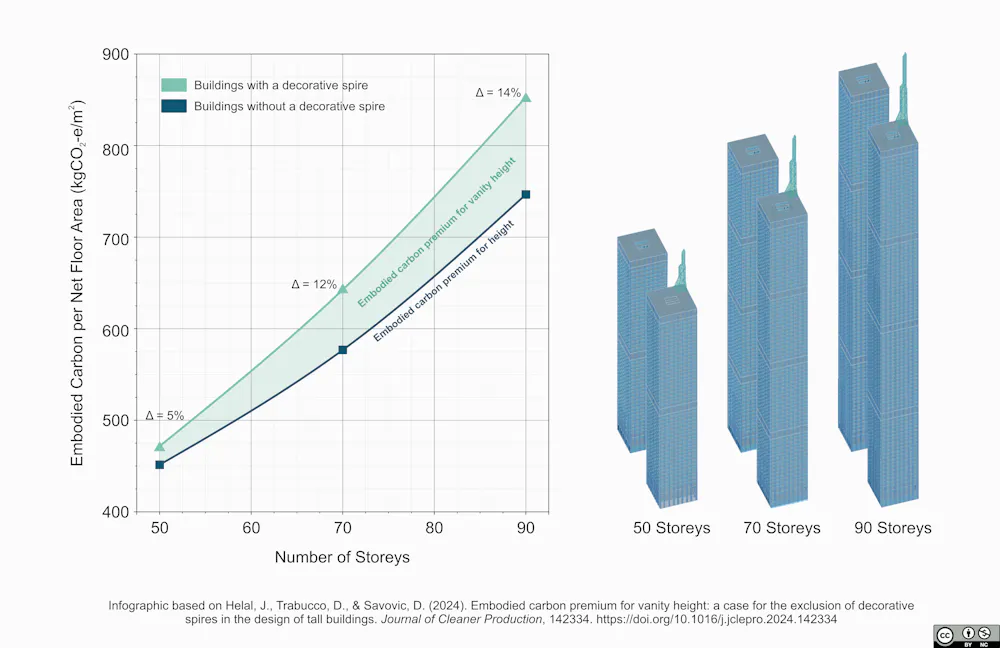 The exponential impact of vanity height on the embodied carbon of skyscrapers.
Adapted from Helal et al. (2024), CC BY
The exponential impact of vanity height on the embodied carbon of skyscrapers.
Adapted from Helal et al. (2024), CC BY
We took a detailed look at Dubai, a city celebrated for its towering skyline. We found the collective vanity height of its 100 tallest buildings adds up to more than 3.5 kilometres.
We estimate these decorative elements contributed at least 300,000 tonnes of greenhouse gas emissions. That’s both the direct embodied carbon of the spires and, much more importantly, the embodied carbon added by reinforcing the buildings to support the extra structural loads.
To put this impact into perspective, 300,000 tonnes of emissions is equivalent to the embodied carbon associated with building about 2,400 average Australian homes. It’s a hefty price to pay, simply to adorn 100 skyscrapers with pointy hats that inflate their heights and status in global rankings.
Redefine heights to set more sustainable standards
The Council on Tall Buildings and Urban Habitat, which champions the motto “Towards Sustainable Vertical Urbanism”, has a crucial opportunity to lead change. What if it revised how we measure and rank tall buildings to better reflect this commitment to sustainability?
In light of our findings, we call on the council to remove the incentive for vanity height. We propose the “height to highest occupied floor” be adopted as the main standard for ranking skyscrapers by height.
Such a change may be controversial. Burj Khalifa would keep its title as the world’s tallest, but One World Trade Center with a vanity height of 155 metres, for example, would drop nine places, losing its status as the tallest in North America.
However, for every building that falls in the rankings, others will rise. Our research shows there are more winners than losers among the 100 tallest buildings worldwide. So support for this change could outweigh resistance.
 The impact of the proposed change in skyscraper ranking criteria on the world’s 100 tallest buildings as of May 2024.
Adapted from Helal et al. (2024), using data from the CTBUH Skyscraper Center, CC BY
The impact of the proposed change in skyscraper ranking criteria on the world’s 100 tallest buildings as of May 2024.
Adapted from Helal et al. (2024), using data from the CTBUH Skyscraper Center, CC BY
Cities continue to grow and environmental challenges are becoming more acute. The need to re-evaluate our approach to architectural design is becoming ever more pressing. In particular, vanity architecture features like excessive decorative spires burden not only our skylines but also our environment.
Ultimately, we’re all better off if we change how we rank the world’s tallest buildings.
Authors: James Helal, Assistant Dean (Sustainability), The University of Melbourne


















