How Fraser Anning was elected to the Senate – and what the major parties can do to keep extremists out
- Written by: Adrian Beaumont, Honorary Associate, School of Mathematics and Statistics, University of Melbourne
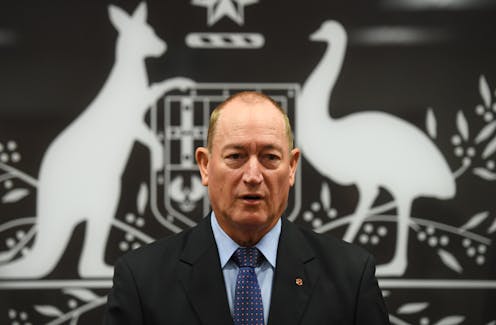
In the wake of the far-right terrorist atrocity in Christchurch on March 15, there has been much condemnation of independent senator Fraser Anning’s anti-Muslim comments. Anning won just 19 personal votes below the line, so how was he fairly elected?
In the Senate, voters can either vote “above the line” or “below the line”. Above the line votes will go to the party’s candidates in the order they are placed on the ballot paper. Below the line votes are personal votes for a candidate.
At normal federal elections, six senators per state are elected, and a quota is one-seventh of the vote, or 14.3%. As the 2016 election was a “double dissolution”, where all senators were up for election, 12 senators per state were elected, and the quota was reduced to one-thirteenth of the vote, or 7.7%.
Electoral reforms were implemented at the 2016 election. Voters were asked to number at least six boxes above the line, though a “1” only vote would still be accepted. The effect was that voters would direct their own preferences once their most preferred party was excluded from the count. Previously, parties controlled their voters’ preferences, and still do in Victoria and WA, leading to bizarre results.
Voting below the line was also made easier. Voters were asked to number at least 12 boxes, though only six numbers were required for a formal vote. Previously, every box below the line needed to be numbered.
In the Senate system, any candidate who has a quota is immediately elected, and their surplus is distributed. Major parties elect multiple senators by this method, as almost all of the top candidate’s surplus goes to the second candidate, and so on.
When there are no more surpluses to distribute, candidates are excluded from the count starting with the candidate with the smallest number of votes, and their preferences distributed. During this process, candidates that reach quota are elected, and their surpluses distributed.
With the current Senate system’s semi-optional preferential voting, there will often be two or more candidates short of a quota with all preferences finished. In this case, the candidates further ahead are elected.
How this applies to Anning
The whole One Nation ticket had over 250,000 votes (9.2% or 1.19 quotas) in the Queensland Senate. Over 229,000 of these votes were above the line ticket votes, and virtually all the rest were personal votes for lead candidate Pauline Hanson.
Hanson was immediately elected, and her surplus was passed on to One Nation’s second candidate, Malcolm Roberts, who had just 77 below the line votes. In the race for the last seat, the Liberal Democrats started the preference phase of the count with 0.37 quotas, and Roberts (0.19 quotas) was also behind Nick Xenophon Team (0.27 quotas), Family First (0.25 quotas), Katter’s Australian Party (0.23 quotas) and Glenn Lazarus Team (0.22 quotas).
With nine candidates left, two of whom were certain to be elected (Labor’s Chris Ketter and the LNP’s Barry O'Sullivan), Roberts already had 0.45 quotas, thanks to voter-directed preferences from Australian Liberty Alliance (0.14 quotas) and the Shooters, Fishers and Farmers (0.14 quotas). At this point, Roberts was tied for the lead with Family First from the seven contenders for the last seat, and ahead of everyone else.
With assistance from Glenn Lazarus Team and Katter’s Australian Party preferences, Roberts defeated Family First for the last seat by 0.78 quotas to 0.69.
Read more: Final Senate results: 30 Coalition, 26 Labor, 9 Greens, 4 One Nation, 3 NXT, 4 Others
When Roberts was disqualified by the High Court in October 2017 over Section 44 issues, he was effectively replaced in the count by Fraser Anning, One Nation’s third candidate. That is how Anning won his seat despite earning just 19 personal below the line votes.
Although the new Senate system makes it easier to vote below the line, above the line votes were still over 90% of all formal Senate votes in all jurisdictions except Tasmania and the ACT at the 2016 election, according to analyst Kevin Bonham. Only one candidate was elected against the party ordering of candidates on personal below the line votes: Labor’s Lisa Singh in Tasmania.
Read more: Tasmanian Senate result: 5 Labor, 4 Liberals, 2 Greens, 1 Lambie
Anning’s 19 personal votes and Roberts’ 77 are far fewer than those received by any other winning candidate in Queensland. The other 11 winners (five LNP, four Labor, one Green and Pauline Hanson) all received at least 1,000 personal votes. Prior to the election, there was no interest in any One Nation candidate other than Hanson.
Can the major parties prevent the election of extreme candidates?
In Queensland 2016, the major parties were not responsible for Roberts’ election. Both Labor’s fourth candidate, Ketter, and the LNP’s fifth candidate, O'Sullivan, started the preference phase of the count well short of a quota. O'Sullivan eventually made quota, but Ketter was elected with 0.97 quotas. O'Sullivan’s tiny surplus assisted Family First rather than Roberts.
In general, the total vote for the major parties has been declining in the past two decades, and as a result, their influence on who wins has been reduced. The combined share for the two major parties in the Queensland 2016 Senate was just 61.7%. By contrast, the last time One Nation was strong, gaining 10.0% of the Queensland Senate vote in 2001, the total major party vote was 75.1%.
In the lower house, Labor will put One Nation behind the Coalition on its how to vote cards, but there has been some infighting within the Coalition over whether to return this favour.
On March 28, Scott Morrison announced that the Liberals would preference Labor ahead of One Nation in all seats; this applies only to the Liberals, not the Nationals, and it is not clear what the Queensland LNP will do. There had been pressure on the Liberals following revelations that One Nation solicited donations from the US National Rifle Association.
Read more: View from The Hill: James Ashby rocks a few boats, including his own
One Nation won one seat at the 2017 Queensland election because the LNP preferenced it above Labor, so putting One Nation below Labor will assist Labor in any seats where One Nation is ahead of the Liberals.
In the Senate, neither major party is likely to put the other major party in its top six preferences for above the line voters. It is likely that, as far as vote recommendations go, both major parties will treat the other major party the same as One Nation in the Senate.
Even if the major parties placed the other major party in the top six preferences on their how to vote material, the follow the card rate was low in 2016. According to Bonham, about 30% of Coalition voters in the mainland states followed the card, 14% of Labor voters and 10% of Greens voters. No other party had a follow the card rate above 10%.
Coalition wins majority at NSW election
The ABC has called all 93 lower house seats for the March 23 New South Wales election. The Coalition won 48 of the 93 seats (down six since the 2015 election), Labor won 36 seats (up two), the Greens three (steady), the Shooters three (up three) and independents three (up one). The Coalition will have a three-seat majority.
Seat changes are compared with the 2015 election results, and do not include Coalition losses in the Wagga Wagga and Orange byelections. If measured against the pre-election parliament, the Coalition lost four seats.
Brexit delayed until at least April 12
On March 21, a European leaders’ summit was held. Leaders of the 27 EU nations, not including the UK, agreed to delay the date of Brexit until April 12 (originally March 29). If UK Prime Minister Theresa May’s deal passes the House of Commons, Brexit would be delayed until May 22 to allow necessary legislation to pass.
European parliament elections will be held from May 23-26. If the UK were to participate in these elections, a longer extension could be given, but the UK must inform the European Commission of its intent to participate by April 12, hence the new deadline.
I wrote for The Poll Bludger about Brexit on March 22. House of Commons Speaker John Bercow has ruled that May’s deal cannot be brought back to the House, but there is a workaround – if May had the votes. May’s deal was defeated by 149 votes on March 12, after a record 230-vote loss on January 15.
Authors: Adrian Beaumont, Honorary Associate, School of Mathematics and Statistics, University of Melbourne