

Pay-by-weight airfares are an ethical minefield. We asked travellers what they actually think
- Written by: Denis Tolkach, Senior Lecturer, James Cook University
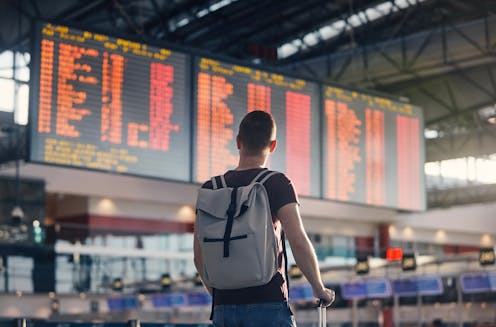
Imagine checking in for a flight with your two teenage children. At the counter, you are told that your youngest teenager’s suitcase is two kilograms over the limit. You get slapped with a $75 penalty for their excess luggage.
This penalty feels arbitrary and unfair. The youngest weighs about 45 kg, and their luggage weighs 25 kg, making their total payload on the flight 70 kg.
Their older sibling, on the other hand, weighs 65 kg, and has brought 23 kg of luggage to check in. Their total weight is higher – 88 kg – yet they receive no penalty.
Obviously, things aren’t that simple. Charging passengers based on their weight is highly controversial for many reasons. But that hasn’t stopped some airlines experimenting with such policies.
Imagine checking in for your flight only to have the staff tell you to purchase an extra seat as you are a plus-size passenger. You feel discriminated against because you are using the same service as other passengers and your weight is beyond your control.
But despite the lived experience of many and hot debate in the media, there has not been a formal study into what passengers themselves think about this matter.
Our recently published research examined air passengers’ views on alternative airfare policies to understand whether the public finds them acceptable and what ethical considerations determine their views.
Though we found a range of ethical contradictions, most travellers were guided by self-interest.
Read more: Even after the government's aviation crackdown, Australia will lag behind on flyers' rights
A controversial but important topic
The issue of whether airlines should weigh passengers is an ethical minefield with no easy answers.
Despite its sensitivity, the aviation industry can’t ignore passenger weight. Airlines intermittently undertake passenger weight surveys as they need to accurately calculate payload to ensure flight safety and estimate fuel consumption.
The evidence shows passengers are getting heavier. Airlines including the now-defunct Samoa Air and Hawaiian Airlines have taken things one step further and experimented with weighing passengers regularly.
Samoa Air, for example, became the first airline to introduce a “pay-as-you-weigh” policy, where the cost of your ticket was directly proportional to the combined weight of you and your luggage.
In contrast, Canada has now long had a “one person, one fare” policy. It is prohibited and deemed discriminatory to force passengers living with a disability to purchase a second seat for themselves if they require one, including those with functional disability due to obesity.
To complicate matters further, the issue of passenger and luggage weight is not only ethical and financial, but also environmental. More weight on an aircraft leads to more jet fuel being burned and more carbon emissions.
About 5% of human-driven climate change can be attributed to aviation, and the industry faces enormous pressure to reduce fuel consumption while it waits for low carbon substitutes to become available.
What do passengers actually think?
To get a better sense of how the public actually feels about this issue, we surveyed 1,012 US travellers of different weights, presenting them with three alternatives:
- standard policy – currently the most widely used policy with passengers paying a standard price, irrespective of their weight
- threshold policy – passengers are penalised if they are over a threshold weight
- unit of body weight policy – passengers pay a personalised price based on their own body weight, per each pound.
The standard policy was the most acceptable for participants of differing weight, although the heavier the passenger, the more they preferred the standard policy. This can be partially explained by status quo bias. Generally, people are likely to choose a familiar answer.
The threshold policy was the least acceptable. This policy was seen to violate established social norms and be generally less fair.
The unit of body weight policy was preferred to the threshold policy, although participants raised concerns about whether it would be accepted by society.
Perhaps unsurprisingly, we found that self-interest played a clear role in determining whether respondents considered a policy acceptable.
Younger, male, financially well-off travellers with lower personal weight generally found the alternative policies more acceptable.
An ethical conflict
Alternative airfare policies that are based on passenger weight bring environmental and ethical concerns into conflict. Obviously, the effect isn’t from any one traveller, in particular, but averages over the entire industry.
Interestingly, respondents that were more concerned about the environment – “ecocentric” – preferred air fare policies that would reduce the carbon emissions. This made them more open to the controversial alternatives.
While the threshold policy was clearly rejected by many respondents as discriminatory, environmental concern played a role in the level of acceptance of the unit of body weight policy.
It’s important to apply a critical lens here. These ecocentric travellers were also generally younger and had lower personal weights, so many would benefit from the alternative policies financially.
For policymakers overall, our study suggests when it comes to controversial ticketing policies, the public is more likely to be swayed by self-interest than anything else.
Authors: Denis Tolkach, Senior Lecturer, James Cook University


















