why urban mining’s time has come
- Written by Michael Odei Erdiaw-Kwasie, Lecturer in Sustainability| Business and Accounting Discipline, Charles Darwin University
Pollution and waste, climate change and biodiversity loss are creating a triple planetary crisis. In response, UN Environment Programme executive director Inger Andersen has called for waste to be redefined as a valuable resource instead of a problem. That’s what urban mining does.
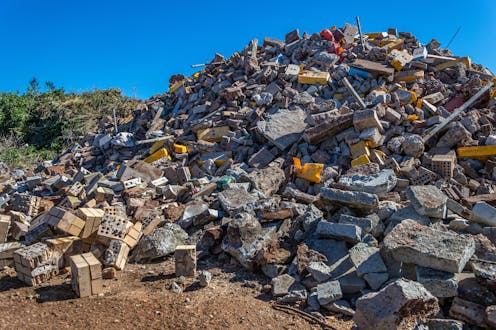
We commonly think of mining as drilling or digging into the earth to extract precious resources. Urban mining recovers these materials from waste. It can come from buildings, infrastructure and obsolete products.
An urban mine, then, is the stock of precious metals or materials in the waste cities produce. In particular, electronic waste, or e‑waste, has higher concentrations of precious metals than many mined ores. Yet the UN Global E‑waste Monitor estimates US$62 billion worth of recoverable resources was discarded as e‑waste in 2022.
Urban mining can recover these “hidden” resources in cities around the world. It offers sustainable solutions to the problems of resource scarcity and waste management. And it happens in the very cities that are centres of overconsumption and hotspots for the greenhouse gas emissions driving climate change.
What sort of waste can be mined?
Materials such as concrete, pipes, bricks, roofing materials, reinforcements and e‑waste can be recovered for reuse. Urban waste can be “mined” for metals such as gold, steel, copper, zinc, aluminium, cobalt and lithium, as well as glass and plastic. Mechanical or chemical treatments are used to retrieve these metals and materials.
Simply disposing of this waste has high financial and environmental costs. In Australia, about 10% of waste is hazardous. Landfill costs are soaring as cities run out of space to discard their waste.
The extent of this fast-growing problem is driving the growth of urban mining around the world. We are then salvaging materials whose supply is finite, while reducing the impacts of waste disposal.
What’s happening globally?
In Europe, the focus is largely on construction and demolition waste. Europe produces 450 million to 500 million tonnes of this waste each year – more than a third of all the region’s waste. Through its urban mining strategy, the European Commission aims to increase the recovery of non-hazardous construction and demolition waste to at least 70% across member countries by 2030.
In Asia, urban mining has focused on e‑waste. However, the region recovers only about 12% of its e‑waste stock. Rates of e‑waste recycling vary greatly: 20% for East Asia, 1% for South Asia, and virtually zero for South-East Asia. China, Japan and South Korea are leading the way in Asia.
Australia is on the right track. Our recovery rate for construction and demolition materials climbed to 80% by 2022 — the highest among all types of waste streams. However, we recover only about a third of the value of materials in our e-waste.
Africa has also recognised the growing value of urban mining resources. Regional initiatives include the Nairobi Declaration on e‑waste, the Durban Declaration on e‑Waste Management in Africa and the Abuja Platform on e‑Waste.
Urban mining solves many problems
The OECD forecasts that global materials demand will almost double from 89 billion tonnes in 2019 to 167 billion tonnes in 2060. The United Nations’ Global Waste Management Outlook 2024 shows the amount of waste and costs of managing it are soaring too. It’s estimated the world will have 82 million tonnes of e‑waste to deal with by 2030.
These trends mean urban mining is becoming ever more relevant and important.
Urban mining also helps cut greenhouse gas emissions. Unlocking resources near where they are needed reduces transport costs and emissions. Urban mining also provides resource independence and creates employment.
In addition, increasing recovery and recycling rates reduce the pressure on finite natural resources.
Urban mining underpins circular economy alternatives such as the “deposit and return” schemes that give people financial incentives to return e‑waste and containers for recycling in cities such as Singapore, Sydney, Darwin and San Francisco. By 2030, San Francisco aims to halve disposal to landfill or incineration and cut solid waste generation by 15%.
What more needs to be done?
Governments have a role to play by adopting and enforcing policies, laws and regulations that encourage recycling through urban mining instead of sending waste to landfill. European Union laws, for example, mandate increased recycling targets for municipal waste overall and for packaging waste, including 80% for ferrous metals and 60% for aluminium.
In Australia, 2019 legislation prohibits landfills from accepting anything with a plug, battery or cord. Anything with a plug is designated as e-waste.
Product design is an important consideration. A designer must balance a product’s efficiency with making it easy to recycle. Products with greater efficiency and easy-to-recycle parts are more likely to use less energy, lead to less waste and hence less natural resource extraction.
Our urban mining research documents a more sustainable approach to product design. Increasing product stewardship initiatives are expected to encourage better product design and standards that promote reuse and recycling, producer responsibility and changes in consumer behaviour.
Good information about the available resources is essential too. The Urban Mine Platform, ProSUM and Waste and Resource Recovery Data Hub collect data on e‑waste, end-of-life vehicles, batteries and building and mining waste. These centralised databases allow easy access to data on the sources, stocks, flows and treatment of waste.
Traditional mining is not the only method for extracting raw materials for the green transition. Waste is set to be increasingly recycled, reducing demand for virgin materials. A truly circular economy can become a reality if governments develop and apply an urban mining agenda.
Authors: Michael Odei Erdiaw-Kwasie, Lecturer in Sustainability| Business and Accounting Discipline, Charles Darwin University