

Building companies feel they must sacrifice quality for profits, but it doesn’t have to be this way
- Written by: Kerry London, Deputy Vice-Chancellor of Research, Torrens University Australia
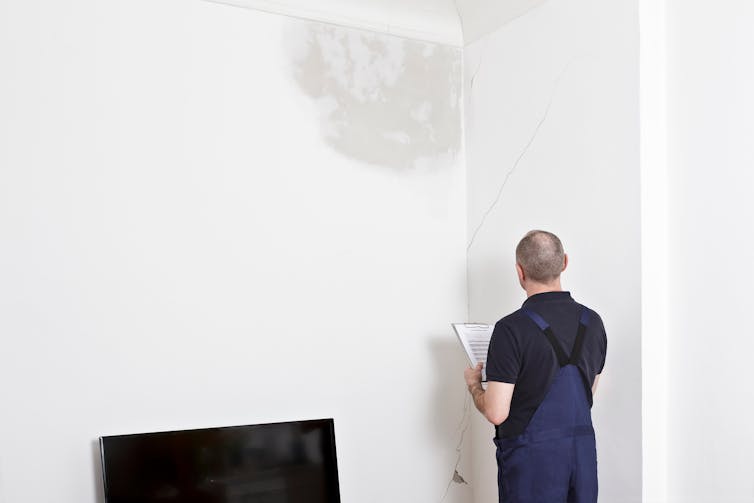
The Australian construction industry has long been facing a crisis of serious defects in apartment buildings. In the past, alarming incidents such as the Sydney Opal Tower evacuation and the Melbourne Lacrosse fire signalled systemic problems in construction.
The same problem persists today. One recent report shows serious defects in apartment buildings in New South Wales have more than doubled between 2021 and 2023.
As the Albanese government fast-tracks its five-year plan to build 1.2 million dwellings, this number will likely worsen.
We’ve researched the pressures the construction industry feels and how that can result in unsafe apartments, and what can be done to make housing like this better for everyone.
Why are we in this situation?
Serious defects endanger lives, cost building and insurance firms millions of dollars, and put pressure on regulators. Typical responses involve increased regulation, but the lack of change in apartment quality shows increased regulation is not enough. Behavioural and cultural changes are needed.
We found the poor quality of apartment buildings is often the result of deeply entrenched patterns of unprofessional behaviour across the industry. These often arise as professionals face pressures to cut costs in an industry notorious for its low profit margin.
We also found this pressure is exacerbated by aggressive competition, work overload, exploitation and a toxic culture.
As pressures mount, professionals’ decision-making becomes increasingly fraught. For example, many professionals we interviewed largely believe they must choose between profit and quality.
There are no simple answers to this age-old conundrum. However, our study shows a way forward.
What did we find?
Our three-year study funded by the Australian Research Council is the first in Australia to extensively investigate 12 building professions struggling to navigate and resolve this perceived dilemma.
Teams from four Australian universities conducted desktop reviews, analysed professional codes of conduct, interviewed 53 professionals and conducted six focus group discussions. After two years of analysis and model development, we published our industry technical report and presented our findings to practitioners in NSW and Queensland.
We have empirical evidence that shows profitability and quality do not have to be mutually exclusive. We have uncovered powerful, innovative but ad hoc strategies showing businesses can reconcile both.
One builder we profiled, a multinational company and a market leader in apartment construction, took a pioneering approach to this dilemma.
For many years, the company’s strategy was to build as quickly and cheaply as possible to save money. However, these savings were ultimately lost because they found they had “[…] made some money at the time, but we basically spent it all fixing things that we didn’t build that well”.
The company re-examined its business model and developed a new strategy that reconciled profitability, quality and professional behaviours.
The company analysed where the majority of their defects arose from and there were five key areas including:
balcony waterproofing
shower construction and waterproofing
fire wall installations
penetrations through fire walls
brick masonry construction.
They then built prototypes of high quality construction for each of these typical building elements. They found their prototypes addressed defects while also integrating different technical standards.
The company then informed their clients, subcontractors and suppliers that “this is how we will build from now on”. Over time, it became apparent their strategy supported skills training while also improving long-term financial sustainability.
These prototypes are now showcased at a centre in NSW. Subcontractors, architects, engineers, designers, professional associations and other supply-chain actors regularly visit.
The company now conducts training for quality based on these prototypes and reports that since the establishment of this strategy, defects have been reduced by 85%.
Our empirical evidence shows these strategies drive quality and long-term financial sustainability.
Safer homes nationwide
This strategy does not have to be limited to a few large companies.
In our report, we provide a plan to ensure safer, more financially sustainable building practices can be rolled out across the industry. It relies on collaboration across sectors.
Best-practice companies in each state, like the one in NSW, would come under a national umbrella. Commonwealth and state governments would initiate the effort by identifying the best examples in different states. Together, they could focus on design, construction quality and on innovative materials, standards and ways to build safely and cost-effectively.

With positive role models to follow, other companies can improve. This would instil a mindset and culture of leadership, accountability and responsibility across the sector. More coherent standards would be embedded across the industry would ensure workers at all levels are no longer siloed.
Education and training organisations would progressively incorporate these new standards. Over time, the workforce would rebuild knowledge and skills that are perceived to have largely disappeared.
It’s important to ensure clients help drive this too. By mandating or incentivising companies with safer supply chains, there’s a commercial imperative to do better.
Professional associations also have a role to play. They can support these efforts further by creating resources and advocating for best practice.
Making apartments safer requires a shift in the thinking of the entire construction industry. There are inventive ways to align quality with profitability. We must challenge the assumption that they are always irreconcilable.
Authors: Kerry London, Deputy Vice-Chancellor of Research, Torrens University Australia


















