

How do you solve a problem like Louis-Ferdinand Céline?
- Written by: Véronique Duché, A.R. Chisholm Professor of French, The University of Melbourne
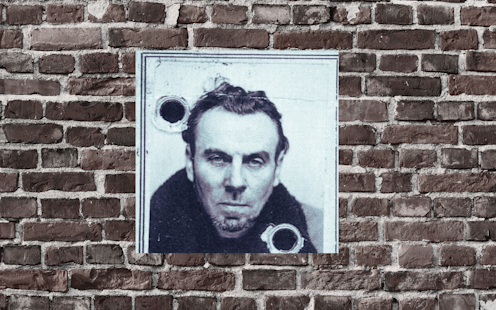
Nowadays, writers take no chances when it comes to safeguarding their work. They ensure multiple backups, storing files on their computer, external USB drives and cloud services to prevent any risk of loss. This was not the case 80 years ago. Writers relied solely on hard copies, which were vulnerable to being damaged, lost, or even stolen. But also sometimes found.
Review: War – Louis-Ferdinand Céline, translated by Sander Berg (Alma)
No one took it seriously when Louis-Ferdinand Céline (the pen-name of Louis-Ferdinand Destouches), claimed in 1944 that manuscripts of several novels had been stolen from him. A consummate mythomaniac, Céline was, at the time, in no one’s good books.
He had made a sensational entrance onto the French literary scene in 1932 with his revolutionary novel Journey to the End of the Night. But he was also a collaborationist writer, who had published three notorious antisemitic works between 1937 and 1941.

In June 1944, 11 days after D-Day, as the Allies pushed on towards Paris, Céline could feel the purge coming and fled to Nazi Germany, leaving behind piles of unpublished manuscripts in his Montmartre apartment.
These manuscripts resurfaced in 2020, at the end of an adventure that has all the hallmarks of one of his plots.
The truth was only revealed in 2022. A resistance fighter by the name of Yvon Morandat had moved into Céline’s vacant flat three months after his escape. He had carefully put Céline’s manuscripts in a trunk, which he stored in a furniture repository, then in his cellar.
Morandat died in 1972 and it was not until 1982 that one of his daughters found the trunk. She entrusted the 5,316 manuscript pages to Jean-Pierre Thibaudat, a journalist at the left-wing newspaper Libération, with one request: the manuscript must not be revealed during the lifetime of Lucette Destouches, Céline’s widow.
When Lucette died in 2019 at the age of 107, Thibaudat, having preserved the “stolen manuscripts” for almost 40 years, finally made them public. This reappearance sparked a frenzy in the academic and publishing worlds, as well as legal battles between Céline’s heirs, Thibaudat, and the publisher Gallimard.

In 2022, 250 leaves of the manuscript were published in France under the title Guerre (War). Part autobiography, part novel, War reconnects with Ferdinand Bardamu, the narrator of Journey to the End of the Night. It takes place during an ellipsis created in Journey to the End of the Night, when the novel’s young hero, a soldier in the first world war, is seriously wounded in battle.
In this tragic, burlesque farce, Ferdinand is in remission in a military hospital in Flanders. There he makes friends with another French casualty, a former pimp known alternatively as Bébert or Cascade. With Cascade, he visits L’Hyperbole, the local café in the garrison town, before leaving for London where “there was no war”.
Violence and contamination
Newly translated into English by Sander Berg, War attests to Céline’s literary genius. The manuscript was probably written in 1934 and, like Journey to the End of the Night, it shatters the literary conventions of the time by bringing spoken language into the written language.
Céline revolutionised French prose by bringing popular banter and cheekiness into literary discourse. The remarkable inventiveness in his vocabulary and his highly creative use of metaphors magnified the expressiveness, humour and emotional power of his narratives.
Céline’s writing drew inspiration from his life. Like the hero of War, the young Louis Destouches, who had joined the 12th Cuirassiers regiment in 1912, fought in the first world war. On 27 October 1914, his regiment was tasked to attack Poelkapelle and he volunteered for a liaison mission. As he was returning, he was hit in the right arm by a German bullet.
Sergeant Destouches was treated at the first aid post in Ypres, then at the Hazebrouck and Val de Grâce hospitals. He was awarded the Military Medal and the Croix de Guerre.
 Louis-Ferdinand Destouches in his cavalry uniform, May 1914.
J. Coutas, Public domain, via Wikimedia Commons
Louis-Ferdinand Destouches in his cavalry uniform, May 1914.
J. Coutas, Public domain, via Wikimedia Commons
The fighting marked Céline for the rest of his life. Although he only experienced the first few months of conflict and not the horror of the trenches, it was enough to instil in him a profound distaste for war. As a doctor – he studied medicine after the war and was awarded his doctorate in 1924 – Céline bore witness to war’s physical and psychological devastation. Heroism, glory and defence of the homeland were for him no more than pretexts for sending men to slaughter. He hated warmongers, whatever side they were on.
This dark, almost misanthropic vision of life permeates War. The novel is short, only 125 pages, but a work of concentrated violence. The opening of the first of its six “sequences” packs a real punch. The soldier Ferdinand awakes half-dead in a landscape that has just been bombed. It is scattered with corpses and animals. Buildings have been crushed by shells. His first words are: “Not quite. I must have been lying there part of the following night too.”
Throughout the story, the sound of the cannon is never forgotten, nor is Ferdinand’s terrible suffering. The denunciation of war, even in its early stage during the 1914 “war of movement” phase, the sheer horror of it, is striking and unmistakably in Céline’s style:
It’s revolting when for months you’ve seen nothing but convoys of men in all kinds of uniforms parading in the streets like strings of sausages, men in khaki, reservists, men in horizon blue and apple green, nothing but meat carried on wheels to be minced by that great meat grinder of fools.
Crude and intense sex scenes abound, in the hospital and in the town, where Cascade’s protegee Angèle hustles allied soldiers in garrison. The second sequence introduces the character Mademoiselle Lespinasse, a nymphomaniac and necrophiliac nurse, who jerks off the priapic wounded and dying.
A graphic description of prostitute life is given at the end of the fourth sequence, when Angèle revolts and takes power over her pimp:
You tell yourself that your Angèle must be as stupid as she was before … Well? Ain’t that what you think? She’ll train you up another whore, ten more little whores, and three floozies to boot, plus all the other trash Monsieur drags off the street, with their festering twats, and every month a brat in one belly or another that we then have to get rid of together, and each of ‘em with two or three cases of the syph that cost an arm and a leg to treat, and that your Anglèle’d stump up the cash, pays for the family’s meds and booze with her cunt, her whole cunt and nothing but her cunt … No, my pumpkin, I’ve had enough, I don’t give a shit about you. You’re a dirty rotten son of a bitch, so rot away.
The war has contaminated the social environment. Denunciation and betrayal have replaced honour and solidarity. In this violent world, everything can be exchanged.
The young Ferdinand quickly learns how to take advantage of the people around him: “The blow that had shaken me to the core had relieved me of the enormous burden of having a conscience, of decency, as they say.”
Not quite a novel
But War is not quite a novel. It is only a draft novel, a draft that the author never got the chance to go back to. There seem to be missing parts, the manuscript starting with a sequence numbered “10”. There are numerous indentations and erasures, many illegible words and blank spaces, which the French editor Pascal Fouché and the translator after him have tried to fill.
War is not up to the standard of Céline’s official novels, all of which demonstrate a painstaking perfectionism in the writing. Nevertheless, the sections of manuscript published since 2022 have met with extraordinary success, helping to restore, a little, the reputation of this antisemitic collaborationist writer, who in 1945 was officially declared a “national disgrace”.
The manuscript’s incompletion has certainly increased the challenge for the translator. In a reflexive passage that stresses the fact he is writing a long time after the events he is describing, Ferdinand states:
Twenty years will teach you. My soul has hardened, like a biceps. I no longer believe anything comes easy. I’ve learnt to make music, sleep, forgive and, as you can see, create beautiful literature too, with little bits of horror wrested from that never-ending noise.
But this “beautiful literature” is not easily transferable into English.
 As Céline expert Henri Godard aptly states: “Against all the rules we conform to out of habit when we write, [Céline’s] prose gives an impression of spontaneity and life in the moment”. The narrator of War expresses a profound hatred of his father’s formal language, rejecting letters from him that are “perfectly written in a perfect style. […] with their well-crafted, balanced sentences”.
“The first thing that strikes you about Céline’s style is its apparent orality,” Godard adds. Indeed, Céline introduces leaps and breaks in tone that give his prose an inimitable music. The syntax, in particular, produces a dizzying rhythm, as if to make it capable of expressing the detonation of the war, the frenzy that took the entire world.
And this is where the translation into English misses the point. Syntactic creativity is at the heart of Céline’s style. According to Eric Pellet, its use of segmentation is “halfway between literary style and the annihilation of all linked syntax”.
Céline’s prose shatters the traditional sentence, accelerating and decelerating the discourse, focusing on a particular component, but not the one you might expect in a “perfect style”. In the original French, for example, Céline writes:
De mon oreille on ne parlait jamais, c’était comme l’atrocité allemande, des choses pas acceptables, pas solubles, douteuses, pas convenables en somme, qui mettaient en peine la conception de remédiabilité de toutes choses de ce monde.
The fracturing of this sentence and the momentum it creates are lost in the English translation, which offers instead a bland and conventional syntax that erases syntactic “errors” and “agrammaticalities”, and ignores neologisms. In Berg’s rendering, the lines become:
We never spoke about my ear. It was like the German atrocities, one of those unacceptable, unsolvable, dubious and frankly improper things that got in the way of their conception that everything in the world was redeemable.
Another example:
M. Harnache il s’appelait l’agent de La Coccinelle. Pour une jolie maison on pouvait pas faire mieux que la sienne comme confort à l’époque.
The English version simplifies the syntax and, in doing so, loses the informal tone:
The agent from La Coccinelle was called Mr Harnache. He lived in a pretty house, about as comfortable as you could get at the time .
In the French version, Céline writes:
Question d’atrocité on nous ménageait les oreilles à Cascade et à moi.
A literal rendering of this might be something like: “On the question of atrocity they spared us our ears, Cascade and me.” But the line is rendered simply as:
They spared Cascade and me the atrocities.
“Translating is making choices,” Berg writes in his introduction to this “first ever English translation”:
lexical, grammatical, stylistic. It is an act of re-creation, of invention. Of course you lose a lot in the process, but you can recoup some of the losses.
But too few losses are recouped here. As Godard rightly observes in the foreword of the French edition: “It is through style that Céline holds his readers”. In the English version, the style has been watered down, with only crude vocabulary and insults floating on the surface. The translation softens Céline’s language into a lyrical “admirable” tone that he strove to avoid at all costs.
Some punchy phrases are, nevertheless, sprinkled throughout the text and succeed in waking up the reader. “I caught the war in my head,” says Ferdinand. “It’s trapped inside my head.” He is describing both his trauma and the damage to his ear, with a bullet trapped in it.
Céline portrayed the vertigo of the human condition with an intensity that still has no equal, eighty years on. But this English version is not quite Céline.
Authors: Véronique Duché, A.R. Chisholm Professor of French, The University of Melbourne
As Céline expert Henri Godard aptly states: “Against all the rules we conform to out of habit when we write, [Céline’s] prose gives an impression of spontaneity and life in the moment”. The narrator of War expresses a profound hatred of his father’s formal language, rejecting letters from him that are “perfectly written in a perfect style. […] with their well-crafted, balanced sentences”.
“The first thing that strikes you about Céline’s style is its apparent orality,” Godard adds. Indeed, Céline introduces leaps and breaks in tone that give his prose an inimitable music. The syntax, in particular, produces a dizzying rhythm, as if to make it capable of expressing the detonation of the war, the frenzy that took the entire world.
And this is where the translation into English misses the point. Syntactic creativity is at the heart of Céline’s style. According to Eric Pellet, its use of segmentation is “halfway between literary style and the annihilation of all linked syntax”.
Céline’s prose shatters the traditional sentence, accelerating and decelerating the discourse, focusing on a particular component, but not the one you might expect in a “perfect style”. In the original French, for example, Céline writes:
De mon oreille on ne parlait jamais, c’était comme l’atrocité allemande, des choses pas acceptables, pas solubles, douteuses, pas convenables en somme, qui mettaient en peine la conception de remédiabilité de toutes choses de ce monde.
The fracturing of this sentence and the momentum it creates are lost in the English translation, which offers instead a bland and conventional syntax that erases syntactic “errors” and “agrammaticalities”, and ignores neologisms. In Berg’s rendering, the lines become:
We never spoke about my ear. It was like the German atrocities, one of those unacceptable, unsolvable, dubious and frankly improper things that got in the way of their conception that everything in the world was redeemable.
Another example:
M. Harnache il s’appelait l’agent de La Coccinelle. Pour une jolie maison on pouvait pas faire mieux que la sienne comme confort à l’époque.
The English version simplifies the syntax and, in doing so, loses the informal tone:
The agent from La Coccinelle was called Mr Harnache. He lived in a pretty house, about as comfortable as you could get at the time .
In the French version, Céline writes:
Question d’atrocité on nous ménageait les oreilles à Cascade et à moi.
A literal rendering of this might be something like: “On the question of atrocity they spared us our ears, Cascade and me.” But the line is rendered simply as:
They spared Cascade and me the atrocities.
“Translating is making choices,” Berg writes in his introduction to this “first ever English translation”:
lexical, grammatical, stylistic. It is an act of re-creation, of invention. Of course you lose a lot in the process, but you can recoup some of the losses.
But too few losses are recouped here. As Godard rightly observes in the foreword of the French edition: “It is through style that Céline holds his readers”. In the English version, the style has been watered down, with only crude vocabulary and insults floating on the surface. The translation softens Céline’s language into a lyrical “admirable” tone that he strove to avoid at all costs.
Some punchy phrases are, nevertheless, sprinkled throughout the text and succeed in waking up the reader. “I caught the war in my head,” says Ferdinand. “It’s trapped inside my head.” He is describing both his trauma and the damage to his ear, with a bullet trapped in it.
Céline portrayed the vertigo of the human condition with an intensity that still has no equal, eighty years on. But this English version is not quite Céline.
Authors: Véronique Duché, A.R. Chisholm Professor of French, The University of MelbourneRead more https://theconversation.com/how-do-you-solve-a-problem-like-louis-ferdinand-celine-247793




















