

Formula One drivers face temperatures up to 50°C. High tech racing suits help keep them cool
- Written by: Carolina Quintero Rodriguez, Senior Lecturer and Program Manager, Bachelor of Fashion (Enterprise) program, RMIT University
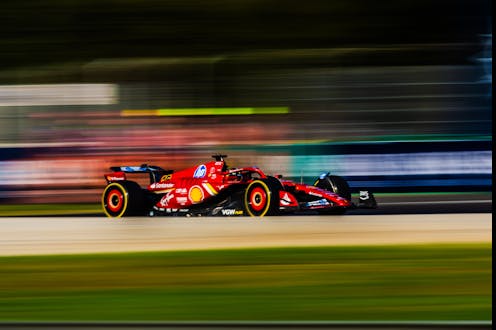
Motorsport fans are getting their first taste of racing this year, with the opening grand prix of the 2025 Formula One (F1) season starting in Melbourne today.
But it’s not just the cars people should be watching. In a sport where milliseconds determine champions and conditions push the human body to its limits, drivers’ racing suits have evolved from a simple fire protection tool to a sophisticated performance tool.
In fact, today’s F1 suits represent something of a technological revolution that could determine who stands on the podium.
Driving at 300km/h in 50°C for two hours
F1 drivers compete at nearly 300 kilometres per hour while enduring cockpit temperatures of up to 50°C.
In case of an accident, they are required to wear multilayer fireproof clothing, including long underwear, a balaclava, gloves, and a helmet. But this can severely restrict the body’s natural cooling mechanisms.
Research has found that during races in extreme heat, skin temperature quickly rises from normal levels (32–33°C) to over 38°C, with hands and forehead sometimes exceeding 39°C.
This isn’t just uncomfortable for drivers. It also increases the risk of dehydration, muscle cramps, cognitive impairment, heat exhaustion and heat stroke.
Developers of driving suits therefore have a challenging job. They must design garments that provide maximum fire protection while also allowing drivers to maintain peak cognitive and physical performance for roughly two hours in extreme heat.

A driver-centred approach to design
Fire protection remains the primary function of racing suits. Because of this, flame-resistant synthetic materials such as nomex, oxidized polyacrylonitrile and polybenzimidazole are used for the suit. Wool is also prevalent in the inner layers, because of its flame-resistant characteristics.
But racing suits are also now designed to improve driver comfort and movement.
For example, the racing suits of motorsport company Alpinestars, which supplies the McLaren F1 team, feature pre-curved sleeves and legs that match the natural driving position. This reduces the energy drivers expend fighting against their clothing.
Alpinestars’ suits also have minimal seams around the elbow joints. This increases flexibility and eliminates pressure points during the continuous small steering adjustments drivers make throughout a race. The suits also have elasticated inserts and multiple panels around the elbow which reduces material bunching at this crucial joint.
Sportswear company PUMA, which supplies the Ferrari and Aston Martin F1 teams with driving suits, adopt similar features in their driving suits.
But this attention to joint mobility extends beyond elbows.
F1 suits are flexible and loose fitting around the arms. They also incorporate elasticated panels in the lower back region and seamless shoulder epaulettes. This means the suits move naturally with the driver and minimise resistance.
Adjustable features such as elasticated waists and belts allow drivers to personalise their suits. They can also request specific modifications, such as where ventilation openings are placed, based on their individual comfort needs.
The result is a racing suit that functions as a second skin, tailored precisely to each driver’s body and movements.
Cooling the elbows
Racing suit manufacturers have also developed advanced approaches to keep drivers cool as well as safe.
Research has demonstrated that advanced fabrics with improved air permeability (how air passes through the fabric) and breathability (how moisture and heat passes through the fabric), as well as reduced thickness, could reduce core temperature rise by 40% compared to thicker and tighter types of materials.
Fabric manufacturers have engineered breathable fabrics for the suit and inner layers. Product developers also strategically place ventilation zones and internal cooling systems with technology that draws moisture away from the skin in the suits to help drivers manage their core temperature
These thermal management features are carefully tailored to different body regions.
For example, knowing that elbows experience a 6–7°C temperature increase during racing, suit designers make the suit thinner in this region to improve air flow and use materials capable of adjusting their thermal properties to temperature.
The impact of these design innovations goes beyond basic comfort. They translate directly to competitive advantage. When body heat is better managed, drivers can think more clearly and have better reaction times.

The road ahead
The development of racing suits continues to accelerate, with several emerging technologies promising even better performance and safety.
Reflective elements are showing particular promise for thermal protection by reducing the rate of skin temperature increase compared to conventional racing suits.
Wearable technology built into the fabrics of suits can also monitor drivers’ physiological changes, and help predict performance changes and enhance safety during racing.
The emerging popularity of electric racing series such as Formula E is also changing the environmental challenges drivers face.
Electric cars generate far less heat and noise than traditional race cars. This shift may prompt a reevaluation of suit requirements. It may potentially allow for designs that prioritise driver comfort and performance over heat management, while maintaining their fire safety properties.
The next time you watch a F1 race, look beyond the fancy aerodynamics and engine performance. Observe who emerges from their cockpit looking relatively fresh after two long hours of driving. The competitive advantage might not be in the car alone. It might be woven into the fabric protecting the driver inside the car.
Authors: Carolina Quintero Rodriguez, Senior Lecturer and Program Manager, Bachelor of Fashion (Enterprise) program, RMIT University


















