

beetles and other brilliant bugs are nature’s unsung pollinators
- Written by: Tanya Latty, Associate Professor, School of Life and Environmental Sciences, University of Sydney
About 90% of flowering plants rely on animals to transfer their pollen and optimise reproduction, making pollination one of nature’s most important processes.
Bees are usually the first insects to come to mind when people think of pollinators. But many other insects – including beetles, flies, moths and butterflies – also visit flowers to feed on nectar and pollen.
In doing so, they can play an essential role in pollinating plants.
Let’s take a closer look at some of nature’s unsung insect pollinators.
Fabulous flies
An estimated 30,000 species of fly (Diptera) call Australia home, making them the second largest group of insects after the beetles.
Flies have a huge variety of feeding habits including flower-visiting groups such as:
- blow flies (Calliphoridae)
- bee flies (Bombyliidae)
- hover flies (Syrphidae)
- noseflies (Rhinidae) and
- march flies (Tabanidae).
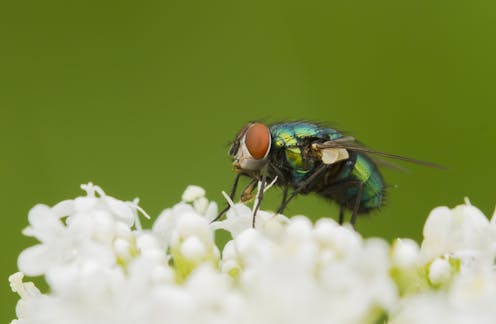
Blow flies often get a bad rap for their tendency to cluster on faeces and dead animals. But these amazing (and often beautiful!) animals can be important pollinators, especially in alpine regions such as the Australian Alps.
Named for their distinctive hovering flight, stripey yellow-and-black hover flies (Syrphidae) are often mistaken for bees. Hover flies are potential pollinators of several native plants.
The larvae of many common hover fly species prey on pest insects such as aphids, and so play an important role in controlling pest populations.
Another group in the hover fly family, known as drone flies, have larvae that live in stagnant water.
These larvae have a long, slender breathing tube, or “snorkel” that allows them to access air from the surface, earning them the rather unflattering name “rat-tailed maggots”.
Then there are the bee flies. As the name suggests, many species of bee fly (Bombyliidae) have fuzzy, bee-like bodies. Australia boasts around 400 species of bee fly.
Bee flies feed on the nectar or pollen of many native flowering plants and so may act as pollinators.
The larvae of most bee fly species lay their eggs in or on other insects, particularly wasps and solitary bees. The larvae then feed on the insect host, usually killing it.
Being both pollinators and natural regulators of insect populations, bee flies play an important yet often overlooked role in Australia’s ecosystems.
Don’t forget frit flies and march flies
Despite being relatively common, you’ve probably never noticed tiny frit flies (Chloropidae). No, that’s not a typo; frit flies are different to fruit flies (although they are often around the same size).
There are 322 described species of frit fly in Australia, although the actual number is probably much higher as these diminutive flies are understudied.
Frit flies and their relatives, the jackal flies (Milichiidae), are believed to be the pollinators of midge orchids (Genoplesium spp), many of which are rare or threatened in Australia.
Exactly how midge orchids are attracting these tiny flies is not clear, but at least some Genoplesium species may be mimicking the smell of wounded insects.
Biting flies can be annoying, but some are also pollinators. March flies, also known as horse flies (Tabanidae), are often disliked for their painful bites, but these large flies can act as pollinators when they visit flowers to feed on nectar and pollen. In fact, it’s only the females that eat blood to support egg development.
One species, the flower-feeding march fly (Scaptia auriflua), has abandoned blood meals altogether, feeding exclusively on nectar and pollen.
March fly larvae, which develop underground, are formidable predators. Equipped with venomous fangs, they actively hunt and subdue prey.
Friendly flower chafer beetles
Many beetle species visit flowers to feed on nectar and pollen, including the flower chafers (subfamily Cetoniinae). The flower chafer group includes beautiful beetles such as:
- green (and occasionally yellow) and black fiddler beetles (Eupoecila australasiae)
- big buzzy cowboy beetles (Chondropyga dorsalis), and
- the delightfully spotty punctuate flower chafers (Neorrhina punctatum).
Adult flower chafers feed on the nectar and pollen of many flowering plants, especially natives such as eucalyptus and angophoras.
Their larvae live underground, feeding on decaying organic matter. So don’t panic if you find curl grubs in your garden – they might be baby flower chafers.
Nectar scarabs (Phyllotocus spp) are another beetle frequently seen foraging on native flowers. There are about 28 species in Australia.
Most are smaller and less conspicuous than flower chafers, although some species form large swarms on flowering trees such as Angophora, Eucalyptus and Leptospermum.
The larvae of nectar scarabs feed on decaying organic matter and grass roots in soils.
Even wasps help pollinate
Unlike bees, which mostly get their protein from pollen, wasps are primarily predators, although they may act as pollinators when they visit flowers for a sip of sugary nectar.
Some Australian orchids have evolved a remarkable strategy for attracting their wasp pollinators: they deceive unsuspecting males by mimicking the scent (and sometimes shape) of female wasps. Male wasps attempt to mate with the flower, unwittingly transferring pollen in the process.
Next time you’re outside, say a silent thanks for the many unsung insect pollinators helping to keep our ecosystems healthy.
Authors: Tanya Latty, Associate Professor, School of Life and Environmental Sciences, University of Sydney


















