

Adelaide Festival gives a hopeful vision for the future of Australian contemporary dance
- Written by: Erin Brannigan, Associate Professor Theatre and Performance, UNSW Sydney
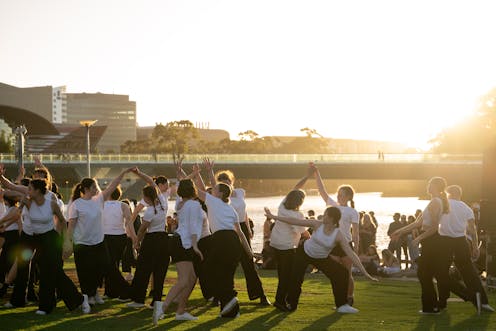
I arrived at Stephanie Lake’s premiere of Mass Movement a little late on my first day at Adelaide Festival.
Walking down the hill from King William road towards Elder Park, the Torrens River was lit up in oranges and golds by the setting sun. A river of people came into view, winding from a thin spread on the hillside nearest me to a thick block of settled-in picnicers, back up the opposite hill to the bank of institutional buildings along the river.
In the centre of this river, a stage crowded with performers in black and white waved and flowed: movements that passed along individuals juxtaposed with sharper unison actions, vocalisations and free-for-alls.
I missed the solo performance that opened this outdoor performance, and the procession of dancers winding down onto the stage. But what I saw left an impression of an excellent community activation with many performers of all ages and training backgrounds, and an audience of family, friends and strangers here to see this part-human part-natural spectacle.

This work sits within Lake’s body of spectacle-scale works that have become a signature for this important new-generation Australian choreographer. With 1,000 performers, the most she has ever worked with, whether bigger is better may be neither here nor there when the emphasis is on spectacle and community.
One Single Action in an Ocean of Everything
Established Melbourne-based choreographer Lucy Guerin’s mastery of the duet, her use of unison and tight spatial delineations, gestural detail and intensely demanding timing are all there in her most recent work, One Single Action in an Ocean of Everything.
Dancers and choreographic collaborators Amber McCartney and Geoffrey Watson are up to the task and perfectly matched. McCartney is compact, precise but playful. Watson is more measured yet somehow looser and more sensual.
The first half of the piece works intricate movements along a diagonal across the stage to downstage right, where a moon-like sphere hangs at head height.

The dancers’ trajectory, and often their gaze, are locked on this object. In the upper corner on the floor are mallets. Taken up by the dancers, they become part of a percussive choreography. The spectacle of the dancers making their mark on time within the complex choreography locks us all into a ride that we anticipate will end with a smashed sphere.
Guerin’s experience is evident in how she shapes a work. The opening sections with their tightrope-like structure are physically, temporally and spatially smashed as the material from the sphere flies across the stage.
A broom is introduced by Watson. This precipitates a new relationship between the two dancers. Experiential chaos versus spatial order replaces the teamwork of the first half, as the two become constantly at odds with each other.
Themes of destruction, orthodoxy, disobedience, care and empathy are not hard to draw out of this microcosm. The sound, by CS + Kreme, does great support work with its mechanical complexities, pounding meter and a high synthetic sound like a tap running in the next hotel room. The lighting design by Paul Lim is also a star.
A Quiet Language
A Quiet Language asks a tall order of Daniel Riley and co-director Brianna Kell: to create a performance work that spoke to the 60th anniversary of Australian Dance Theatre (ADT).
Riley, a Wiradjuri man from Western New South Wales, took on the directorship of ADT in 2022 following Garry Stewart’s 20-year plus tenure, with Kell as artistic associate. The introduction of Indigenous leadership for the company is welcome. There is a history of cultural appropriation across many Australian dance artists, from Beth Dean and Rex Reid in the 1950s, to the complex case of Jiri Kylian’s Stamping Ground (1983) later performed by Bangarra Dance Theatre in 2019.
It is well overdue that the rich and deep choreographic practices of our First Nations people are now being represented by leadership in a major dance company outside Bangarra.
In A Quiet Language, the names of artists associated with the company flicker as the years scroll past on the horizontal screens at either end of the space. But the real homage might be in the tone and style of this work.
Tie-dyed costumes by Ailsa Paterson, featuring an occasional headband, speak to the genesis of the company under the direction of Elizabeth Cameron Dalman across 1965–75.
 A Quiet Language is a homage to the choreographic history of ADT.
Morgan Sette/ADT
A Quiet Language is a homage to the choreographic history of ADT.
Morgan Sette/ADT
Dalman is credited as collaborator, and the company spent four weeks of development with this extraordinary artist now in her 90s.
A Quiet Language begins with two female dancers, Yilin Kong and Zoe Wozniak, walking from one bank of audience to the other, directing their bold and curious gaze at us. They are accompanied by composer and musician Adam Page who remains on stage throughout.
Sebastian Geilings, Zachary Lopez and Patrick O'Luanaigh join them with more playful provocations for the audience, making the school group in the bank opposite me squirm.
We have met the dancers first as individuals, and the full cavalcade of ADT’s historical casts rests, virtually, behind the five young artists.
This breaking of the fourth wall speaks to the radical new approach that Dalman’s work represented in the 1960s when contemporary approaches to dance were still emerging locally.
The dancers move into group work that dominates the many phases of the piece, memorably a stormy section representing protest in theatre dance around the world in the 1960s.
This is followed by a dark solo by Wozniak that heaves itself off the floor in tense, cramping movements, resonating with the suffering behind current international headlines.
The dancers are credited with choreographic collaboration and it shows in their commitment to, and comfort within, the movement. This is delivered at an intense and unrelenting pitch throughout, recalling Stewart’s signature high-impact work. But the way the choreography is drawn to the floor – through tenacious connection or a giving-in that slides joyfully across its surface – feels fresh.
The Walking Track
I end my time in Adelaide with Karul Projects’ The Walking Track, presented by Vitalstatistix in Port Adelaide, where six performance pieces were commissioned by local First Nations dance and performance artists.
These are dispersed on site along a walk hosted by Karul Projects’ artistic director, Thomas E.S. Kelly, a Minjungbal, Wiradjuri and Ni-Vanuatu man.
Kelly established Karul Projects alongside Taree Sansbury, a local Kaurna, Narungga and Ngarrindjeri woman, in 2017 in Queensland, making this a rare First Nations dance company existing outside Bangarra Dance Theatre.
 The Walking Track shows the future of Australian contemporary dance is bright.
Heath Britton/Vitalstatistix
The Walking Track shows the future of Australian contemporary dance is bright.
Heath Britton/Vitalstatistix
The all-female cast of artists – Adrianne Semmens, Alexis West, Caleena Sansbury, Janelle Egan, Kirsty Williams, Lilla Berry, Mel Koolmatrie and Pearl Berry – offered works-in-development that told stories of family, loss, displacement and environmental destruction.
Their careful framing by Kelly on Country gave assurance that the future of Australian contemporary dance is bright.
Walking with the small audience around Port Adelaide, I kept an eye out for the dolphins Kelly informed us were just below the surface and imagined the local Kaurna people who had gathered on the banks there before being moved on. I could feel a slowly turning tide that will, no doubt, inspire fresh creative and critical gains for Australian contemporary dance.
Authors: Erin Brannigan, Associate Professor Theatre and Performance, UNSW Sydney


















