Australia is too often a leader in conspiracy thinking – from Port Arthur ‘trutherism’ to Christchurch
- Written by Alexander Howard, Senior Lecturer, Discipline of English and Writing, University of Sydney
The Australian government officially categorised the white supremacist Terrorgram Collective as a terrorist organisation last month – after it was linked to an alleged plot to kill a New South Wales Labor MP. A decentralised network, Terrogram mostly operates on the messaging app Telegram.
Perpetrators of mass violence – including the Australian perpetrator of the Christchurch mosque shootings – are called “saints” by its users. They are treated as icons, martyrs and even role models.
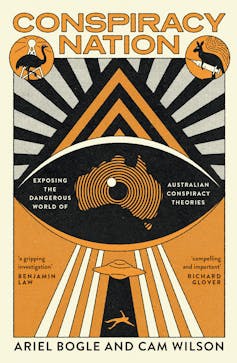
Review: Conspiracy Nation – Ariel Bogle & Cam Wilson (Ultimo)
Terrorgram promotes white supremacist and neo-Nazi beliefs, and encourages acts of violence. It also spreads propaganda and instructional guides for terrorism. Ariel Bogle, an investigations reporter at Guardian Australia, and Cam Wilson, associate editor of Crikey, argue artefacts circulated online (like footage of the Christchurch shootings, and the perpetrator’s 74-page manifesto) serve as blueprints for subsequent atrocities.
Conspiracy Nation, their impressively researched new book of investigative journalism, explains how conspiratorial thinking, misinformation and radicalising narratives move through online platforms and real-world communities in contemporary Australia. They find them in fringe forums, mainstream politics, encrypted group chats, rallies and physical attacks.
One of this riveting book’s most surprising takeaways is how often Australia has proved to be a forerunner rather than a follower when it comes to conspiratorial thinking. For example, the 1996 Port Arthur massacre, our deadliest mass shooting, has spawned a set of conspiracy theories to rival those around Lee Harvey Oswald.

The Christchurch massacre legacy
The appalling legacy of the Christchurch massacre, and the social media pulpits that allow it to be amplified, make for a sobering (and at times, difficult) read.
Bogle and Wilson pay close attention to the shooter’s manifesto, a document that “laid out his so-called vision of the world”. He uploaded it to the internet immediately before launching his rampage – and posted copies to various media outlets and the New Zealand parliament.
They start by reminding us:
it’s not possible to completely understand the mind of someone like the Christchurch terrorist. His statements – better seen as propaganda – were calculated to gain notoriety, to muddy the waters.

While it may seem at first glance to be a straightforward expression of white supremacist ideology, argue the authors, the shooter’s manifesto is better understood as a text shaped by conspiracy theory.
The document echoes longstanding tropes from the transnational white power movement, references notorious slogans, and paints an idealised image of motherhood and pastoral life. Yet its rhetorical force derives from a deeper paranoia: a belief that Western civilisation is under coordinated attack.
The Great Replacement Theory
The Christchurch shooter’s manifesto was titled “Great Replacement”. In it, he accused liberal politicians of “deliberately engineering the extinction or replacement of White Westerners through mass immigration of non-Whites”.
The title clearly referenced a foundational myth for the international far-right: the Great Replacement Theory. It takes its name from a 2011 book by French activist and conspiracy theorist Renaud Camus, which claimed white populations in Europe were being systematically replaced by Muslims, as part of a wider globalist plot.
 “Combined with a fixation on a decline in white birth rates in Western countries,” Bogle and Wilson write, “it has mutated into an all-encompassing conspiracy theory, and at times, an incitement to violence.” The ideological origins of this inflammatory conspiracy, however, stretch even further back.
One of Camus’ main influences was Jean Raspail’s dystopian 1973 novel The Camp of the Saints: a cult text in far-right circles. In the book, a flotilla of migrants from India sails towards France, eventually overwhelming its institutions and destroying the nation. Raspail depicts non-white migrants as a barbaric, invidious force – an existential threat to the very fabric of Western civilisation.
The Camp of the Saints has long been championed by white nationalists, and was reportedly described by former Trump strategist Steve Bannon as essential reading. White House deputy chief of staff Stephen Miller, the architect of the Trump administration’s hardline immigration policy, is also a fan.
The theory is framed as concern over birth rates or border control. But, like so many conspiratorial narratives, it frequently shades into antisemitism. Behind the scenes of demographic change, so the story almost always goes, lies a covert cabal – typically Jewish – manipulating migration flows to undermine and eventually erase white Christian populations.
As Conspiracy Nation emphasises, this fusion of racial panic, conspiracism and violence is not incidental. It is integral to how the far-right radicalises, mobilises and ultimately sows the seeds of discord and destruction.
“Combined with a fixation on a decline in white birth rates in Western countries,” Bogle and Wilson write, “it has mutated into an all-encompassing conspiracy theory, and at times, an incitement to violence.” The ideological origins of this inflammatory conspiracy, however, stretch even further back.
One of Camus’ main influences was Jean Raspail’s dystopian 1973 novel The Camp of the Saints: a cult text in far-right circles. In the book, a flotilla of migrants from India sails towards France, eventually overwhelming its institutions and destroying the nation. Raspail depicts non-white migrants as a barbaric, invidious force – an existential threat to the very fabric of Western civilisation.
The Camp of the Saints has long been championed by white nationalists, and was reportedly described by former Trump strategist Steve Bannon as essential reading. White House deputy chief of staff Stephen Miller, the architect of the Trump administration’s hardline immigration policy, is also a fan.
The theory is framed as concern over birth rates or border control. But, like so many conspiratorial narratives, it frequently shades into antisemitism. Behind the scenes of demographic change, so the story almost always goes, lies a covert cabal – typically Jewish – manipulating migration flows to undermine and eventually erase white Christian populations.
As Conspiracy Nation emphasises, this fusion of racial panic, conspiracism and violence is not incidental. It is integral to how the far-right radicalises, mobilises and ultimately sows the seeds of discord and destruction.
 A group of white supremacists demonstrating in Corowa on the Murray River, in October 2024.
Noticer/AAP
Australia’s convenient ‘great forgetting’
“Australian politics, media and the culture more broadly have arguably engaged in a great forgetting” over the “local origins” of the Christchurch shooter, write Bogle and Wilson. On March 15 2024, the fifth anniversary of the attack, the event barely warranted a mention in the national press.
There has been a persistent tendency among Australian politicians and the media punditry to treat the Christchurch shooter as a lone wolf, radicalised elsewhere, who has absolutely nothing to do with us, they write.
This distancing, deliberate or not, has allowed Australia to sidestep a long-overdue reckoning with the domestic conditions that helped shape his worldview. A media environment saturated with race-baiting rhetoric, a political class willing to flirt with talking points from the culture wars – and a national climate in which Islamophobia has too often gone unchecked.
Bogle and Wilson, to their credit, insist Australian readers sit with this discomfort. Indeed, it is one of the most compelling – and quietly confronting – aspects of their excellent book.
Australia has, at various moments, helped incubate and export narratives that gain traction globally – often with disastrous consequences. The Christchurch shooter is just one example of this disturbing pattern.
Despite overwhelming evidence, for instance, elements of Australia’s conspiratorial fringe have long claimed the Port Arthur massacre was a false flag operation, designed to pave the way for the introduction of strict gun control laws.
Theories ranged from Martin Bryant as a government patsy in the mould of Lee Harvey Oswald, to the belief the entire massacre was staged.
A group of white supremacists demonstrating in Corowa on the Murray River, in October 2024.
Noticer/AAP
Australia’s convenient ‘great forgetting’
“Australian politics, media and the culture more broadly have arguably engaged in a great forgetting” over the “local origins” of the Christchurch shooter, write Bogle and Wilson. On March 15 2024, the fifth anniversary of the attack, the event barely warranted a mention in the national press.
There has been a persistent tendency among Australian politicians and the media punditry to treat the Christchurch shooter as a lone wolf, radicalised elsewhere, who has absolutely nothing to do with us, they write.
This distancing, deliberate or not, has allowed Australia to sidestep a long-overdue reckoning with the domestic conditions that helped shape his worldview. A media environment saturated with race-baiting rhetoric, a political class willing to flirt with talking points from the culture wars – and a national climate in which Islamophobia has too often gone unchecked.
Bogle and Wilson, to their credit, insist Australian readers sit with this discomfort. Indeed, it is one of the most compelling – and quietly confronting – aspects of their excellent book.
Australia has, at various moments, helped incubate and export narratives that gain traction globally – often with disastrous consequences. The Christchurch shooter is just one example of this disturbing pattern.
Despite overwhelming evidence, for instance, elements of Australia’s conspiratorial fringe have long claimed the Port Arthur massacre was a false flag operation, designed to pave the way for the introduction of strict gun control laws.
Theories ranged from Martin Bryant as a government patsy in the mould of Lee Harvey Oswald, to the belief the entire massacre was staged.
 Thousands gather for a anti gun rally on the grounds of Parliament House, Hobart Tasmania, in 1996, in response to the Port Arthur masacre.
Rick Rycroft/AAP
Port Arthur: a common thread
Port Arthur has become “one of the foundational stories in the construction of Australian conspiracy lore”, note Bogle and Wilson. It is regularly cited
as the original reason why the police, the government, mainstream media and, well, everyone, can’t be trusted. It is the common thread through a swathe of Australian conspiracy theory communities. If you believe you’ve been lied to about vaccines, elections, the law, immigration, et cetera – well, it wouldn’t be surprising if “they” had lied to you about Port Arthur, too.
Significantly, this was one of the first Australian conspiracy theories to take root and flourish online. We can thank Perth’s late conspiracy theorist Joe Vialls. A prolific and high-profile figure in conspiracy circles, he specialised in producing a “surprising number of alternative explanations for world events casting them as the handiwork of nefarious, hidden forces”.
His “magnum opus”, the book Deadly Deception at Port Arthur, was first published in 1999. A pseudo-scientific screed, it cast aspersions on shadowy state actors and exonerated Bryant. It was widely distributed in both print and digital form.
This was the dawn of what we now call Web 1.0. For enterprising figures like Vialls – operating outside traditional media channels – the internet was transformational. It allowed conspiracy peddlers to bypass mainstream gatekeepers and reach global audiences of like-minded believers.
A digital copy of Vialls’ Port Arthur book became especially popular, gaining traction in the outer rims of the online world. Emboldened by the international response to his work, Vialls began soliciting donations to fund a new investigation into Bryant’s actions. He died before he got the chance to carry it out.
Thousands gather for a anti gun rally on the grounds of Parliament House, Hobart Tasmania, in 1996, in response to the Port Arthur masacre.
Rick Rycroft/AAP
Port Arthur: a common thread
Port Arthur has become “one of the foundational stories in the construction of Australian conspiracy lore”, note Bogle and Wilson. It is regularly cited
as the original reason why the police, the government, mainstream media and, well, everyone, can’t be trusted. It is the common thread through a swathe of Australian conspiracy theory communities. If you believe you’ve been lied to about vaccines, elections, the law, immigration, et cetera – well, it wouldn’t be surprising if “they” had lied to you about Port Arthur, too.
Significantly, this was one of the first Australian conspiracy theories to take root and flourish online. We can thank Perth’s late conspiracy theorist Joe Vialls. A prolific and high-profile figure in conspiracy circles, he specialised in producing a “surprising number of alternative explanations for world events casting them as the handiwork of nefarious, hidden forces”.
His “magnum opus”, the book Deadly Deception at Port Arthur, was first published in 1999. A pseudo-scientific screed, it cast aspersions on shadowy state actors and exonerated Bryant. It was widely distributed in both print and digital form.
This was the dawn of what we now call Web 1.0. For enterprising figures like Vialls – operating outside traditional media channels – the internet was transformational. It allowed conspiracy peddlers to bypass mainstream gatekeepers and reach global audiences of like-minded believers.
A digital copy of Vialls’ Port Arthur book became especially popular, gaining traction in the outer rims of the online world. Emboldened by the international response to his work, Vialls began soliciting donations to fund a new investigation into Bryant’s actions. He died before he got the chance to carry it out.
 Over a three-month period, hundreds of guns were handed in during the second national gun amnesty since the Port Arthur massacre (this one in 2017).
Ethan James/AAP
Canary in the conspiracy coalmine
In the three decades since the massacre, “Port Arthur trutherism” has grown from a marginal curiosity into a persistent current in Australian conspiracy culture. As Bogle and Wilson record, it even found a “foothold” in parliament.
In 2019, Pauline Hanson appeared to reference Vialls’ infamous “blue book” (referring to its distinctive cover) during an interview with Andrew Bolt on Sky News. She claimed she had “read a lot” on the subject, made some odd remarks about “precision shots” and seemed decidedly sceptical about the official account of the event.
One Nation has occasionally distanced itself from such claims, write Bogle and Wilson. But conspiracy theories about Port Arthur continue to circulate – and often do real harm to those who come into contact with them.
Knowing this, Bogle and Wilson are surely right to describe the Port Arthur massacre conspiracy theory as “the canary in the coal mine for modern conspiracy theories”. Sadly, its endurance demonstrates how fringe narratives can metastasise online. Whether they will prove fatal to public life – and our already fragile shared understanding of reality – remains to be seen.
Authors: Alexander Howard, Senior Lecturer, Discipline of English and Writing, University of Sydney
Over a three-month period, hundreds of guns were handed in during the second national gun amnesty since the Port Arthur massacre (this one in 2017).
Ethan James/AAP
Canary in the conspiracy coalmine
In the three decades since the massacre, “Port Arthur trutherism” has grown from a marginal curiosity into a persistent current in Australian conspiracy culture. As Bogle and Wilson record, it even found a “foothold” in parliament.
In 2019, Pauline Hanson appeared to reference Vialls’ infamous “blue book” (referring to its distinctive cover) during an interview with Andrew Bolt on Sky News. She claimed she had “read a lot” on the subject, made some odd remarks about “precision shots” and seemed decidedly sceptical about the official account of the event.
One Nation has occasionally distanced itself from such claims, write Bogle and Wilson. But conspiracy theories about Port Arthur continue to circulate – and often do real harm to those who come into contact with them.
Knowing this, Bogle and Wilson are surely right to describe the Port Arthur massacre conspiracy theory as “the canary in the coal mine for modern conspiracy theories”. Sadly, its endurance demonstrates how fringe narratives can metastasise online. Whether they will prove fatal to public life – and our already fragile shared understanding of reality – remains to be seen.
Authors: Alexander Howard, Senior Lecturer, Discipline of English and Writing, University of Sydney