

Why every child needs explicit phonics instruction to learn to read
- Written by: Pamela Snow, Professor and Head, Rural Health School, La Trobe University
Being able to read means being able to make meaning from printed words. At a functional level, we read to get the message – such as how many times per day to take our medication – but in a literate society reading provides much more. A successful reader is someone who can access the thoughts, opinions, memories, theories, desires, experiences and feelings of others.
Reading is a transformative experience. But it is also a “biologically unnatural” process humans have been doing for only a brief time in evolutionary terms. Unlike acquiring spoken language, children need to be taught how the English writing system works and how to master the code for both reading and spelling.
The written English code
Written English is considered a code because letters and letter combinations (graphemes) represent spoken speech sounds (phonemes). The English alphabet has 26 letters, which represent 44 speech sounds. This means some letter combinations (graphemes) comprise more than one letter. For example, in the first sound of “ship” two letters, “s” and “h”, make one grapheme that represents the phoneme “sh”.
For beginning readers, being able to connect graphemes to their corresponding phonemes is not an intuitive, natural process.
Learning the complex code is best done through explicit and systematic phonics instruction. This involves directly teaching children to associate graphemes with their corresponding phonemes.
Instruction starts using a clearly defined (systematic) sequence of letters, starting with only a few correspondences reflecting simple code (such as single letters) and progressively moving to complex code, such as “ng” and “ough”, once mastery is achieved at each level.
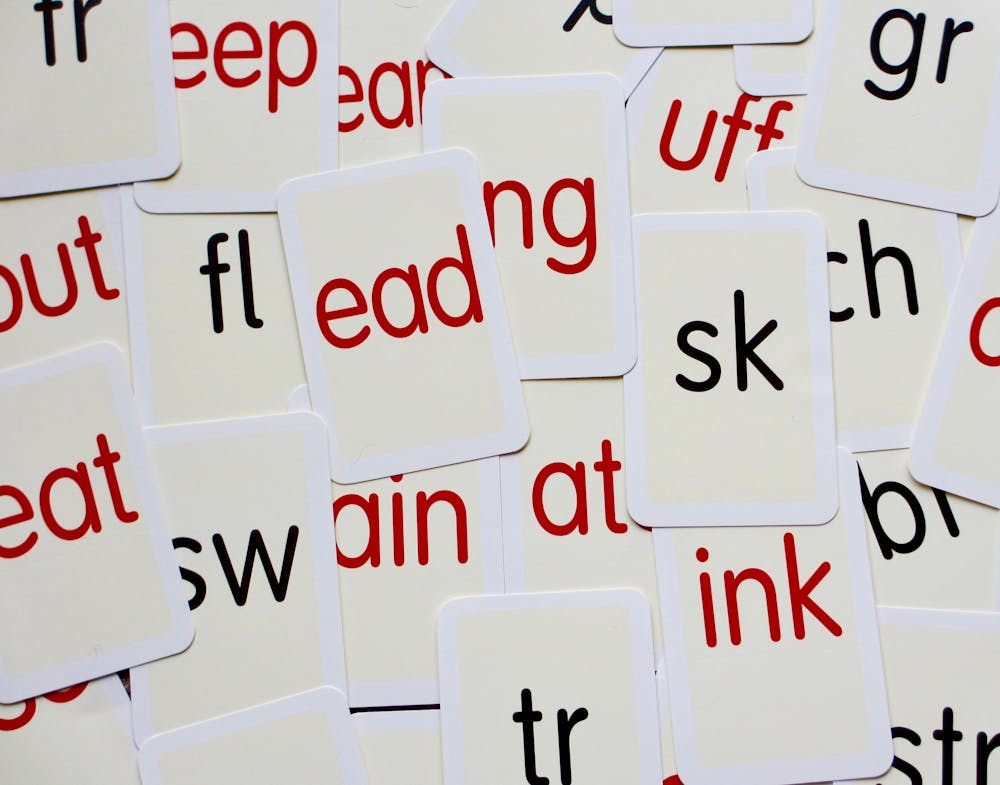 English has 44 speech sounds.
from shutterstock.com
English has 44 speech sounds.
from shutterstock.com
Once children have learnt a few grapheme-phoneme correspondences, they will be explicitly shown how to segment words (containing only known correspondences) into their constituent parts and blend them together to decode and read the word. At this point, children will be able to read short decodable books.
All children must learn to decode. Without decoding skills, children could not read made-up words such as Harry Potter’s “quidditch”. Nor could they read unfamiliar names (of places such as Oodnadatta) or medication names (such as azithromycin) as these have no other cues to guide the reader to pronunciation.
Why phonics works
Synthetic phonics instruction aligns with the two strongest and most well-regarded theoretical frameworks in contemporary reading science.
The first is the simple view of reading developed in 1986, which has more recently (2018) been reformulated as the cognitive foundations of learning to read. This holds that reading comprehension is made up of two mutually dependent and essential processes: being able to decode words and being able to understand what connected text means.
The simple view theory had provided valuable insights into the cognitive processes necessary for reading comprehension. Evidence also shows the model to be a valid means of sub-classifying children as “able readers”, “poor decoders” and/or “poor comprehenders”.
The second framework is dual route theory (developed in 2012). This refers to the fact some words readers encounter are already stored as recognisable letter strings in their long-term memory. We instantly recognise these words when we see them, through the lexical route.
But unfamiliar words need to be decoded, via a phonological (sound-based) route, using knowledge of how letters and letter combinations (graphemes) map onto speech (phonemes). As we become more skilled as readers, we access more words automatically.
Dual route theory aligns with cognitive load theory. This is the idea that there is only so much information a human brain can hold at any one time unless there is a dedicated and structured opportunity to practise and rehearse it.
 Children should be taught word structures, so they can read unfamiliar words without context – like Cowra Boorowa.
Brenden Ashton/Unsplash, CC BY
Children should be taught word structures, so they can read unfamiliar words without context – like Cowra Boorowa.
Brenden Ashton/Unsplash, CC BY
In line with this, the workings of the English writing system are best taught explicitly and systematically, so beginning readers are not put into the unfortunate and unnecessary situation of being cognitively overloaded. The risk of cognitive overload is high when the code is shown to children in an unsystematic, unstructured way or, even more worryingly, if it is assumed children will intuitively understand the code simply by exposure to written text.
Read more: Explainer: what is explicit instruction and how does it help children learn?
Instruction should also include an emphasis on morphology (word building, such as happy, unhappy, unhappily) and etymology (study of word origins), so students recognise patterns and relationships between words.
Although knowing how to decode words is fundamental to becoming a reader, teaching children to crack the code should also be done alongside instructional practices that ensure rapidly expanding vocabularies and world knowledge, so children can bring language skills and background knowledge to the task of comprehending what they read.
Covering all bases
A significant proportion, close to 40%, of children manage to learn to read without explicit and systematic phonics instruction (or with phonics instruction of variable impact) due to a confluence of biological and environmental advantages. These children may receive less structured initial reading instruction that encourages them to use a variety of strategies, such as picture and context cues, before attending to the graphemes within a word.
Read more: Reading progress is falling between year 5 and 7, especially for advantaged students: 5 charts
The remaining 60% of children taught in this way are highly vulnerable to falling behind as readers. And the proportion of vulnerability increases with the level of disadvantage.
No teacher of children in their first year of school can reliably identify, in the first term, which children will struggle with reading and which will get there seamlessly. To wait until a year (or more) has passed and then try to back-fill and close this gap shows a poor understanding of the importance of making every day count in children’s early learning.
We should be teaching 95% of children to read successfully, so need to be using high-impact teaching approaches from the outset, with all children.
If not explicit and systematic phonics instruction, what is the teacher’s time being spent on? Teaching words from flash cards for children to learn as wholes without any analysis of what is happening within the word? Or promoting inefficient strategies (ironically those used by weak readers) such as trying to work out what “kind” of word might work?
Even more bizarrely (and unhelpfully), children might be encouraged to “get their mouths ready” to read an unfamiliar word. It is not a child’s mouth that needs to be ready for learning to read, but her brain.
We must provide and promote reading instruction approaches that ensure the overwhelming majorly of children learn to read in the early years of school, regardless of their starting point.
Read the accompanying article on the the whole language approach to teaching reading here.
Authors: Pamela Snow, Professor and Head, Rural Health School, La Trobe University


















