

Australians scorn this fish once adored by monks and kings
- Written by Paul Humphries, Associate Professor in Ecology, Charles Sturt University
In many parts of Europe, the common carp is a prized table fish. But the common carp (Cyprinus carpio) is arguably Australia’s most vilified fish. Nicknamed the “river rabbit” for its prolific breeding, carp is blamed for degrading rivers, lakes and billabongs.
Despite its popularity overseas, and among catch-and-release anglers and koi enthusiasts, carp in Australian rivers cause significant damage to aquatic plants, denuding the riverbanks and riverbeds when they feed.
In the 1960s, a European strain of carp entered Victoria’s Latrobe Valley and the Murray River near Mildura, believed to originate from a fish farm in Boolarra, in the south east of the state. This strain spread through the Murray–Darling Basin, prompting extensive research and attempted control programs, including the proposed cyprinid herpesvirus.
While debate continues over management, a question rarely asked is why carp was a strong candidate for introduction in the first place? For this, we need to take a two-thousand-year trip back in time.

Roman troops needed food
Common carp comprises two subspecies: the European form (Cyprinus carpio carpio) and East Asian form (Cyprinus carpio haematopterus). Historically, the former’s range extended as far west as present-day Vienna, along the River Danube and as far east as Central Asia and Kazakhstan.
Archaeological remains suggest carp were especially abundant where a breakpoint in the Danube’s gradient and its tributaries, the Morava, Váh, Hron, Drava and Tisza rivers, converged. For millennia, large permanent and seasonal floodplains provided ideal conditions for carp.
Two thousand years ago, after crossing the Alps and pushing north to the Danube, the Roman army established military bases between modern-day Vienna and Budapest. Across the river, Celts and Germans watched with gritted teeth and weapons at the ready. Although only 240 km long, the frontier needed four Roman garrisons to hold out. Around 20,000 legionnaires, accompanied by families, slaves and tradespeople, meant a population of more than 100,000. And they all needed food.
Fortresses upstream and downstream of the Morava River lined one of the Danube’s largest floodplains. Czech-Canadian fish biologist Eugene Balon argues this frontier marked the beginning of Western Europe’s enduring love affair with carp. Archaeological excavations of these forts have uncovered abundant fish remains, predominantly carp, supporting his hypothesis.
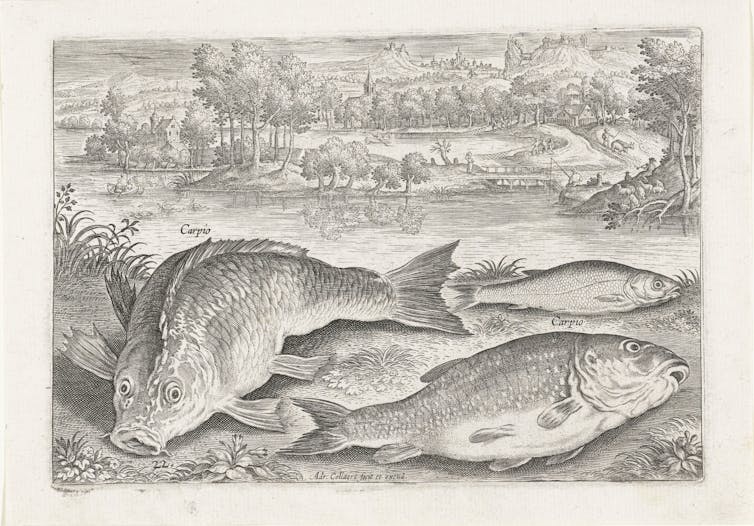
Carp becomes European fish du jour
Whether legionnaires carried carp back toward Rome remains uncertain, but by the early Medieval period, carp was steadily spreading westward. Evidence from monastic latrine deposits (poo, to you and me) has shown carp moving through what are now France, Netherlands, Belgium and Luxembourg by the late 13th century. By 1400, carp was the fish du jour in Parisian cuisine. The “Carpocene” had arrived.
Canadian historian Richard Hoffmann has documented carp’s westward spread, as it followed sweeping changes to European riverine landscapes, especially the rise of water mills. From about 1000 CE, an energy revolution of sorts shifted grain milling and paper production from oxen to water power. Thousands of mill dams transformed free-flowing streams into ponds and races, disrupting habitats and effectively expunging the previously abundant trouts, salmons and sturgeons. These heavily modified riverscapes proved ideal for carp.
This growing dominance of carp in Western Europe coincided with the rise of Christianity and founding of monasteries. Carp domestication in China may date back thousands of years, but Western European aquaculture probably had its origins in 11th and 12th century France, through monasteries and the nobility.
Christian precepts restricted meat on holy days and Fridays, but fish and laurices (unborn rabbit) were exempt. Monastic ponds, perhaps initially adapted from drainage works, were soon stocked with local fish. Monasteries with their own ponds meant monks could harvest carp and other fish for fasting days.
The techniques of pond construction and fish keeping by the Normans in continental Europe made their way over the Channel with the Norman Invasion in 1066, and were adopted in England. Carp arrived around the mid-1300s, and English monasteries quickly embraced this hardy, tasty and fast-growing new fish on the block.
Carp’s transformation from a monastic delicacy to national favourite in England came in 1536 through Henry VIII. During the “Dissolution”, Henry closed more than 600 monasteries as part of the Protestant Reformation. These changes formed part of the wider political and religious manoeuvres of Henry in England, including his effort to annul his marriage to Catherine of Aragon to marry Anne Boleyn. Monastic wealth was redirected to the Crown, with lands and buildings commonly purchased by nobles and elites.
In England, fishponds became status symbols, with aristocratic owners keeping ponds for private use and sport. But as pond upkeep lost its appeal, many were leased to commoners who operated them as commercial enterprises. Fish, including carp, entered expanding markets, especially in fashionable London. By then, carp had spread across the Kingdom, outperforming other cultured species by growing faster and reaching market size years earlier.
Carp was now the most popular fish in England, widely recognised for its hardiness, and even appearing in Shakespeare’s All’s Well That Ends Well (c. 1603–06), in which Parolles is compared to a carp that can survive in a pool of excrement. Fifty years before Izaak Walton’s The Compleat Angler (1653), carp was as familiar to the average English person as it had become on continental Europe centuries earlier.

Carp comes to Australia
Fast forward to mid-1800s Australia. Environmental destruction wrought by gold mining, especially in Victoria, was widespread. Acclimatisation societies were founded to introduce familiar “useful” species and “renovate” degraded ecosystems.
For those wanting a fish tolerant of heavily altered rivers, that provided sport, grew rapidly and was good eating, they had to look no further than carp. A fish that had once been on the outskirts of Western Europe, virtually unknown, was now an obvious candidate for introduction to the other side of the world.
The first carp arrived in Hobart on February 22 1858 aboard the Heather Bell and was released into Cascades Reservoir. And so began the story of carp in Australia.
This is an edited extract from Carp in Australia, by Paul Humphries and Katherine Doyle, published by CSIRO Publishing.
Authors: Paul Humphries, Associate Professor in Ecology, Charles Sturt University
Read more https://theconversation.com/australians-scorn-this-fish-once-adored-by-monks-and-kings-276278

















