

Health-care workers share our trauma during the coronavirus pandemic – on top of their own
- Written by: Pippa Blackburn, Adjunct Senior Lecturer, Griffith University, Qld, Griffith University
Health-care staff are trained to deal with whatever comes through the hospital doors. But COVID-19 is a completely different ballgame.
During this pandemic, health-care workers are facing traumatic experiences in both their professional and personal worlds. They face challenges at work treating patients with COVID-19, or dealing with the roll-on effects of a pandemic.
Meanwhile they must contend with coronavirus-related challenges in their own lives, whether children home from school, partners out of work, or other pressures.
Health-care workers are trained to keep the professional and personal separate. But the boundaries between these two spheres are now blurred. They are sharing the same collective trauma as the communities they serve.
Read more: Collective trauma is real, and could hamper Australian communities' bushfire recovery
Shared trauma
The concept of shared trauma was first introduced by social work expert Carol Tosone. She was in a counselling session with a client when two passenger planes crashed into the World Trade Center twin towers near her New York office on September 11, 2001.
Tosone became interested in the shared traumatic reality as she dealt with her own trauma after this event, while remaining in a supportive and professional role to her clients and students.
While secondary and vicarious trauma help to explain a professional’s psychological and emotional response to hearing others’ traumatic stories, Tosone was interested in the clinician’s experiences when living and working in the same traumatic environment.
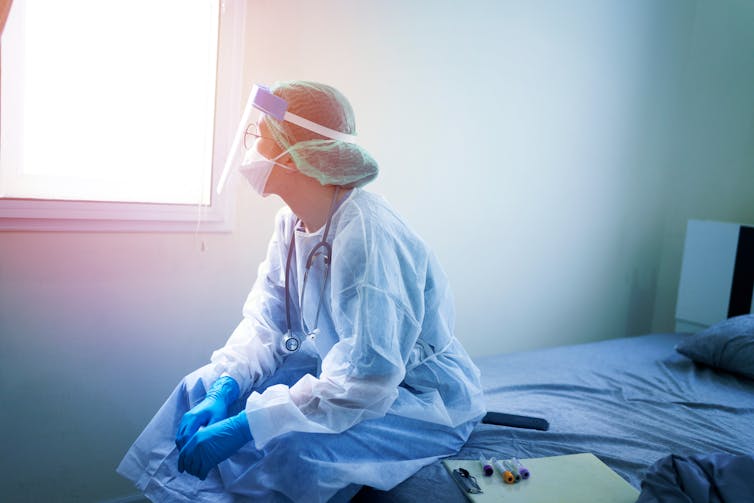 During the coronavirus pandemic, health-care staff are going through the same trauma as the people they’re looking after.
Shutterstock
During the coronavirus pandemic, health-care staff are going through the same trauma as the people they’re looking after.
Shutterstock
Since 2001, Tosone’s concept of shared trauma has been used to explore the experiences of hundreds of clinicians, particularly trauma and mental health workers and researchers impacted by catastrophic events, such as natural disasters, school shootings, human conflict and war.
In essence, the helping professional experiences a sort of doubling of their trauma – they’re experiencing the same traumatic event as an individual member of the community and as a professional providing services to people directly affected.
A tough time to be a health-care worker
Clinicians are not only dealing with the confronting reality of the risk to their own health in caring for patients with COVID-19, but the environments in which they work are rapidly changing.
For example, health-care workers are having to quickly navigate new technologies in providing clinical care, as well as evolving protocols and systems.
Some might be worried about the pandemic’s impact on their role, which may include job loss or redeployment.
Read more: We need to flatten the 'other' coronavirus curve, our looming mental health crisis
Anxiety may also come from not being able to minimise risk, such as not having enough personal protective equipment (PPE), and the fear of bringing home COVID-19 to their families.
The distress for health-care professionals who have infected others, including people in their care, would be uniquely difficult.
Alarmingly, health professionals have been abused by the general public out of fear they may spread the virus.
We’ve also seen reports of an increase in racism towards health-care staff of Asian appearance.
Moral distress
Health-care workers may also be experiencing high levels of moral distress as a result of having to make difficult decisions.
Moral distress occurs when clinicians feel emotionally, psychologically, spiritually and professionally compromised when they’re unable to deliver care consistent with their personal and professional values.
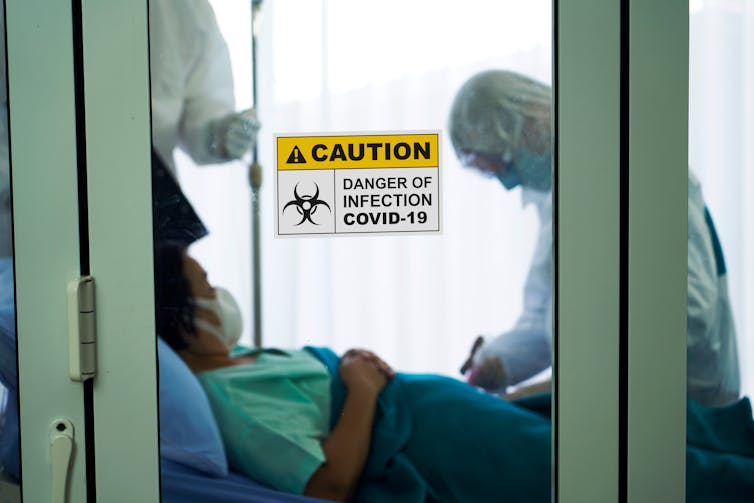 Health-care staff may need to make difficult decisions during the pandemic.
Shutterstock
Health-care staff may need to make difficult decisions during the pandemic.
Shutterstock
Fortunately in Australia we’ve been able to avoid scenarios where clinicians have had to choose one patient over another to receive life-saving treatment due to resource limitations.
But medical professionals here have had to modify the usual practices around care of dying patients. The inability to support families in this context has caused much distress to doctors and other clinicians in relation to care of patients who have died from COVID-19.
Rising to the challenge
Health-care professionals are aware of their own vulnerability during this pandemic. Even knowing colleagues across the globe have died from COVID-19, they continue to step up to the challenge.
Research shows clinicians in these shared traumatic environments recognise they have a key role in caring for their community, even when experiencing their own elevated levels of anxiety and personal risk.
Clinicians have reported identifying more deeply with patients, as well as a higher level of openness and an increased sense of compassion between professionals and their patients than would happen under normal circumstances.
However, clinicians also reported a need for a significantly higher level of attention to their judgement and decision making in relation to clinical assessments and interventions.
Read more: To improve firefighters' mental health, we can't wait for them to reach out – we need to 'reach in'
COVID-19 brings ongoing uncertainty and an anticipatory anxiety about what the future holds. For example, will we experience the large number of deaths that have occurred overseas once our restrictions ease?
If we place the COVID-19 pandemic within the context of shared trauma, it not only recognises the impact on our health-care staff in the current climate, but highlights the fact our health-care staff are part of our communities.
The collective mental health of those impacted by COVID-19 heightens the risks for a potential range of mental health issues such as depression, anxiety, traumatic grief, post-traumatic stress disorder and prolonged grief disorder in the immediate and long-term future.
Although mental health services are responding to the current need, continued mental health assistance for health-care staff for the longer term is imperative.
While perceiving them as heroes is a positive public accolade, it does create an illusion of martyrdom, camouflaging what is really required – quality ongoing support.
Authors: Pippa Blackburn, Adjunct Senior Lecturer, Griffith University, Qld, Griffith University

















