

Solar Panel Maintenance Tips for Melbourne Homes
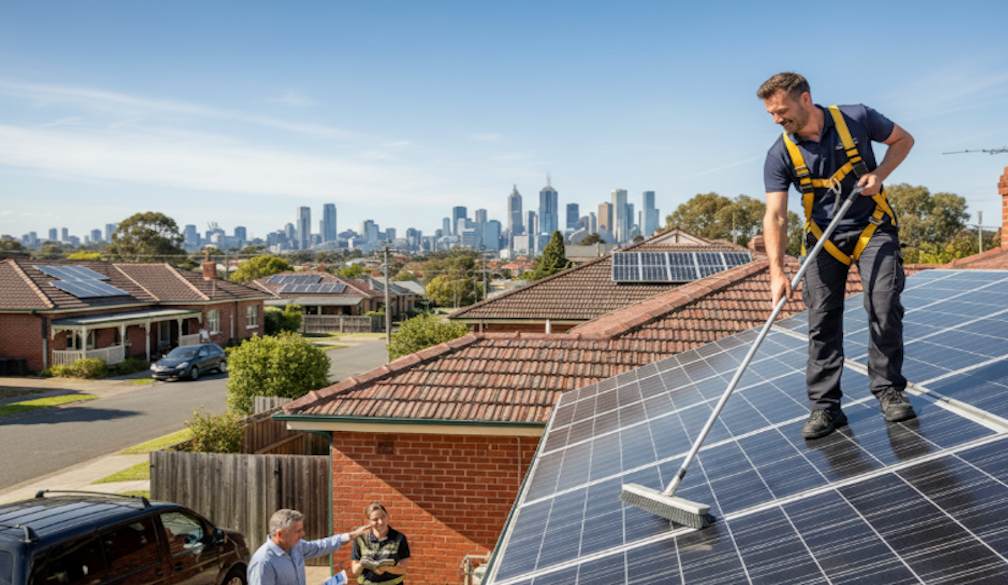
Three years in and the panels are still on the roof. The inverter is still blinking. The electricity bills are still lower than they used to be, roughly. Most Melbourne homeowners at that point assume everything is fine. Some of them are right. A fair number are not, and they have no way of knowing the difference.
Melbourne conditions are not forgiving on panels
Rain keeps panels clean. That is the assumption, and it is not entirely wrong. But it is incomplete in ways that cost money quietly.
Melbourne's spring carries pollen loads that film across low-tilt panels and resist rainfall. Summer brings fine dust on the north wind, settling across the same surfaces. Pigeons and starlings treat panel edges as perches, and what they leave behind is not a cosmetic problem. A dropping sitting on a cell creates a hot spot underneath it, where the shaded cell forces the others in the same string to work around it, generating heat and causing damage that compounds over months.
Roofs pitched at 10 or 15 degrees, common across Melbourne's western and northern suburbs, drain poorly compared to steeper pitches. Grime builds up. Rain skims over the top without dislodging it. From the footpath, the panels look fine. From the data, they are not.
Soiling losses of five to fifteen percent over a Melbourne summer are not unusual on panels that have gone years without attention. That figure does not announce itself on a bill. It accumulates, invisible, until the gap is hard to ignore.
The inverter knows things most homeowners don't
Every solar inverter logs performance data. Fault codes, efficiency trends, communication errors between the panels and the grid. Most systems installed in the last five years include a monitoring app that surfaces all of it.
Most homeowners open it once, find it unremarkable, and never go back.
That is where problems hide. A string of panels with a failing bypass diode or a loose DC connection will show up in inverter data months before it registers on a power bill. Systems where monitoring was never properly configured after installation carry fault codes that have been sitting there, unread, since the first summer. None of it is dramatic. All of it matters.
Shading is the other silent issue. A liquid amber that was knee-high when the panels went in is now throwing shade across the eastern array from 3pm onwards every autumn afternoon. The inverter records the drop in output. Nobody has looked.
Systems installed by operators who have since left the industry sometimes carry wiring and configuration decisions that do not meet current CEC standards. That does not always show up as an obvious fault. It shows up as a system that works, just not as well as it should.
What maintenance actually looks like
Output check first. Pull up the monitoring app and compare generation for the same month, year on year. A five percent annual drop sits within the normal degradation range. Fifteen percent does not. If monitoring was never configured at installation, a solar company in Australia holding CEC Approved Retailer accreditation can retrieve historical data directly from the inverter and build a baseline to work from.
Twice a year, look at the panels from the ground. Not carefully. Just look. Visible soiling, cracked glass, a shifted mounting, a branch that landed and stayed, a new shadow from next door. Then check the inverter display. Green indicator, output reading in the expected range, no fault codes showing. If any of those three are off, it is worth a call before it becomes something bigger.
Cleaning is not a calendar event. It depends on pitch, orientation, and local conditions. A steeply pitched north-facing roof in Eltham that catches regular rainfall may go two years without professional attention. A shallow west-facing system near Tullamarine under the flight path will need it sooner. The monitoring data tells you which situation you are in.
Do not go on the roof to do it yourself. Terracotta and Colorbond are dangerous underfoot, particularly on a wet Melbourne winter morning. Cold water sprayed onto panels that have been sitting in full sun causes thermal shock, microcracking, and the kind of damage that voids warranty without leaving a visible trace. Professional cleaning uses deionised water at the correct pressure, and the liability stays with the person holding the equipment.
Helcro Solar has been running site assessments across Melbourne for over 18 years, and what turns up on an inspection follows a consistent pattern. Soiling losses on systems that have never been cleaned. Fault codes on inverters where the monitoring app was never set up. Mounting issues on systems where hardware decisions were made quickly. None of it is catastrophic on its own. Left unaddressed, it compounds.
Inverter service life runs ten to fifteen years under normal conditions. A unit mounted in an enclosed space with poor ventilation throttles output before it fails outright, and most homeowners assume the panels are the problem. Any system approaching the ten-year mark is worth having assessed on its own terms.
What a well-maintained system actually does
It runs close to its rated output, year after year. The warranties on the panels and inverter remain intact because the conditions that void them, improper cleaning, ignored fault codes, unaddressed thermal stress, have been managed rather than ignored. The homeowner knows what the system is generating each month because they have looked at the monitoring data at least once since installation.
That is not a demanding standard. It is just a consistent one.
The panels are doing their job. The question is whether the routine around them is doing its job too. Get that right and a well-designed Melbourne system will keep delivering for twenty years.





















