

Let's heed the warnings from aged care. We must act now to avert a COVID-19 crisis in disability care
- Written by Helen Dickinson, Professor, Public Service Research, UNSW
In Victoria there are nearly 80 active COVID-19 cases linked to more than 50 disability accommodation sites. At least two people have died.
These don’t sound like big numbers in the context of Victoria’s second wave, and particularly when we compare it to the COVID-19 crisis in residential aged care.
But similarities between residential disability care and aged care — including vulnerable residents and a casualised workforce — give us cause for concern.
Recent experience in Victoria’s aged-care sector shows the potential for the current outbreaks to escalate very quickly.
What is residential disability care?
When we talk about residential disability care, this includes group homes and respite services. Usually these have fewer than six residents.
We’re also talking about larger facilities such as supported residential services. These privately-run services accommodate between ten and 80 residents.
In Victoria, around 6,500 people receive disability accommodation or respite services.
Read more: People with a disability are more likely to die from coronavirus – but we can reduce this risk
We’ve already seen COVID-19 outbreaks in group homes, respite services and supported residential services in Victoria. One notable example is Hambleton House in the Melbourne suburb of Albert Park, where 15 residents and one staff member tested positive.
The Victorian government recently requested help from the federal government following outbreaks at a number of disability accommodation sites.
An ‘at risk’ group
Australians with disability are at heightened risk during COVID-19 because many have other health conditions (for example, problems breathing, heart disease, diabetes). This makes them more likely to be sicker or die if they become infected.
People with disability are also more likely to be poorer, unemployed and socially isolated, making them more likely to experience poor health outcomes during the pandemic.
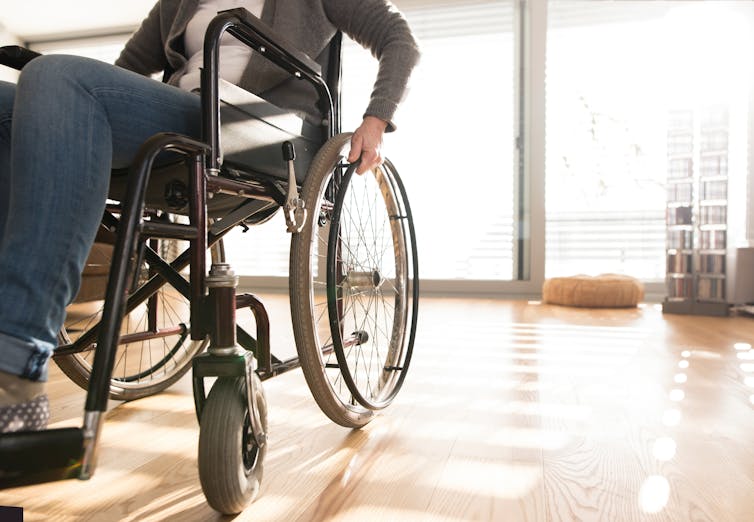 People with a physical disability or an intellectual disability can be at higher risk from coronavirus.
Shutterstock
People with a physical disability or an intellectual disability can be at higher risk from coronavirus.
Shutterstock
Many people with disability, particularly those with complex needs, require personal support, which puts them in close contact with other people. Different workers will come through residential disability-care settings, sometimes moving between multiple homes and services, just as in aged care.
The potential for coronavirus spread is also high because some residents may have difficulties with physical distancing and personal hygiene. They may have trouble understanding public health recommendations and/or have behavioural or sensory issues that make these recommendations hard to follow.
Read more: 'I'm scared': parents of children with disability struggle to get the basics during coronavirus
Aged care and disability care
Federal NDIS Minister Stuart Robert has said disability and aged-care settings differ because aged-care settings tend to be larger than disability accommodation, and this is generally true.
But as well as their vulnerable residents, they share many important similarities — including communal living arrangements and a highly mobile, precariously employed workforce.
This is a significant risk factor because casual, low-paid workers have greater incentive to come to work when they’re sick. Recent government moves to provide financial compensation or paid pandemic leave when workers need to take time off to get tested and/or self-isolate are welcome, but came too late.
The disability sector also lacks a “surge workforce” — people skilled in disability support who are able to step in and provide care in the event usual workers become sick. In aged care we’ve seen a lack of appropriate workers during the pandemic lead to neglect.
A lack of planning and preparedness
Since at least April, disability advocates have been warning about the potential for COVID-19 outbreaks in residential disability care. But there’s been little active work to develop preventative strategies or plans to deal with an outbreak.
A national plan has addressed the needs of people with disability in relation to COVID-19, and state and territory governments have also produced their own plans. But these plans don’t include effective strategies specifically for residential disability settings.
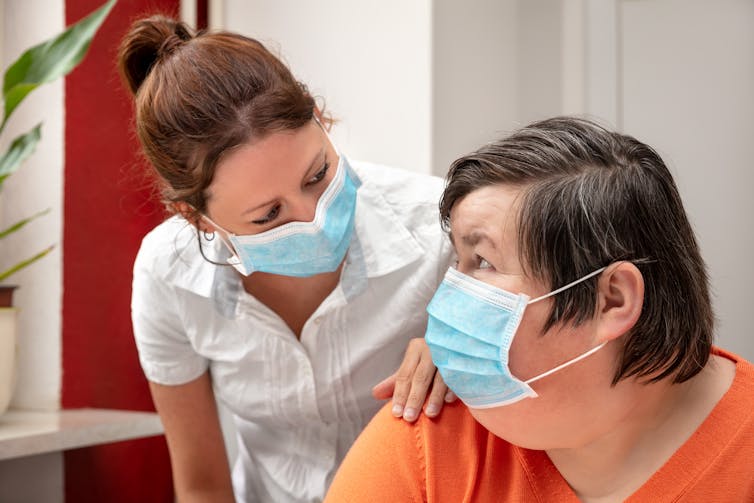 Our research found disability support workers feel inadequately prepared in the use of PPE.
Shutterstock
Our research found disability support workers feel inadequately prepared in the use of PPE.
Shutterstock
Importantly, disability support staff appear to be be inadequately trained and prepared with regards to personal protective equipment (PPE).
We recently surveyed 357 disability support workers from around Australia. More than one-quarter reported cancelling shifts because they feared they might contract coronavirus at work. Not all workers had accessed even basic infection control training, and of those who had, half wanted more.
Even those properly trained to use PPE can’t necessarily access it. Distribution of PPE has been beset with difficulties and the disability workforce hasn’t been a priority.
Read more: 4 steps to avert a full-blown coronavirus disaster in Victoria's aged care homes
So the outbreaks we’ve witnessed among residents and support workers in disability accommodation are not particularly surprising. They indicate services, workers and governments weren’t as prepared as they should’ve been to respond to this public health emergency.
What now?
Here’s how we could prevent the current COVID-19 infections in residential disability care in Victoria from becoming more widespread, and avoid the deaths we’ve seen in residential disability services in other countries.
First, we should reduce the number of workers who support people across multiple sites. Some states have banned staff working across multiple aged care sites to minimise contacts. This approach might be more difficult in disability services, but we should encourage it wherever possible within workforce constraints.
The federal government should update current guidelines for disability support workers around PPE and enhance their training in its use.
Where residents are suspected or confirmed to have coronavirus they must be separated from uninfected residents to prevent spread. If the facility they’re in is too small to accommodate this, it may mean moving them to another appropriate location.
Finally, we need urgent action to create surge disability support workforce capacity and trained health staff who can be rapidly deployed to work alongside disability support workers if the situation deteriorates.
Authors: Helen Dickinson, Professor, Public Service Research, UNSW

















