War on the demolishers? Probably not, and timing of NSW heritage review is curious
- Written by James Lesh, Research Fellow, Melbourne School of Design, The University of Melbourne
The New South Wales government has released a discussion paper expressing its ambition to review and “modernise” the Heritage Act (1977). Announcing the review, Arts Minister Don Harwin said:
“Too often we see once cherished heritage properties experience dilapidation by neglect.”
Harwin was alluding to the troubling practice known as demolition by neglect. This is when property owners fail to maintain historic buildings in order to hasten their demise and leave no option but demolition.
So, is the review designed to crack down on this cynical exploitation of an apparent loophole in the system, paralleling recent reforms in Victoria? Probably not.
Read more: Stuck in the past: why Australian heritage practice falls short of what the public expects
One way to understand what has really prompted the review is to turn to the purpose of heritage legislation generally. Its primary stated objectives are to protect and promote heritage.
If we can all agree about what heritage is, that seems straightforward. But do we?
Another way of discovering what heritage legislation does is to ask what problems it sought to fix in the first place. This requires some historical context. We should also consider what the future role of heritage could be.
War on the demolishers
In 1825, French writer and politician Victor Hugo launched his public career with a powerful essay, War on The Demolishers. It was arguably the first major political broadside launched on behalf of architectural and urban conservation.
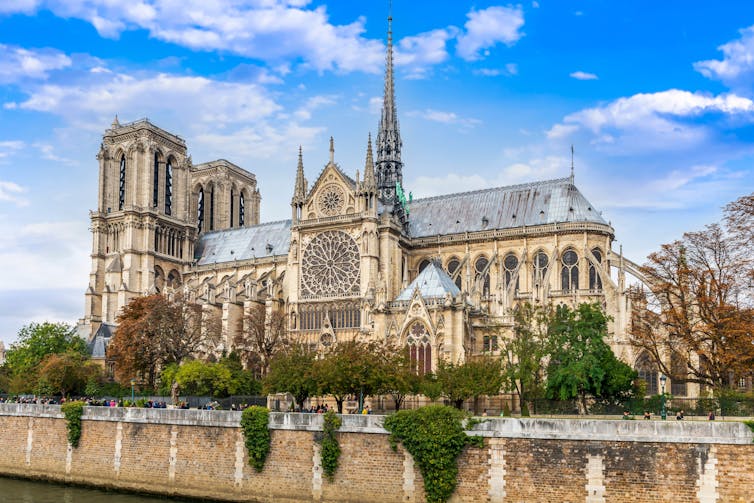 Notre Dame Cathedral was one of the inspirations for Victor Hugo’s essay.
Shutterstock
Notre Dame Cathedral was one of the inspirations for Victor Hugo’s essay.
Shutterstock
While Hugo’s war raged in France and Britain, it lacked a prominent Australian battleground until the mid-20th century. In Sydney, between 1971 and 1974, the Builders’ Labourers Federation famously launched a militant campaign of work bans: the Green Bans. This direct-action advocacy tool, on behalf of community groups, was then applied to places across Australia, frustrating developers.
Read more: Our cities owe much of their surviving heritage to Jack Mundey
State and Commonwealth governments mediated. The NSW Heritage Act (1977) was the new Wran Labor government’s attempt to achieve peace in this local war on the demolishers. It built on the legislative precedent set by the Victorian Liberal government in 1974.
Competing outlooks
Almost half a century later, we need to reflect on the system while charting new directions for it. The NSW discussion paper explores no less than 19 “focus questions”. Many appear to be well founded, but will be challenging to resolve all at once.
Existing legislation is not the underlying cause of all the identified concerns. Rather, authorities responsible for heritage are under-resourced and rely on dated policy and practice instruments. As well as acting on these issues, the inquiry will need to articulate a clear vision for heritage governance and management.
Embedded in the discussion paper are two overarching – but competing – outlooks for heritage. First, adopting a traditional view, the government promises to renegotiate the peace with “the demolishers”. Second, acknowledging shifting public and development attitudes, the discussion paper recognises heritage has an unrealised capacity to better respond to social, environmental, economic and cultural opportunities.
Read more: Why heritage protection is about how people use places, not just their architecture and history
In the traditional view, heritage values are always implicitly of the past. Any change to a designated place can only diminish its established aesthetic, historic and social qualities. Basically, this means legislation must act as the strongest possible barrier to materially changing places, to accrue wins for heritage against the demolishers: a zero-sum game.
In the emerging view, the value of heritage lies in its capacity to enhance places. Although historic sites and areas remain our past inheritance, the objective becomes to promote the sustainability and continuity of places and their evolving values. In this view, the law can direct change and development, as guided by public participation, design interventions and cultural values. In this way heritage policy and process can amplify the significance of places.
Confidence in conservation
Heritage is grappling with the inherent tensions between traditional and emerging views. Even if new legislation is developed, its translation into meaningful policies will prove challenging, particularly if these are still tied to traditional assumptions within governance and management.
Public confidence is paramount. Understandably, some suspect the hidden agenda of the NSW review is to fast-track development. Recent public comments by the state treasurer about the White Bay Power Station and government actions in connection with the Sirius Building, Willow Grove in Parramatta and WestConnex in Haberfield erode confidence in the protection of heritage and urban governance more broadly.
 The state’s attitude to preserving the social heritage represented by the Sirius building in Sydney does not inspire confidence.
Shutterstock
The state’s attitude to preserving the social heritage represented by the Sirius building in Sydney does not inspire confidence.
Shutterstock
Read more: Saving Sirius: why heritage protection should include social housing
The timing of the inquiry is also curious. For more than a decade, the NSW government has been examining the antiquated structure in which Aboriginal cultural heritage is largely administered under the National Parks and Wildlife Act (1974). Instead of completing that important work, attention has prematurely shifted to the less troubling Heritage Act.
This century, Queensland and Victoria have modernised their Aboriginal heritage legislation to bring Aboriginal decision-making to the fore. The passage of standalone Aboriginal heritage legislation in NSW should be the first priority. Not only could that correct a fundamental historical failing, but it would also provide a set of policy precedents and pathways for linking up heritage policy in the state.
Read more: What kind of state values a freeway's heritage above the heritage of our oldest living culture?
New models
Adapting heritage governance for the 21st century calls for a long-term view and substantial consultation.
Scotland, for instance, has spent much of the past decade engaging with the heritage and development sectors and the wider public about its legislation. Its Infrastructure Commission has recommended a “re-use first” principle for its assets. Moving away from the instrument of heritage listings, property owners might instead have to justify demolition against sustainability principles.
Authorities should be developing models of heritage governance that enhance public participation and the inherited environment. Heritage conservation needs to be reimagined to renew its mission as a centrepiece of aspirations towards social, environmental, economic and cultural sustainability. If our leaders and policymakers can achieve this, they might be able to declare, at least temporarily, a halt to hostilities between communities and the demolishers.
The National Trust of Australia (NSW) is holding a public forum to discuss the review on June 9 2021.
The NSW Parliament’s Standing Committee on Social Issues is accepting submissions on the review of the Heritage Act 1977 until June 27 2021.
Authors: James Lesh, Research Fellow, Melbourne School of Design, The University of Melbourne