

Why the way we talk about Olympian Laurel Hubbard has real consequences for all transgender people
- Written by: Holly Thorpe, Professor in Sociology of Sport and Physical Culture, University of Waikato
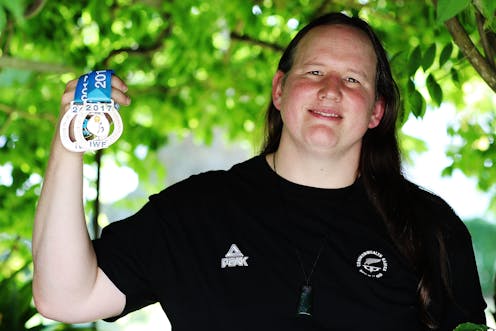
When Laurel Hubbard was announced as the first out transgender woman athlete to compete in an individual sport at an Olympic Games, controversy wasn’t far behind. One prominent commentator even called it a “disaster for women’s sport”.
In Aotearoa New Zealand, the topic was hotly debated across television, radio, newspapers and social media. And earlier this week there was a protest outside the New Zealand High Commission in London against Hubbard’s inclusion in the weightlifting team.
The arguments are emotive and polarising, and often ignore key facts — in particular that Hubbard qualified through processes outlined by the International Weightlifting Federation and the International Olympic Committee.
More broadly, the language deployed has real consequences beyond this specific debate. It is important, therefore, to consider the impact this can have on the mental health and well-being of transgender athletes, and transgender communities in general.
Whose voices are heard?
Sadly, the perspectives most often absent from these debates are those of transgender athletes themselves.
But the backlash against Hubbard following the 2018 Commonwealth Games, echoing now in the lead-up to the Olympics, contributes to a climate in which transgender athletes don’t feel safe speaking to the media.
By protecting their own mental health and well-being, their stories, their humanity and their courage are largely lost from the media narrative. That is a loss to us all, leaving the wider discussion about transgender people’s participation in sport to centre around often ill-informed fears.
Read more: The debate over transgender athletes' rights is testing the current limits of science and the law
This has serious implications, as the power of the media to reinforce or sometimes challenge stereotypes and misunderstandings about transgender athletes is well established.
Preliminary analysis of 111 articles on the day of Hubbard’s Olympic inclusion shows 33 (mostly from the UK) “deadnamed” her — meaning they deliberately used her pre-transition name. Referring to people as they choose to be known should be a basic principle of media ethics.
Discriminatory language, underpinned by fear, phobias and characterisation of transgender athletes as “cheats” or worse, is likely to contribute to the already very high levels of psychological distress and suicide among transgender communities.
Selective science
We need to be careful about other aspects of the language being used to argue against Hubbard’s inclusion in the Olympics, and transgender participation in sport generally.
Often this language plays on fear and misinformation, rather than being based on well-founded evidence. For example, there is a tendency to selectively cite research focused on testosterone levels, although the science on this is far from settled.
Other research has shown many variables contribute to sporting performance and achievement. Bodies come in all shapes and sizes, and testosterone is just one part of a much bigger picture of what builds sporting greatness.
Many researchers and experts are encouraging approaches that go beyond physiological criteria to better recognise the complex social (rather than strictly biological) understandings of athletes’ gender experiences.
A growing body of research also shows the importance of ethics and human rights as the basis for developing sporting policy and law that enable transgender people to participate in sport at elite and community levels.
The importance of listening
Unfortunately, the entire topic is too often approached from a position of ignorance rather than curiosity and compassion. As one researcher has argued:
Those persistent in their views that trans women ought not to compete with cis women in elite women’s categories would benefit from talking to trans women, getting to know trans athletes, and reading the qualitative research that delves deeply into trans athletes’ experiences, motivations and reasons for participating in sport.
This was reinforced in a recent report from the United Nations independent expert on protection against violence and discrimination based on sexual orientation and gender identity:
All persons who struggle against violence and discrimination based on sexual orientation and gender identity have in common certain lived experiences that should provide a notion of the importance of seeing each other, listening to each other and acting towards each other with kindness and compassion.
The report specifically challenged the belief that the inclusion of trans women threatens women’s sport. It called instead for evidence-based approaches to ensure sports promote the development of all girls, including those who are trans.
Read more: World Rugby's proposed ban on trans athletes is wrong. History shows inclusion is possible
A teachable moment
Meanwhile, mainstream debate is still too often bound up in polarising rhetoric and confused argument. At this important moment in the history of sport, that needs to change.
Hubbard’s groundbreaking Olympic inclusion offers a genuinely teachable moment that allows us to work towards a more constructive dialogue. The work being done by researchers and activists with online resources such as Proud2Play in Australia and Athlete Ally in the US is particularly helpful here.
Finding new ways of speaking about the topic can flow into developing more inclusive and supportive policies and practices in sport at elite and community levels.
More than anything, we need to remember those most directly affected by current media debates and campaigns. That includes the trans girls and young women who simply want to be able to play on their school or club sports teams.
Authors: Holly Thorpe, Professor in Sociology of Sport and Physical Culture, University of Waikato


















