

No, we can’t treat COVID-19 like the flu. We have to consider the lasting health problems it causes
- Written by: Zoë Hyde, Epidemiologist, The University of Western Australia
Earlier this month, the Australian government announced a four-phase plan to return us to something resembling normality. Under this plan, Prime Minister Scott Morrison said, we will eventually treat COVID-19 “like the flu”.
The hope is vaccines will allow us to live with some transmission without many people getting seriously ill or dying.
But death and hospitalisation aren’t the only outcomes of COVID-19 we need to prevent. New research shows even young people can be left with chronic health problems after infection.
COVID-19 will always be a very different disease to the flu. We should aim to stamp it out like measles, not let it spread.
A common misconception
Many people think only the elderly are at risk from COVID-19. Looking at the statistics, it’s easy to see why that misconception came about.
A study of people who tested positive for COVID-19 during the second wave in the United Kingdom found only around 1% of children and 2-3% of young adults had to be hospitalised. In contrast, more than 10% of those aged over 60 needed to go to hospital.
The risk of dying from COVID-19 follows a similar pattern. Only one in 20,000 children who become infected are likely to die, compared to more than one in 100 adults over 60.
But these figures don’t tell the whole story. Many people who have had COVID-19 and survived haven’t returned to their previous state of health.
Read more: Australia has a new four-phase plan for a return to normality. Here's what we know so far
COVID-19 can cause lasting health problems
A study of people who were hospitalised for COVID-19 during the first wave in the UK found these patients were four times more likely to be readmitted to hospital and eight times more likely to die than a matched control group over an average follow-up period of four to five months.
The researchers found these people were particularly likely to develop diabetes, heart disease and kidney disease.
People can also experience complications after having the flu, but we’re seeing this more frequently with COVID-19, and the complications are more serious.
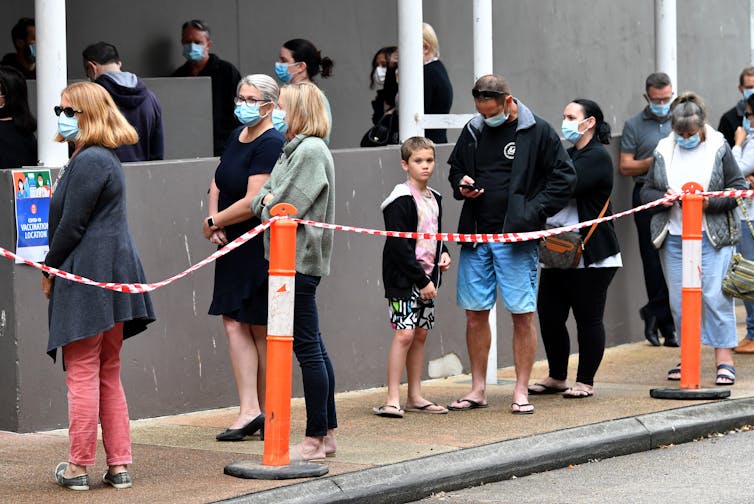 Australia’s COVID vaccination rollout is ongoing.
Darren England/AAP
Australia’s COVID vaccination rollout is ongoing.
Darren England/AAP
Even people who aren’t unwell enough to go to hospital with COVID-19 can experience complications.
A Sydney study found one-third of people with mild-to-moderate COVID-19 were left with persistent symptoms lasting at least two months, including fatigue and shortness of breath. More than 10% had impaired lung function.
This potentially life-altering condition has a name: long COVID.
Long COVID affects young people too
The UK’s Office for National Statistics has calculated about one in seven people who contract COVID-19 will experience persistent symptoms lasting at least 12 weeks.
They estimate nearly one million people are currently living with long COVID in the UK, and 40% of them have been living with the condition for over one year. Two-thirds report being adversely affected in their day-to-day activities as a result of long COVID, and 18% report they are limited a lot.
While children are very unlikely to die from COVID-19, the Office for National Statistics estimate 7-8% of children and adolescents who get infected will develop long COVID.
They estimate 10,000 children and 16,000 adolescents in the UK have been living with long COVID for at least 12 weeks.
The condition is so common that the UK’s National Health Service is opening 15 long COVID clinics for children.
What does this mean for Australia?
COVID-19 is a very different disease to influenza, and our reopening plan should ensure it doesn’t get a foothold in Australia. The alternative would have huge economic and social costs, owing to the large number of people likely to be left with chronic health problems.
We can work towards reopening safely by first reaching herd immunity through vaccination.
With the emergence of more transmissible variants such as the Delta variant, we’ll likely need to vaccinate more than 90% of the population to achieve herd immunity. This is an ambitious goal, but we already achieve it as part of routine vaccination for measles in childhood.
To reach that target, we’ll need to offer vaccination to children and adolescents, who also need protection from long COVID.
Some have suggested vaccinating adults may be sufficient to reach herd immunity, but Israel has shown us this isn’t the case. New outbreaks linked to schools have forced the country to bring back a mask mandate and step up vaccination in adolescents.
 To reach herd immunity, we’ll need to vaccinate children and adolescents against COVID-19.
Shutterstock
To reach herd immunity, we’ll need to vaccinate children and adolescents against COVID-19.
Shutterstock
What else do we need to do?
It will take time to achieve herd immunity in Australia. So we’ll need to keep a strong quarantine system in place until we’ve got the job done.
We’ll also need to closely watch the situation overseas and be prepared to roll out a third booster dose in response to emerging variants.
We should also be prepared to give people who have received the AstraZeneca vaccine a third booster dose of the Pfizer vaccine, when supplies are available.
While both the AstraZeneca and Pfizer vaccines are more than 90% effective at preventing severe disease, the AstraZeneca vaccine is slightly less effective at preventing infection overall.
We don’t know how well either vaccine prevents long COVID, but again, the best defence will be to have a high level of vaccination in the community.
Inevitably, Australia will experience future outbreaks of COVID-19, just as we sometimes do with measles. But we should have a very low tolerance for the degree of transmission we’re prepared to accept.
The coronavirus is an airborne virus that’s more transmissible than influenza, and causes more severe disease. It’s not a flu-like illness and never will be.
Authors: Zoë Hyde, Epidemiologist, The University of Western Australia


















