

When will we reach herd immunity? Here are 3 reasons that's a hard question to answer
- Written by: Julie Leask, Professor, University of Sydney
As we try to control COVID-19, many people are keen to know what proportion of the population will need to be vaccinated in order to reach “herd immunity”.
It’s a reasonable question. People are asking because they want to know when we’ll see an end to lockdowns; when they’ll be able to reunite with loved ones overseas; when their businesses will have more security; when headlines will no longer be dominated by COVID-19.
Right now expert modellers are plugging in numbers and looking at various scenarios to estimate the scope of protection different levels of vaccination coverage will give us. We’re expecting to see the results of this modelling from the Doherty Institute as early as this week.
But it’s important to acknowledge it’s difficult to pin down a single magic number for herd immunity.
What is herd immunity again?
To understand why experts often avoid pinpointing a single vaccination figure needed to reach herd immunity for COVID-19, let’s first recap the concept.
Herd immunity is when immunity in a population is high enough to block the pathway for the ongoing transmission of the disease.
While vaccination provides each of us with direct protection against disease, with herd immunity, even people who are unvaccinated benefit from that blocked transmission pathway.
Different diseases have different thresholds for herd immunity. For measles, for example, the herd immunity threshold is 92%-94%. Estimates for COVID-19 have varied, with some putting it at 85% or higher.
However, many hesitate to give a single number. Here are three reasons why.
Read more: What is herd immunity and how many people need to be vaccinated to protect a community?
1. Variations in the vaccines, and the disease itself
A single herd immunity figure is difficult to estimate when the infectiousness of SARS-CoV-2 (the virus that causes COVID-19) remains so variable.
We understand the infectiousness of a disease by looking at the R0, or reproduction number — the average number of people infected by one case where no control measures are in place. The ancestral strains of SARS-CoV-2 have an R0 of 2-3, but Delta is estimated to be twice as infectious, with an R0 around 4-6.
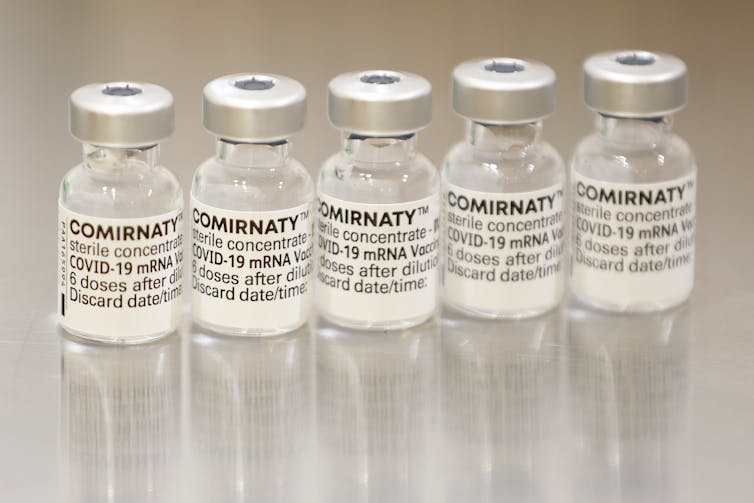
The type of vaccine, doses given (whether one or both), and how well the vaccines cover the different variants all factor in.
Estimates from the United Kingdom show two doses of the Pfizer vaccine are between 85% and 95% effective against symptomatic disease with the Alpha variant, while two doses of AstraZeneca are 70% to 85% effective. Overall vaccine effectiveness appears to drop about ten percentage points with the Delta variant.
The lower the vaccine effectiveness, the higher the level of coverage we’ll need to control COVID well.
 Vaccine effectiveness can differ between different vaccines.
Daniel Pockett/AAP
Vaccine effectiveness can differ between different vaccines.
Daniel Pockett/AAP
2. We cannot cover the entire population yet
The Pfizer vaccine has now been provisionally approved for 12-15-year-olds in Australia. If it becomes routinely recommended for this age group, it will still take time to vaccinate them. Even once that occurs, there will remain a gap in our population protection among younger children.
Children should benefit somewhat from adult vaccination. In England, where overall vaccine uptake is 48.5% for two doses, there was initially a decline in infections for children aged under ten years. This is partly due to indirect protection offered by adults being vaccinated.
Read more: How well do COVID vaccines work in the real world?
3. Population protection will vary in time and space
There is rarely a neat threshold after which everything changes for good. Vaccine protection in individuals is likely to wane over time. With that and new variants appearing, we will almost certainly need boosters to sustain population protection against COVID-19.
With influenza vaccination, we rarely even talk about herd immunity, because the duration of protection is so short. By the next flu season, immunity from the current season’s vaccine will be much less effective against the newest viral strain.
Spatially, protection can vary across localities and demographics. Even in a country that has reached a herd immunity threshold for vaccination coverage against measles, you can see small outbreaks in pockets of lower coverage in kids, or where a cohort of teens and adults weren’t adequately vaccinated as children.
The capacity to achieve herd immunity is also affected by population density and how much people in a population mix with a variety of others — what’s called heterogeneity of mixing.
 We don’t yet have a COVID vaccine approved for children under 12.
Shutterstock
We don’t yet have a COVID vaccine approved for children under 12.
Shutterstock
Life will gradually change as more people are vaccinated
Given these factors, it’s understandable experts often avoid giving a single figure for herd immunity.
With the infectiousness of Delta, we will need very high vaccination rates. Then, life will look different, particularly once this happens globally. Australia will be able to relax its border restrictions. We will likely see modified forms of quarantine, such as home quarantine, for those who are fully vaccinated.
COVID outbreaks will happen, but they will be less risky, with fewer people susceptible to serious illness. City or state-wide outbreaks will be replaced by more localised ones.
We will still require good public health measures like rapid contact tracing and isolation. Rapid tests may be used more often. New treatments may be found.
All the while, we need to be as concerned about global vaccine coverage as we are about national coverage. Because all people, regardless of means, have a right to the freedoms and security that come from COVID-19 protection.
And as we’ve heard from global leaders, “None of us will be safe until everyone is safe”.
Authors: Julie Leask, Professor, University of Sydney


















