

How COVID has shone a light on the ugly face of Australian antisemitism
- Written by Naama Carlin, Lecturer, UNSW
The increased prominence of antisemitic incidents during the COVID pandemic may leave you wondering: has antisemitism always been part of the Australian social fabric, or are we facing a new, sinister trend?
Members of Melbourne’s Jewish community have been subjected to a surge of antisemitic abuse in recent weeks, following breaches of public health orders by ultra-Orthodox Jewish worshippers.
And Victoria’s proposed law to ban Nazi symbols — a first for any state or territory — further reinforces how antisemitism is becoming an increasingly visible problem in Australia.
Understanding the origins of modern antisemitism requires looking back at Australia’s history. Both antisemitism and right-wing extremism are linked with the rise of nationalism from the colonial era through the 20th century.
Because of this, it’s impossible to address antisemitism without also taking into account Australia’s colonial history marred with white supremacy.
How COVID conspiracies are fuelling antisemitism
We have recently seen federal and state politicians cautioning against rising rates of antisemitism, but one can’t help but wonder if these comments are merely lip service.
After all, what good is it to acknowledge antisemitism without taking meaningful action to prevent it?
Consider the following: in 2004, federal parliament expressed its
unequivocal condemnation of antisemitism, of violence directed against Jews and Jewish religious and cultural institutions, and all forms of racial and ethnic hatred, persecution and discrimination on ethnic or religious grounds, whenever and wherever it occurs.
Despite that, antisemitic incidents persist: graffiti on Jewish businesses and kindergartens, threats targeting synagogues, and bullying of Jewish children.
The Executive Council of Australian Jewry releases a yearly report on antisemitism in Australia. In the 2020 report, it found a 10% decrease in reported antisemitic incidents compared to the previous year — likely attributable, in part, to COVID lockdowns.
At the same time, however, there was an increase in serious incidents, such as physical assaults, verbal abuse and intimidation.
Read more: New research shows religious discrimination is on the rise around the world, including in Australia
These figures should be taken with caution. The report doesn’t distinguish between legitimate critiques of Israel’s occupation of Palestine and antisemitism. It also cites a problematic and contested definition of antisemitism as a guiding concept.
Nonetheless, the increase in serious incidents speaks to a dangerous antisemitic sentiment being fuelled by COVID-19 propaganda, namely, that Jews are “responsible for coronavirus”.
This conspiracy theory, originating in extreme right-wing corners of the internet, has quickly become mainstream, circulating through message boards and social media. Now, antisemitic signs and behaviours are increasingly showing up at anti-lockdown and anti-vax rallies across Australia.
For instance, stickers were placed around Melbourne during “freedom” rallies last month bearing a Star of David, the numbers 911 and a QR code. When scanned, it led to a website that blamed the September 11 terror attacks on Jewish people.
An anti-vax group called White Rose, meanwhile, has plastered Jewish neighbourhoods in Melbourne with stickers bearing swastikas and the words, “No Jab, No Job.” The group has likened mandatory vaccines and lockdowns to the rise of Adolf Hitler in Germany in the 1930s.
And a recent investigation by The Age, The Sydney Morning Herald and 60 Minutes revealed the extent of neo-Nazi operations in Australia, including connections between COVID disinformation and conspiracies.
A brief history of Australian Jewry
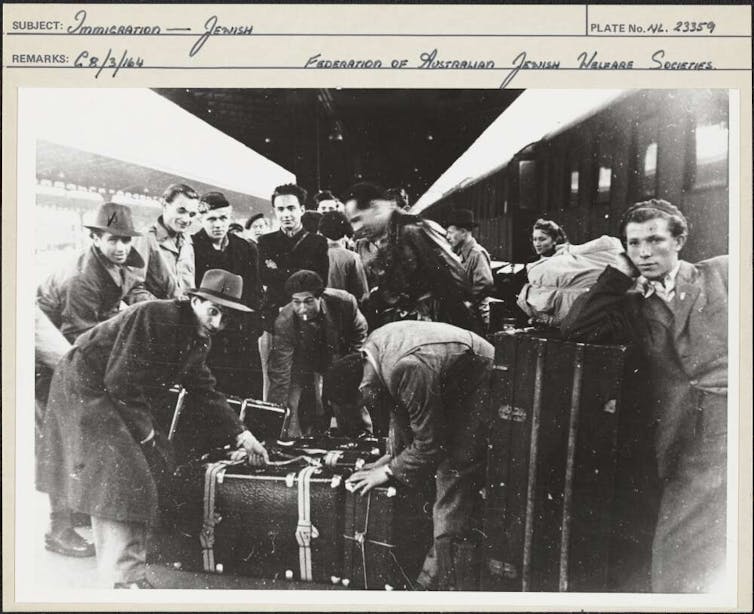
The history of Australian Jewry dates to the start of white colonisation and settlement of this continent. Records in the National Archives show at least eight of the 571 convicts in the First Fleet were Jewish.
While the first waves of free Jewish settlers were largely English speaking, Anglo, and loyal to the “mother country”, subsequent Jewish migration came largely from Germany during the gold rush and as refugees from Tsarist Russia.
After that, the next large wave of Jews migrated from Europe in response to rising fascism.
The Anglo Jewish community, which had largely assimilated by the second world war, was concerned the Jewish community’s standing would be negatively affected by these Eastern European refugees who could be easily marked as “foreign” due to their language, dress and manners.
These concerns were rooted in the historical antisemitism of politicians and trade unions. As historian Malcolm J. Turnbull writes:
sections of the labour movement promoted stereotypes of Jews as manipulative bankers, usurers and profiteers.
And describing the experiences of early Jewish settlers, author Rodney Gouttman writes
negative cultural connotations of the word ‘Jew’ encouraged many Jews to avoid it as a descriptive term for themselves, and ‘Hebrew congregations’ became the preferred name for their faith collectives.
It might seem contradictory that Jews, some of whom came to Australia as part of a colonial project, experienced hatred grounded in colonial racism. However, this is part-and-parcel of the experience of the ever-foreign Jew, needing to assimilate but always seen as “other”.
Is Australia doing enough?
To address this question, we have to recognise that antisemitism cannot be disentangled from other forms of colonial and racial violence and xenophobia.
When we talk about white supremacy and antisemitism, we must talk about racism in all its forms.
In a 2017 study, one-third of respondents said they had experienced racism in the workplace.
The 2020 Mapping Social Cohesion Report, meanwhile, found 37% of respondents had a negative view towards people of the Muslim faith, compared with 9% who held a negative attitude towards Jews. This report demonstrates the urgent need to address antisemitism alongside other forms of racism.
Recently, the Australian Jewish News published an opinion piece calling on the government to appoint an Australian commissioner for antisemitism.
This position would ideally be accompanied by new legislation targeting antisemitism to compensate for what the editorial called the “inadequate” protections under the Racial Discrimination Act.
But this approach segregates the plight of Jews from all other minorities facing daily violence and discrimination. As race critical scholar Alana Lentin says,
the elevation of antisemitism as the racism above all racisms […] constrains solidarity between Jews and other racialised people, thwarting a fuller understanding of race as a colonial mechanism and a technology of power for the maintenance of white supremacy.
So, in order to address antisemitism, we must do two things: understand the Jewish presence in Australia in relation to the country’s brutal colonial history, and understand antisemitism alongside other forms of racial violence.
In these urgent times, we must take a united approach to respond to rising rates of white supremacy and racial violence. Without serious efforts to address the problem of racism as a whole, gestures such as banning the swastika are unlikely to have much material impact.
Authors: Naama Carlin, Lecturer, UNSW

















