

Tornado rips through western NSW — what are tornadoes and what do we need to know?
- Written by: Dale Dominey-Howes, Professor of Hazards and Disaster Risk Sciences, University of Sydney
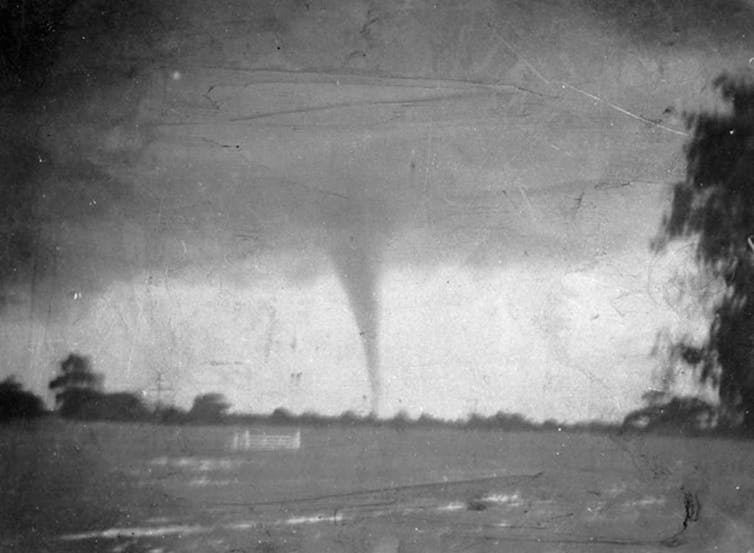
A tornado has swept through central western New South Wales, with the Bureau of Meteorology reporting damage to houses, powerlines and trees around the Clear Creek area, north-east of Bathurst.
But while many think of tornadoes as a rare event in Australia, they are actually surprisingly common, and have killed quite a number of people since European occupation. Geoscience Australia says there have been more than 40 tornado-related deaths in Australia in the past 100 years.
That’s because Australia has the right environmental conditions that favour the formation of tornadoes, which have the fastest wind speeds of any natural hazard type on Earth.
Read more: Tornadoes in Australia? They're more common than you think
Tornadoes are born, they live, they die
Australia has expansive areas of flat land — usually agricultural land — and it’s over these large, flat areas that tornadoes like to form. It’s much the same in “Tornado Alley”, a stretch of central United States where tornadoes are most frequent.
You get thunderstorms developing over these areas of flat land because warm, moist air collides with a front of cold, dry air and that’s exactly what it takes for a storm to be born.
How a tornado forms.You sometimes see a tube coming out from a thundercloud and it’s only once it touches the ground that it’s a tornado.
How long they live on the ground and how far they travel influences the scale of damage.
Most storms only last a few minutes, but in Tornado Alley in the US, there have been tornadoes up to 500m in diameter on the ground for four hours. That kind of tornado would cause monumental damage.
Read more: Explainer: why are tornadoes so destructive?
Some tornadoes touch down briefly and are quite narrow, perhaps just 20m across. They might run for a few metres and then die. Others can be much bigger and obviously if they touch down in a metropolitan area they can do a lot of damage very quickly — and they can behave very unpredictably.
Tornadoes can go up a street and pick one house out on the street and reduce it to a pile of debris, leaving the other houses alone. Or the opposite can happen — every house on the street is smashed but one.
Eventually, tornadoes run out of energy. If the base of the funnel loses contact with the ground, it dies. Most tornadoes occur in the mid afternoon to early evening.
Much like other types of natural hazards, tornadoes can be classified according to their impact. We have a magnitude scale for tornadoes called the Enhanced Fujita scale, which goes from 0-5 (where 5 is the biggest). It’s too early to say what the recent NSW tornado measured on the Enhanced Fujita scale because damage surveys are yet to be completed.
Australia has had some big tornadoes
The BOM has a national tornado database and record of accounts of tornadoes over last century and some were quite big. One of the most memorable tornadoes occurred in December 2015 where a tornado ripped through the Kurnell area of eastern Sydney. No one was killed but people were injured and the tornado caused a lot of damage. Windspeeds got up to 210km per hour. According the BOM, this tornado was recorded as a 2 on the Enhanced Fujita scale.
Generally, Australia gets tornadoes all over NSW and Victoria, as well as the southwestern part of Western Australia.
There is a distinct spatial geography to where tornadoes occur around the world. This map from the National Oceanic and Atmospheric Administration in the US shows those places around the world with the right conditions to allow tornadoes to form.
How do we detect, monitor and give early warning of tornadoes?
The truth is it’s very hard to give precise early warnings. Rather, weather services monitor for the types of conditions right for tornado development because tornadoes can form very quickly.
The Bureau of Meteorology uses Doppler radar to detect them in the short term. In that imaging, they show an unusual thing called a “hook echo”. That’s basically showing inside the thundercloud system, where winds are rotating really fast - a telltale sign that a tornado might be about to form.
But in Australia and in the US, we only usually know when a tornado is coming toward the ground if tornado spotters report them.
Can we expect them to become more frequent with climate change? We’ve got no idea. It’s impossible for climate science to predict because they are such small size phenomena. We need to rely on good planning and great spotters.
Read more: The role of climate change in eastern Australia's wild storms
What should I do if I am in a tornado?
In the US they have evacuation shelters in places such as toilets in malls or airports, which are reinforced with concrete. Residential houses tend to have a central shelter — sometimes in a cellar or under a staircase.
We generally don’t have that in Australia but if you end up in a tornado, it’s basically a case of “duck and cover”.
Find the most secure, reinforced part of the building — which is often the staircase, if the staircase is up against a wall. You want to take shelter in the part of the building that is most likely to stay up if the tornado comes over your head.
Authors: Dale Dominey-Howes, Professor of Hazards and Disaster Risk Sciences, University of Sydney


















