

the 30-year history of Australia’s climate response, in brief
- Written by: Kate Crowley, Associate Professor, Public and Environmental Policy, University of Tasmania
Time is rapidly running out for the Morrison government to announce a new climate policy before the United Nations COP26 climate talks in Glasgow next month. At the 11th hour, the government appears poised to announce a net-zero emissions target for 2050 and, possibly, stronger ambition to 2030.
Infamously, Australia has to date failed to sustain a meaningful climate policy regime. As my latest research has shown, inaction by the federal government has been a particularly effective handbrake on progress. So any new climate targets, and a robust plan to meet them, would be welcome.
The challenge now for the Morrison government is to consign Australia’s fractious climate politics divide to history. The mistakes of the past must be avoided. A new approach is needed, one that delivers on net-zero, with a 2030 target that signals Australia’s intent to join the world in taking climate change seriously.
There is much to learn from analysis of Australia’s poor record, in particular from the divisive “climate wars” which plagued federal politics over the last decade. But Australia’s policy recalcitrance stretches way back, at least 30 years.
To help us understand what’s at stake for Australia at Glasgow and beyond, here’s a quick refresher.
Cast your mind back 30 years
In her detailed history of climate awareness in Australia, academic and journalist Maria Taylor found, through document and interview-based analysis, that as far back as the late 1980s, the Australian public was the best informed on the planet of the urgent need to act on global warming.
She recalls the Hawke Labor government set a target of reducing emissions 20% below 1988 levels by 2005. However, the impetus was lost under the Keating Labor government as the economic recession hit, and concerns about the cost of climate action grew – in particular from the resources industry.
The late 1990s, under the Howard Coalition government, were also lost to inaction. At the 1997 Kyoto climate negotiations, Australia demanded a target that allowed emissions in 2012 to be 8% more than they were in 1990, while developed nations, other than Norway and Iceland, agreed to cut theirs. Australia threatened to walk away from the negotiations if that was not agreed to.
Despite Australia’s demands being met, the Howard government then failed to ratify the Kyoto Protocol, the only developed nation other than the United States to do so.
It did introduce a renewable energy target and propose a carbon tax, prior to losing the 2007 election, as an Australian public gripped by drought sought stronger action on climate change.
 Reporters crowd in front of a TV screen airing a press conference at the UN climate change conference in Kyoto, December 9, 1997.
AP Photo/Katsumi Kasahara
Reporters crowd in front of a TV screen airing a press conference at the UN climate change conference in Kyoto, December 9, 1997.
AP Photo/Katsumi Kasahara
The Rudd Labor government ratified the Kyoto Protocol in 2007. It also attempted to set a carbon price, in the form of the Carbon Pollution Reduction Scheme (CPRS). But the bill failed to pass Parliament after the Coalition and the Greens blocked it in the Senate.
In 2011, the Gillard Labor minority government passed the Clean Energy Act negotiated with her crossbench supporters. This established a carbon pricing mechanism, which critics wrongly branded a “carbon tax”.
Read more: 25 years ago the Australian government promised deep emissions cuts, and yet here we still are
The Abbott years
The Coalition opposition, led by Tony Abbott, was circling. Ever the climate policy pugilist, Abbott pledged to “axe the tax” and repeal other climate policy advances. At the 2013 federal election, he rode those promises into office.
The Abbott government was the first in the world to repeal a carbon price. Gone also were other advances, such as the expert Climate Commission, support for wind and solar power, and policies to promote energy efficiency.
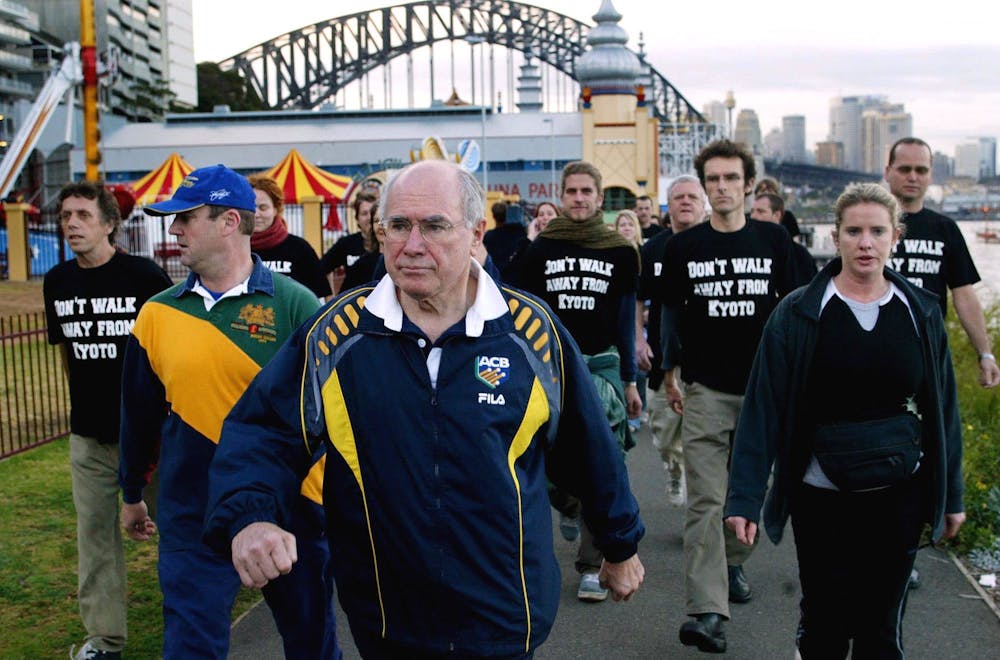 Members of Greenpeace follow John Howard on his morning walk, 2004, protesting Howard’s refusal to ratify the Kyoto Protocol on climate change.
AP Photo/Greenpeace,Hand Out
Members of Greenpeace follow John Howard on his morning walk, 2004, protesting Howard’s refusal to ratify the Kyoto Protocol on climate change.
AP Photo/Greenpeace,Hand Out
The new government’s dismantling closed Australia’s window of opportunity to act on climate change. But the world was moving on. By 2015 international leaders were calling for an end to coal and for steep policy action under the Paris Agreement.
Abbott was deposed as prime minister in 2015 after two years in office. But his dismantling efforts dramatically slowed the transition from fossil fuels to clean energy, which was progressing apace in other advanced industrial economies.
Abbott’s successor, Malcolm Turnbull, understood this. But his efforts to move on climate change were thwarted by internal party politics and dissent, and in 2018 he too was deposed.
It’s up to Scott Morrison
Given this tumultuous history, Prime Minister Scott Morrison has been cautious not to signal abrupt climate policy change. But now, with the international summit just weeks away, he is staring down the Coalition’s naysayers in the National Party to pledge a target of net-zero emissions by 2050.
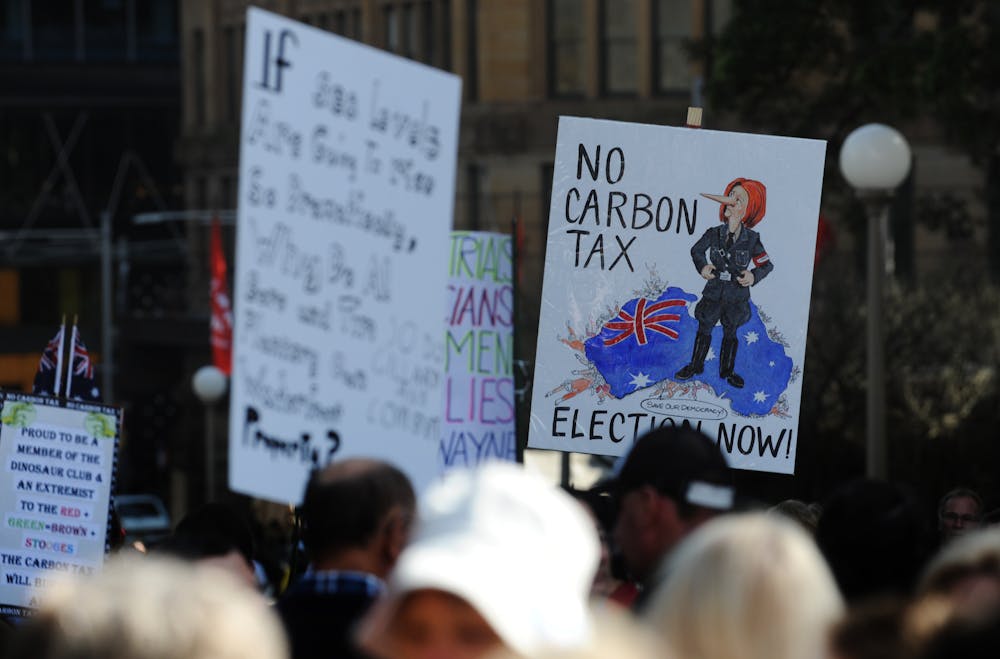 Up to 1,000 protesters take to the streets of Sydney to protest the government’s so-called carbon tax, 2011.
AAP Image/Dean Lewins
Up to 1,000 protesters take to the streets of Sydney to protest the government’s so-called carbon tax, 2011.
AAP Image/Dean Lewins
The political conversation on climate change is finally changing. Even the conservative federal Treasurer Josh Frydenberg recently articulated the economic costs of not making the low-emissions transition.
But 30 years of inaction has left Australia lagging without a long-term target or an effective 2030 target to guide interim action, including a phase-out of coal. So Australia risks being left behind, missing out on the jobs and growth from a low-carbon transition.
Read more: What is COP26 and why does the fate of Earth, and Australia's prosperity, depend on it?
To see bone fide change in Australia’s climate response, the government must not repeat the mistakes of the past: politicising climate change, delaying the clean energy transition, persisting with ineffective policies, and offsetting rather than reducing emissions.
Instead, it should set partisanship aside and develop enduring economic and energy transition plans for affected communities, such as those vulnerable to drought, low-lying coastal communities, and coal workers set to lose their jobs. These plans mustn’t be reversed for political gain, as we’ve seen in the past.
Jurisdictions such as the European Union are planning or considering trade sanctions such as carbon border adjustments on nations that don’t reduce emissions. And stranded fossil fuel investments are inevitable as the market shifts towards renewables. Clearly, inaction on climate change will cost Australia dearly.
Authors: Kate Crowley, Associate Professor, Public and Environmental Policy, University of Tasmania


















