

Five years on, NDIS is getting young people out of aged care, but all too slowly
- Written by: George Taleporos, Adjunct Senior Research Fellow, Living with Disability Research Centre, La Trobe University
In July this year, the National Disability Insurance Scheme marks its fifth anniversary since starting at four trial sites. The latest Summer Foundation NDIS Report Card shows a 5% reduction in the number of young people entering aged care.
While this is a step in the right direction, it is a disappointingly small one. The number of young people living in aged care has remained just above 6,000 for the past 10 years. A 5% reduction in admissions in the past five years is barely scratching the surface of the total numbers still living in aged care.
Read more: Nursing homes are no place for young people with disabilities
One explanation for the stubbornly high number of young people in residential aged care is that over half of the 2,000 people who have an NDIS plan are relatively new to the scheme, having entered between September 2017 and March 2018. This was a result of the “facilitated access” program, a concerted effort by the NDIS to link young people in aged care to the scheme. Dedicated NDIS staff are charged with signing up young people with disabilities living in nursing homes.
Through this program 1,109 young people in aged care have become NDIS participants. That’s 31% more than the 849 young people in aged care who joined between 2013 and 2017. The NDIS deserves credit for this marked turnaround.
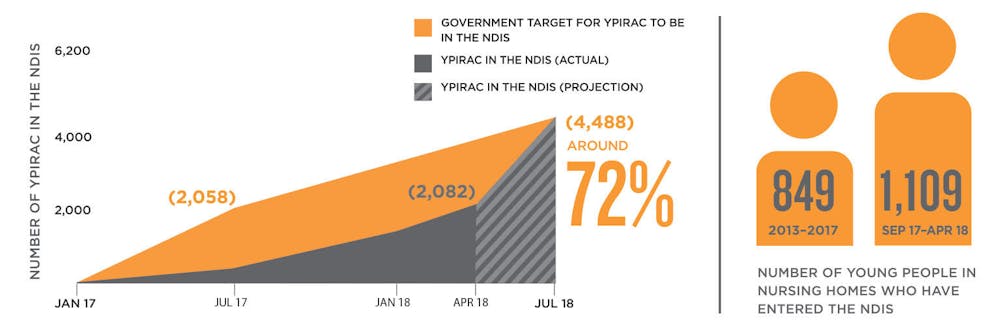 The numbers of young people in residential aged care (YPIRAC) who are signing up to the NDIS have picked up since September 2017, but are still below target.
NDIS Report Card June 2018, Summer Foundation, Author provided
The numbers of young people in residential aged care (YPIRAC) who are signing up to the NDIS have picked up since September 2017, but are still below target.
NDIS Report Card June 2018, Summer Foundation, Author provided
So why is progress so slow?
Finding young people living in aged care and linking them to the NDIS is a vital first step to creating positive and real change in their lives. However, a lot more work needs to be done to ensure that the person‘s NDIS plan is adequate and that they have the capacity and the necessary housing and supports in place to exit residential aged care. A closer look at the detail of the plans allocated to younger people with disabilities in residential aged care suggests inadequate plans may be part of the problem.
Senate estimates data (QON 185) show that the median plan value for young people in aged care is $104,563. This may help improve their quality of life, but when we break down this value we see that $77,539 could be taken up covering aged care costs alone. That leaves only $31,990 for assessments, support, home modifications and other essential supports needed to move out of residential aged care.
A significant factor forcing young people with high physical support into residential aged care is the lack of suitable, accessible and affordable housing. Senate estimates (QON 194) revealed that only 23 or 1.5% of NDIS participants living in residential aged care have funding for housing in their plans. Many may be unable to leave because they have nowhere else to live.
Read more: NDIS needs the market to help make up at least 60% shortfall in specialist disability housing
The report card also shows that NDIS participants living in aged care have difficulty implementing their plans. The data revealed that only 51.3% of these participants were drawing on the funding in their plans. So almost half have funding they are not using.
This may reflect the lack of appropriately skilled support co-ordinators to help with plan implementation, workforce shortages and inadequate housing options. It may also be a result of institutionalisation, where a person loses the capacity to see a future for themselves living in the community.
There are still more than 6,000 young people living in aged care facilities because of a lack of affordable and appropriate housing.What more needs to be done?
Overall, the NDIS has shown that a focused effort to connect people with the scheme is required and will yield results. Much more work, however, is needed to ensure NDIS plans are appropriately designed to support people to live in the community.
Moving out of residential aged care can be a complex and intensive process. While the NDIS has a very important role, so do the health system and other parts of government and society.
If we are to resolve the issues of young people in nursing homes, we need to recognise that access to the NDIS is only part of the solution. Critical enablers are:
- an effective plan that includes adequate support for implementation
- community housing and social infrastructure that are accessible and inclusive of the needs of people with disabilities who have complex needs
- a much larger and flexible workforce with the necessary attitudes and skills to work effectively with people who have high support needs
- information and support to build the capacity of individuals to live in the community
- hospital staff who are resourced to co-ordinate community supports to enable smooth patient discharge that avoids entry into residential aged care
- community health services with the capacity to meet complex health-care needs including high-quality preventive health care and slow-stream rehabilitation.
Read more: How the NDIS is using the market to create housing for people with disability
Authors: George Taleporos, Adjunct Senior Research Fellow, Living with Disability Research Centre, La Trobe University


















