We've unveiled the waratah's genetic secrets, helping preserve this Australian icon for the future
- Written by Stephanie Chen, PhD Candidate, UNSW
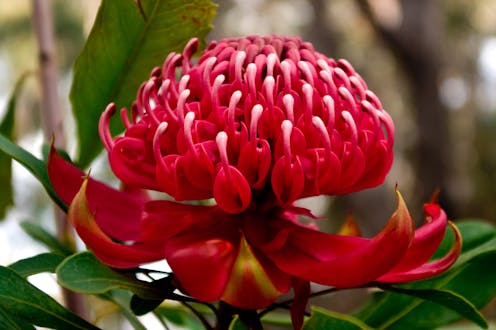
When the smoke cleared after the Black Summer bushfires of 2019-20, the bush surrounding the Blue Mountains Botanic Garden Mount Tomah was charred. Among the casualties was a NSW waratah, Telopea speciosissima, that had recently become the first of its species to have its genome sequenced. We have published this genome in the journal Molecular Ecology Resources.
The waratah is the official floral emblem of New South Wales, and its spectacular red blooms have been adopted as the logos of state government agencies and sporting teams.
The genome sequence paves the way for the waratah to serve as a model for understanding how plant populations change over time and adapt to their environments, and particularly how this species bounces back after a bushfire.
Genome sequencing has come a long way in a short time. The first human genome, completed in 2003, cost around US$1 billion and took about 13 years to compile the roughly 3 billion “letters” of our genetic code. Today, sequencing a human genome would cost less than $1,000 and take just a few days.
With rapidly decreasing costs and advancing technology, the genomic era presents the opportunity to decode many plant genomes that we can then use as reference resources. In turn, this will help us understand and conserve Australian fauna for the long term.
What is a genome anyway?
An organism’s genome is the complete set of genetic information it needs to develop, grow and survive. Plants, animals and many other living things are made of DNA, which consists of a string of four chemical “bases”, known as A, C, G and T.
Sequencing a genome involves determining the order of these bases. When we began our project, we knew from previous research the waratah genome would be quite long, at around a billion bases, that it was likely to be arranged into 11 large parcels called chromosomes, and that each plant would have two copies of the genome in each of its cells.
Cracking the waratah code
Generating the waratah reference genome first involved sampling young leaves from a plant growing naturally in the Blue Mountains. We extracted DNA from the leaves, and used three different sequencing technologies to piece together its genetic code. This approach generated many sequences, hundreds or thousands of bases long, which we then needed to assemble to determine the full genome.
Assembling the genome involved a range of different software tools, running on powerful computers. The result was a sequence of slightly less than a billion bases, mostly in 11 large sequences, as expected. The sequences appear to contain around 40,000 genes in total – roughly twice as many as humans have.
Why we sequenced the waratah
Previous sequencing efforts have focused on important crops and on “model organisms” such as Arabidopsis, which is widely studied by researchers and was the first plant to have its genome sequenced, back in 2000. But of course, there are many other types of species in the plant tree of life.
The NSW waratah is one of five waratah species in the genus Telopea, which grows throughout southeastern Australia, and one of around 1,700 species in the family Proteaceae. This family includes other iconic Australian plants such as banksias, grevilleas and macadamias. Yet despite this, very few Proteaceae genomes have so far been sequenced.
A collaborative effort between the Australian Institute of Botanical Science and UNSW Sydney, the waratah genome project was the first completed as part of the Genomics for Australian Plants (GAP) Initiative. A key aim of this initiative is to generate genomes to enable better conservation and understanding of Australia’s unique plant diversity.
Hope for the future
For many Australians, Black Summer embodied the threat posed by climate change to our unique natural heritage. But waratahs evolved with fire, and can regenerate with the help of a modified stem called a lignotuber, from which masses of fresh shoots emerge after a bushfire. It offers a potent symbol of our hope for the future.
The waratah plant whose genome we sequenced has resprouted after being burned in the Black Summer fires, and has now been propagated at the Blue Mountains Botanic Garden Mount Tomah and will become part of the garden’s living collection.
A display inspired by this plant and its genome will also feature in the foyer of the new National Herbarium of NSW when it opens at the Australian Botanic Garden Mount Annan next year.
The waratah’s genome sequence will provide a platform for future studies of its evolution and environmental adaption, ultimately informing breeding efforts and helping us better conserve this iconic species. By sequencing its DNA, we can uncover its evolutionary past and pave the way for its survival long into the future.
Authors: Stephanie Chen, PhD Candidate, UNSW