

how art forms the heart of Cobargo's Black Summer fires recovery
- Written by Jen Webb, Dean, Graduate Research, University of Canberra
On December 31 2019, the catastrophic fires burning across southeastern Australia reached the small South Coast NSW town of Cobargo in the form of the Badja Forest Road Fire.
Within just a few hours, roads and bridges were impassable, all critical infrastructure was destroyed, and 300 homes in the district along with 30% of businesses in Cobargo’s main street were lost. Six people died, 300,000 hectares were destroyed, and hundreds of kilometres of fencing, thousands of farm animals and countless native flora and fauna were lost. All this in a community of just 2,200 people.
Cobargo became, to quote The Times, “the symbol of a country […] in crisis”.
Communities that have experienced catastrophic ruin often face an ongoing cycle of loss. With material and economic resources largely gone, and significant trauma present, the resource that is the community – the sense of “us” – often crumbles.

Emergency and service providers are there at the beginning, providing vital support, but swiftly move on to the next disaster. The community is then left to its own resources while psychological damage continues to emerge.
This is where art enters the picture.
Research shows participating in an art practice has the capacity to aid the healing of individuals and communities. Participants do not need to be artists in order to gain enormous benefits. The act of engaging in creative expression helps rebuild connections, improves physical and mental health, and provides the capacity to begin imagining recovery.
Read more: A staggering 1.8 million hectares burned in 'high-severity' fires during Australia's Black Summer
Thinking about community
Two years on from Black Summer, rebuilding is still at an early stage. The roll-out of the government’s recovery fund has been slow and uneven: well into 2021, many victims of the fires were still living in tents and caravans.
Adding to the difficulties, the process of crafting a submission for financial support is onerous and complex, particularly for those not practised in grant-writing. And it is highly competitive. Applicants to the second stage of the NSW Bushfire Local Economic Recovery Package, focused on community recovery and resilience projects, requested more than six times the available funds. Most applications were not approved.
Recovery after a natural disaster largely depends on the energy and capability of local people. When those driving the recovery process are community members, the sustained collective activity increases the likelihood of success. Local people are present throughout the long-term process of recovery, and their deep knowledge of the community – its history, its demographics, and its values and aspirations – are vital.
Read more: 'It’s given me love': connecting women from refugee backgrounds with communities through art
Recovery through collaboration
Creative thinking and practice are at the heart of the healing process. Whether macro or micro, planned or ad hoc, creative activities bring people together. In the process of making and talking, recovery can begin: for the individual, and for the community.
Although many of Cobargo’s creative practitioners lost their homes, studios and businesses, they have been prominent in this task of recovery, rebuilding their community at the same time as rebuilding their own practices.
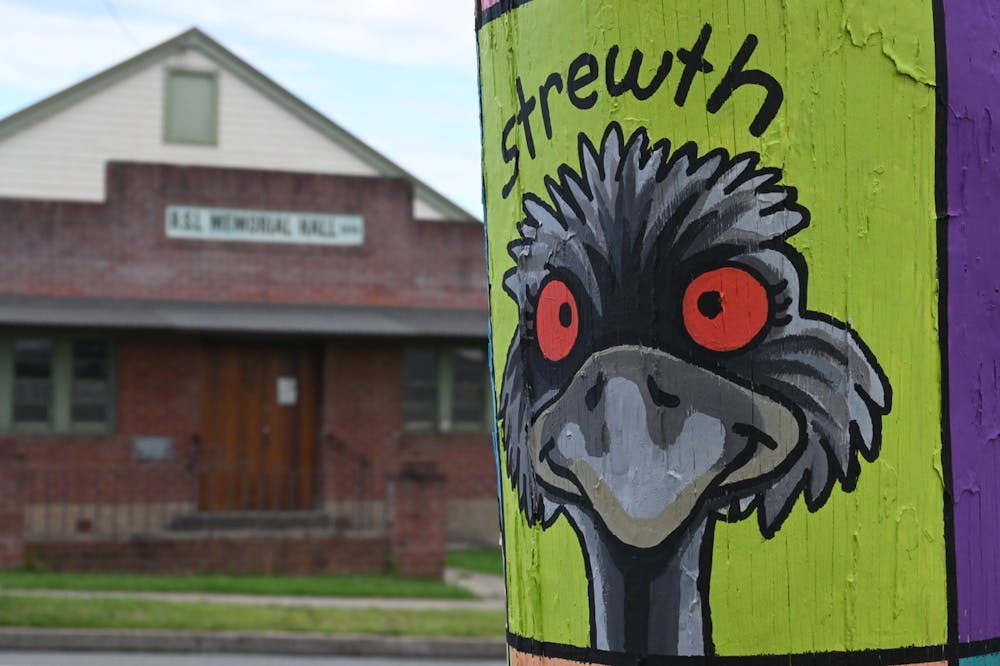 Artists of all stripes came together to repaint telegraph poles throughout town.
Rhonda Ayliffe, Author provided (no reuse)
Artists of all stripes came together to repaint telegraph poles throughout town.
Rhonda Ayliffe, Author provided (no reuse)
Early on, Cobargo residents wrote a creative plan to construct a shared vision, and established the Cobargo Community Bushfire Recovery Fund. With support from this fund, and from charities and private contributors, Cobargo’s creatives have been crafting opportunities for community members to reconnect.
Painted telegraph poles have been a feature of Cobargo’s main street for about 20 years but most were destroyed or damaged by the fire. With the Poles Project, local artists – young and old, professional and amateur – repainted the poles with new interpretations and new senses of a future.
The Cobargo Community Tree project saw Cobargo residents working with local blacksmiths Iain Hamilton and Philippe Ravenel to forge stainless steel leaves for a memorial tree.
Other creatives have organised workshops, hosted the Fire Up Cobargo music festival, presented children’s theatre, and set up a tool library for craft projects.
Local children also played their part. In response to the fires, Year 5 and 6 students at the Cobargo Public School wrote and illustrated a remarkable book titled The Day She Stole the Sun. It tells the story of Ganyi (the Yuin word for fire) who wrestles with and overcomes Nature. The writing and illustrations manifest the children’s distress:
We fought hard, but we lost our farms. We fought hard, but we lost our homes. We fought hard, but we lost our families.
But it ends with a positive turn:
Our community is small, but our spirit is strong. Ganyi will never take that from us.
The work of recovery is progressing, though it is piecemeal, uneven, and by no means complete. There is still a vital need for rebuilding and for support. This is likely to remain the case for years. Meanwhile, the Cobargo community continues to identify and implement creative activities and aims that are both short- and long-term.
One large-scale long-term project is the Cobargo Bushfire Resilience Centre, funded by the NSW government, with construction due to begin later this year. This will be a community cultural centre, with spaces for exhibition, performance and commemoration.
It will also be a place for residents to visit, to rebuild themselves and the community, and to think anew a creative response to climate change – and the challenges yet to come.
Authors: Jen Webb, Dean, Graduate Research, University of Canberra

















