

Sponges can survive low oxygen and warming waters. They could be the main reef organisms in the future
- Written by James Bell, Professor of Marine Biology, Te Herenga Waka — Victoria University of Wellington
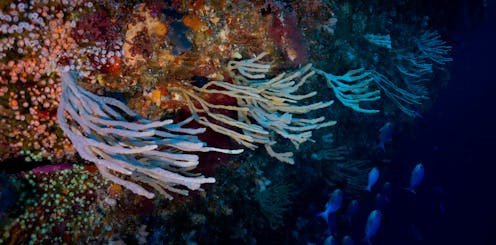
Sponges are ancient marine animals, very common throughout the world’s oceans and seem less affected by ocean warming and acidification.
Our latest research shows they can also survive low levels of oxygen.
This is a surprising finding because most sponges are rarely exposed naturally to low oxygen in modern seas.
We propose their tolerance is the result of their long evolutionary history and exposure to variable oxygen concentrations through geological time.
As our oceans continue to warm due to climate change, they are expected to hold less oxygen.
The ability of sponges to survive low-oxygen conditions means they are likely to tolerate these possible future environments better than other organisms living on the seafloor.
There are an estimated 8000-plus sponge species in the oceans. They are multicellular organisms with a body architecture built around a system of water canals, pores and channels allowing water to be pumped and circulated through them.
Their specialised pumping and feeding cells, called choanocytes, are highly efficient. Sponges can pump the equivalent of their own body volume in a matter of seconds.
In modern oceans, sponges are often the most abundant organisms in rocky reef environments. They fulfil important ecological functions as part of bottom-dwelling (benthic) communities worldwide.
Sponges have many roles in marine ecosystems, but their water-processing ability and efficiency at capturing small particles is the most important because it links the water column with the seafloor. Sponges also support diverse seafloor communities by transforming carbon.
Some sponge species have been shown to be very tolerant to climate change stressors, particularly changing temperature and acidity (measured as pH). This means sponges could be future winners in changing oceans.
Sponges in past oceans
We know that sponges are ancient organisms, but recently described 890-million-year-old fossils have turned our understanding of evolution on its head.
Most major animal groups, including arthropods and worms, first appear in the fossil record during a period known as the Cambrian explosion, 540 million years ago. But if the newly-described fossils are indeed sponges, they would have existed nearly 300 million years earlier, significantly pushing back the date of Earth’s earliest known animals.
Read more: A new fossil discovery may add hundreds of millions of years to the evolutionary history of animals
If the ancestors of modern sponges are about 900 million years old, they would have evolved and survived during the Marinoan glaciation, 657-645 million years ago, when the oceans were extremely low in oxygen.
They would have also likely experienced wide fluctuations in other environmental conditions such as pH, temperature and salinity through evolutionary time.
Sponge tolerance to low oxygen
Our recent environmental tolerance experiments support this scenario, showing they are surprisingly tolerant to low levels of oxygen.
We assessed the response of sponges to moderate and severe low-oxygen events in a series of laboratory experiments on four species from the northeast Atlantic and southwest Pacific. Sponges were exposed to a total of five low-oxygen treatments, with increasing severity (40%, 20%, 6%, 5% and 1.5% air saturation) over seven to 12 days.
We found the sponges generally very tolerant of hypoxia. All but one of the species survived in the extreme experimental conditions, and that species only began to die off at the lowest oxygen concentration. In most experiments, hypoxic conditions did not significantly affect the sponges’ respiration rates, which suggests they can take up oxygen at very low concentrations in the surrounding environment.
As a response to the low oxygen, sponges displayed a number of shape and structural changes, likely maximising their ability to take up oxygen at these low levels.
Sponges in future oceans
Warmer ocean water holds less oxygen, and ocean deoxygenation is one of the major consequences of climate change.
Warmer water also becomes more buoyant than cooler water, which reduces the mixing of surface oxygenated water with deeper layers that naturally contain less oxygen. At the same time, warmer temperatures increase the demand of organisms for oxygen as metabolic rates increase and stress responses are initiated.
Read more: The rise of sponges in Anthropocene reef ecosystems
While oxygen levels in the ocean are only expected to fall on average by 4% across all oceans, these effects are likely to be much more extreme locally and regionally. In coastal waters, climate-driven ocean deoxygenation can be exacerbated by a process called eutrophication, essentially an increase in nutrients. This fuels plankton blooms, and when bacteria breakdown the dead phytoplankton, they use up all the oxygen.
Since the land is generally the source of these excess nutrients, shallow coastal areas are most at risk. These are areas where rocky reefs are typically dominated by sponges, particularly just below the depth of light penetration (typically 20-30m).
Our finding lends further support to the idea that sponges will be the survivors if our oceans continue to warm.
Authors: James Bell, Professor of Marine Biology, Te Herenga Waka — Victoria University of Wellington

















