

research shows old forests are 3 times less flammable than those just burned
- Written by Philip Zylstra, Adjunct Associate Professor at Curtin University, Research Associate at University of New South Wales, Curtin University
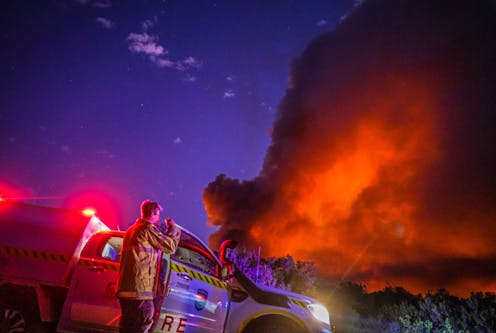
As coal-fired climate change makes bushfires in Australia worse, governments are ramping up hazard-reduction burning. But our new research shows the practice can actually make forests more flammable.
We found over time, some forests “thin” themselves and become less likely to burn – and hazard-reduction burning disrupts this process.
What does that mean as Australians face a more fiery future? Is there a smarter and more sensitive way to manage the bushfire risk?
To find out, we looked at the forests of south-western Australia, where hazard-reduction burns are very frequent.
Lessons from Black Summer
Hazard reduction burning, also known as prescribed or controlled burning, is the practice of deliberately burning off flammable material in a forest, such as leaf litter, grasses and shrubs. It aims to slow the spread of any subsequent bushfires by reducing the amount of fuel available.
In the summer of 2019-20, the Black Summer bushfires ravaged Australia’s south-east. In the decade before the fires, the New South Wales National Parks and Wildlife Service doubled the area of prescribed burns compared to the previous decade.
In fact, the area of national park burned that decade was the largest in the state’s history. But as we now know, it had little effect.
Where prescribed burns had very recently been carried out, the bushfires were marginally less severe, about half of the time. But the bushfires ultimately burned ten times more forest than any other Australian forest fires on record.
Read more: Australia's Black Summer of fire was not normal – and we can prove it
Forests control their own flammability
We wanted to measure how past fires – planned and unplanned – affected the bushfire risk in the forests of Australia’s south-west.
This 530,000 hectares of forest spans the dry jarrah and tuart near Perth, down to Margaret River and east, through tall wet karri and tingle forest, to Denmark and Albany.
We examined official records showing where fires had burned over 65 years in national parks. The results were stark.
Forests were unlikely to burn for five to seven years after a prescribed burn. This finding supported earlier work in the same region. But there’s more to the story.
Other studies have shown fires cause a massive flush of understorey growth in WA’s karri and jarrah forests.
During bushfires, the understorey is the main driver of large flames which cause destructive crown fires.
Our research corroborated these earlier findings. We found as the understorey grew back, becoming taller and denser, fire risk greatly increased for the next 37 to 49 years.
The trend did not change as the climate warmed from the 1980s onward, although the burned area grew larger.
What about older forests?
Ecologists have long known shrub layers often “self-thin” as a forest grows.
Past studies in WA have shown 25 years after fire, there were 13 times fewer shrub stems in karri forests. In jarrah forests, only a quarter of the previous understorey fuel remained 50 years after fire.
Since the 1800s in Australia, there have been concerns that fire, including prescribed burning, converts self-thinned understoreys into dense thickets.
But we didn’t know how self-thinning affected the flammability of older forests in Australia’s southwest. Our research set out to find the answer.
As the below graph shows, 43 to 56 years after a fire, the forests had thinned their shrub layers. We found this meant they were, on average, seven times less likely to carry a bushfire than forests burned more recently.
In other words, burning made forests on average seven times more flammable for 43 to 56 years.
In the hottest and driest climate conditions, old, self-thinned forests even out-competed recent prescribed burns – those up to seven years old. Bushfires were three times less likely in old forests than they were in recent prescribed burns.
Our previous work in the Australian Alps found similar trends; mature forests there are dramatically less likely to burn.
Cooperating with country
Early Australian colonists recorded many Australian forests as park-like with open understoreys.
This reflected First Nations’ care for country. In southwest Australia, as in many parts of the continent, Indigenous fire use was precise and focused. Unlike prescribed burns, Indigenous practitioners did not attempt to burn vast areas at once.
Read more: Australia needs a national fire inquiry – these are the 3 key areas it should deliver in
Instead, they cooperated with natural processes such as self-thinning, so country was allowed to age.
Australia’s forests have controlled their own fire risk since they were part of the Gondwana super-continent. We should respect, rather than disrupt, these ancient natural processes.
Cooperating with country today means moving away from prescribed burning across large areas. Frequent burns may be useful only close to homes, or in other locations where we know with confidence they can achieve an ecological goal or help firefighters stop a burning edge.
Elsewhere, we should work with forest landscapes and allow them to become open again. We can support this process by refocusing fire management to quickly suppress fire when it does break out.
Read more: Native forest logging makes bushfires worse – and to say otherwise ignores the facts
Authors: Philip Zylstra, Adjunct Associate Professor at Curtin University, Research Associate at University of New South Wales, Curtin University

















