

Farmers experiencing drought-related stress need targeted support
- Written by: Emma Austin, PhD Researcher, University of Newcastle
For farmers, drought is a major source of stress. Their livelihoods and communities depend on the weather. To better support farmers and their families we need to better understand the impact of drought on them and their communities.
Our research, published today in the Medical Journal of Australia, found young farmers who live and work on farms in isolated areas and are in financial hardship are the most likely to experience personal drought-related psychological stress.
Read more: The lessons we need to learn to deal with the 'creeping disaster' of drought
What our study found
To examine farmers’ mental health during droughts, we examined data from the Australian Rural Mental Health Study and rainfall conditions in the months before farmers completed the survey.
Importantly, the study covered the period of the Millennium Drought, which had devastating environmental, social and economic impacts on much of southeast Australia from 1997 to 2010. The study captured both drought and wet conditions, which enables comparisons between farmers’ mental health under different climate conditions.
The study included 664 farmers from inner and outer regional, remote and very remote New South Wales. Farmers were defined as: (i) people who lived on a farm; (ii) people who worked on a farm; and (iii) people who lived and worked on a farm.
The gender distribution of the participants was equal and the majority were 55-64 years old.
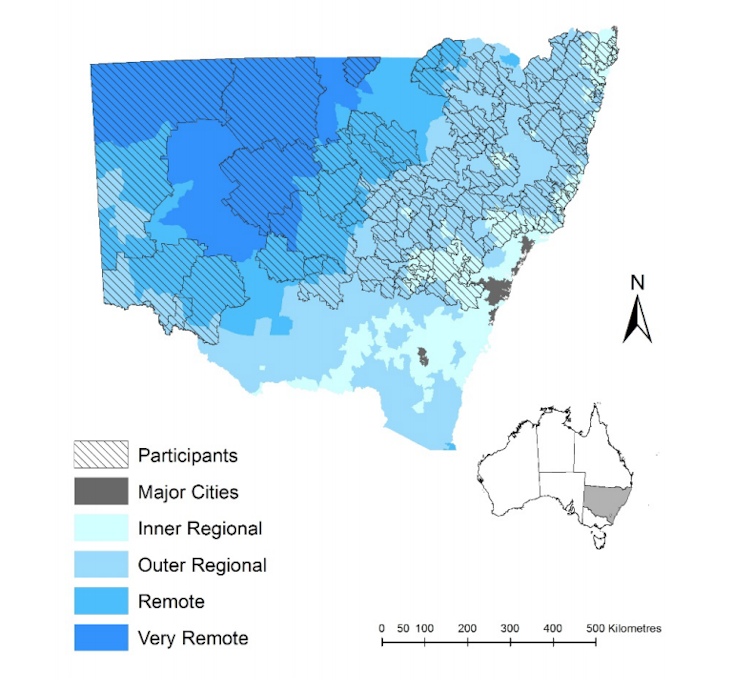 Study participant location according to postcode and remoteness.
Thanks to Olivier Rey-Lescure from the University of Newcastle for technical assistance with mapping., Author provided (No reuse)
Study participant location according to postcode and remoteness.
Thanks to Olivier Rey-Lescure from the University of Newcastle for technical assistance with mapping., Author provided (No reuse)
Of the three groups investigated, farmers who both lived and worked on a farm reported more drought-related impacts and concerns. Moderately dry conditions were related to the highest scores for drought-related concerns and general psychological distress.
Interestingly, higher levels of drought-related concerns were also reported following mild to moderate wet conditions. This is possibly related to much of the study area receiving very high spring rainfall during 2010 and suggests drought-related mental health impacts persist beyond the end of the drought.
Read more: Farmer suicide isn't just a mental health issue
A range of social, demographic and community factors influenced the personal impact of drought for farmers:
Isolation plays a large role in the rural context. Farmers in outer regional, remote and very remote NSW experienced higher levels of concern about drought. Remoteness can mean people aren’t able to engage as much in social networks, which are essential for building resilience.
Financial hardship is increasing in rural areas but many people don’t seek financial assistance due to stigma and ingrained stoicism. Younger farmers may also be particularly impacted by less financial security than older farmers.
Age matters too. Farmers under the age of 35 experienced higher personal drought-related stress.
What can we do about it?
Protracted drought is a rare but recurring element of the Australian climate. Whatever the cause, future drought is inevitable.
Read more: Hairdressers in rural Australia end up being counsellors too
Drought impacts are different from “rapid” climate extremes such as bushfires, floods or cyclones. So drought planning and preparedness needs to consider the impacts of drought on mental health and well-being differently to the way in which we prepare for and respond to “rapid” climate extremes.
We know “rapid” climate extremes can have devastating impacts through loss of life, injury and other threats to communities. The effects can be acute or long-term. While many people cope and adapt to rapid climate extremes, we know a substantial proportion will go on to develop mental health problems as a result.
Much less is known about chronic, slow-onset climate extremes such as protracted drought. The unfamiliarity, unpredictability and longevity of drought have substantial personal and social consequences over time. The mechanisms for such impacts are not as well known as for “rapid” climate extremes.
Our findings suggest the disruption to community viability, the financial strain, loss of property and stock, and impact on future personal hopes are likely to play a role.
Supporting rural communities, and especially farmers, to cope with droughts can have benefits for their well-being and mental health. Strengthening personal, financial and social support for farmers may help in adapting to droughts when drought-related stress is affecting their mental health.
General practitioners are uniquely placed to support farmers experiencing persistent worry that is affecting their day-to-day functioning. But it’s often trusted people who engage with farmers regularly, such as rural financial counsellors and vets, who occupy first responder roles.
Insights from our study are useful for informing the practical steps required to improve farmers’ mental health. These include:
reducing stigma about mental health problems to overcome barriers to seeking professional help and advice early
professional help to be more readily available and easier to access in rural and remote areas (such as e-health programs)
professional education for all health services, including general practitioners, so they can look out for and address the effects of drought-related stress – they need a good understanding of the pressures facing farmers and farming communities and the ways they can be more alert to their needs
community education and public health campaigns so farmers and rural residents can identify the effects of drought-related stress and take appropriate action
education and training for non-medical agricultural support services, such as rural financial counsellors, who need to be able to confidently identify early signs of drought-related stress and provide appropriate support
continued funding of Rural Adversity Mental Health Program coordinators who link rural and remote residents to services and provide community education and support
better opportunities and encouragement to maintain and develop community connections and social networks
reasonably priced and reliable internet access to enable increased use of e-health and relieve isolation
transparent and consistent information about the processes farmers need to follow to access grants and loans. Farmers should be able to apply for financial support when it’s needed rather than having to fit in with government budget cycles and deadlines. Efficient processing of grant and loan applications is needed to minimise the period of uncertainty and stress while waiting for the outcome.
Authors: Emma Austin, PhD Researcher, University of Newcastle
Read more http://theconversation.com/farmers-experiencing-drought-related-stress-need-targeted-support-98239


















