

New study finds Australia's preschool expansion 'has not better prepared' kids for school
- Written by: Ragan Petrie, Professor, Texas A&M University; Professorial Fellow, The University of Melbourne
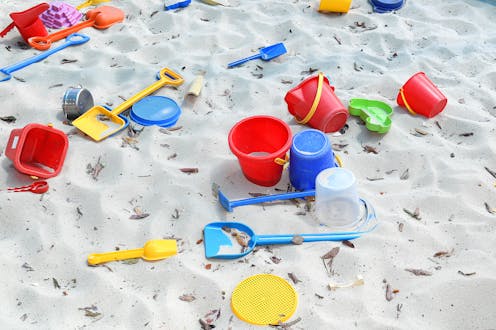
Since 2008, Australia has spent more than A$11 billion dollars over ten years to expand government-funded preschool (or kinder in Victoria) for four-year-olds to better prepare children for school.
But as our new study finds, to date, there is no rigorous evidence to suggest this investment was warranted in the first place or that it has paid off.
The case for preschool funding
Almost every policy report arguing for expansion of early childhood education cites the Perry Preschool Project.
This study was a randomised controlled trial in the 1960s that provided high-quality preschool education to 123 (a small sample) low-income, three- and four-year olds at risk for school failure in Michigan in the United States.
Preschool or kinder is aimed at providing all children with at least a year of early education before they start school. Alan Porritt/AAPA randomised controlled trial randomly assigns participants into an experimental group that receives a treatment or intervention or a control group that does not. Randomisation balances participant characteristics between the groups, so any differences in outcomes can be attributed to the study intervention.
Randomised controlled trials are considered the gold standard for policy evaluation because they provide direct, causal evidence of the effectiveness of a policy.
The Perry Preschool Project found that by age five, 67% of those who attended the program had an IQ above 90, compared to 28% in the non-program group. Almost 80% of the program group graduated from high school, compared to 60% in the non-program group. The program group also performed better on income at age 40.
While the returns to Perry are impressive, it remains unclear how generalisable these returns are to other contexts and populations.
Preschool in Australia
The federal government expanded preschool funding for four-year-olds in 2008 to improve the supply of early childhood services to all children. Since then, it has also billed the program as better preparing children for school.
Victoria is currently rolling out funded preschool to three-year-olds under the argument that “two years are better than one”.
Recently, New South Wales and Victoria announced government-funded preschool would extend to 30 hours a week (from the current 15) for four-year-olds. More than $9 billion is committed over the next decade in Victoria for early childhood education, and NSW has committed $5.8 billion to expand four-year-old education.
But this has not been accompanied by randomised evaluations of these universal programs.
A common approach to evaluate programs is to conduct a “before and after” evaluation that relies on statistical methods. These methods compare those who chose to be in a program to those who did not and make statistical adjustments.
This approach is second best because the methods are not designed to provide causal evidence of a program’s effectiveness.
Our study
Despite the large investment, and significant increase in preschool enrolment, school readiness scores have remained flat for more than a decade.
Just over half (55%) of Australian children are developmentally on track to start school, based on the most recent Australian Early Development Census of five-year-olds entering school. In 2009, 51% of children were on track.
Being on track means a child has met development milestones across five important areas of early childhood development. These are:
- physical health and wellbeing (such as motor skills and energy levels)
- social competence (getting along with other children and adults)
- emotional maturity (being kind to others, not having tantrums)
- language and cognitive skills (interested in books, recognising numbers)
- communication skills and general knowledge (can tell a story and have knowledge for that age, such as knowing dogs bark or apple is fruit).
To understand this issue further, we conducted a population-level analysis of preschool expansion for four-year-olds on measures of child development. That is, we looked at changes in school readiness as four-year-old preschool/kinder enrolment increased.
We used Australian census data on preschool enrolment and Australian Early Development Census data on the five development outcomes, and mapped them to local government areas.
The goal was to see if there is any evidence areas in which preschool has expanded also has improved school readiness. The analysis is not causal, but it illustrates associations at the population level for children who did and did not attend preschool. Plus, it accounts for differences across regions.
Our findings
We found there are no, or negative, effects of preschool on child outcomes.
Areas which had increased preschool enrolment by ten percentage points saw a decrease in school readiness by half-a-percentage point. This implies billions spent with no evidence children are better prepared for school.

If we only look at areas outside of Victoria and NSW, the results are worse. The decline in school readiness doubled to a decrease of one percentage point.
Of course, this analysis cannot speak to how school readiness would have evolved without preschool expansion. We do not observe this. The analysis cannot say if children would have been less, similarly or better prepared without investment in preschool.
What we can say is that areas that saw an increase in preschool enrolment did not see a corresponding increase in school readiness, which you would assume from the level of investment. Preschool expansion, as it happened in Australia, has not better prepared kids for school.
More research is needed to determine whether and how to expand preschool offerings.
More evidence needed
We are not arguing governments should not invest in children or their early education.
On the contrary. Evidence exists that high-quality preschools delivered at small scale to targeted groups can have positive returns to child development.
Preschool might have other benefits – such as more affordable childcare or workforce participation for families. But we have found universal preschool, rolled out to everyone, does not necessarily pay off for development.
Investment should be made based on scientific evidence and take into account how programs will be affected as they are scaled up.
Without rigorous evidence from randomised controlled trials, money may be spent unwittingly on programs for Australian children that have no effect on development when the money could have been spent on alternative programs that yield positive results.
Authors: Ragan Petrie, Professor, Texas A&M University; Professorial Fellow, The University of Melbourne


















