Australians now expect local councils to act on bigger issues, including climate change
- Written by: Mark Chou, Associate Professor of Politics, Australian Catholic University
News headlines about local government in Australia often have a familiar storyline: councils should stick to their “core purpose […] to collect rubbish, fix local roads and keep rates down”. However, our newly published research shows most Australians expect more from their local councils, and that includes climate action.
Yet councils still tend to find themselves on the receiving end of public criticism when they veer from delivering “services to property” to activities that fall under the “services to people” category. They attract headlines like The Guardian’s “Council of war: how much should local government stray from roads, rates and rubbish?” and the Courier Mail’s “Stick to collecting rubbish – not spreading it”.
In one respect, it’s easy to understand why. The 537 local councils around Australia are creations of state and territory statutes. Until relatively recently, they were restricted to administering a select number of services to property. They are not mentioned in the Commonwealth Constitution and sit squarely at the bottom of our federal hierarchy.
This is why when we do hear about local government it’s usually in relation to the “three Rs” (roads, rates, and rubbish). It’s also why, as experts in governance like A.J. Brown observe, the tier of government closest to Australians remains “the poor cousin if not ‘lame duck’ in the Australian federal system”, despite having “grown rapidly in capacity and importance”.
But to what extent do Australians really think local councils should stick to the three Rs?
Our national survey during June and July 2022 asked 1,350 Australians this question. The results are presented in our report about the changing role of local government. Most people surveyed agreed their local councils should engage with bigger, contentious issues.
Read more: Lessons from history point to local councils' role in Australia's recovery
Australians see a bigger role for their local councils
Australians now have an expansive view of the role of local government. More than nine in ten respondents, for instance, believed local councils should:
advocate for the needs of the local community (93%)
reflect local community values (93%)
deliver services that contribute to a healthier and fairer society (91%).
Interestingly, almost as many Australians were of the view that political parties should play a greater role in local government (69%) and local government should have more power (66%) as those who felt it should focus only on providing basic services – the three Rs (70%). And 83% of respondents agreed local government should be a place where the local community can debate national issues.
What we see challenged, then, are three longstanding ideological underpinnings of Australian local government. These are:
the ratepayer ideology that underlies the focus on the three Rs
the localist ideology that places the suburb and neighbourhood as the sole focus of local politics
the ideology of political neutrality or “opposition to politics in local government”.
Social services matter too
Australians still identify traditional services to property as the most important for local councils to provide. However, there’s a growing appreciation that a more diverse array of socially oriented services are important as well, as the chart below shows.
These council activities range from health and the promotion of the local area to community development, youth services and lobbying higher governments. It’s clear Australians now agree with one of the touchstone findings of the 2003 Hawker parliamentary report that “[l]ocal governments’ roles […] are diverse”.
Read more: Local councils put affordable housing supply in the too hard basket
Contentious issues aren’t off-limits
Australians also believe their local councils should engage with contentious issues, even those that were once well beyond their remit.
We’ve seen in recent years a growing number of local councils around the country have been shaking off the “lame duck” moniker. They are jumping headfirst into ideologically contentious issues like same-sex marriage, Australia Day, the climate emergency and pill testing. In almost all cases, media and state and federal governments have accused councils taking these actions of over-reach.
But our survey showed Australians want their local councils to act on these issues.
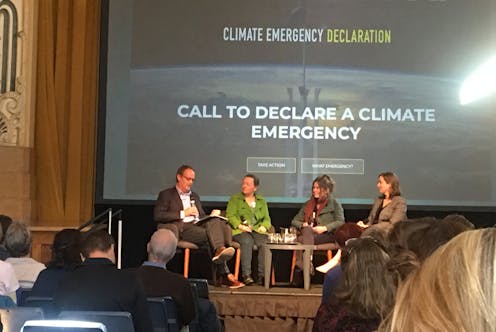
Take climate change, for instance. We found 80% of respondents broadly agreed local government should engage with this issue. Even when it came to the more controversial act of declaring a climate emergency, which close to one-fifth of Australian local councils have already done, 75% of respondents still felt that was right.
Read more: Ordinary people, extraordinary change: addressing the climate emergency through 'quiet activism'
Read together, these findings show the cliched debate about local government and the three Rs, still favoured among some media and policy pundits, may have had its day. We need a new and more expansive debate that reflects the role local councils play in Australia today.
Authors: Mark Chou, Associate Professor of Politics, Australian Catholic University