

Tax breaks cost a reported $250 billion, but handle these new figures with care
- Written by: Robert Breunig, Professor of Economics and Director, Tax and Transfer Policy Institute, Crawford School of Public Policy, Australian National University
Treasurer Jim Chalmers promised a Tax Expenditures Statement by the end of February – and he delivered this week, just in time, on Tuesday February 28.
The statement contains many headline-grabbing figures about the cost of various tax breaks, including claims made against income from rental properties (A$24.4 billion), the concessional or zero tax on employer superannuation contributions ($23.3 billion), concessional or zero tax on super earnings ($21.5 billion), and the tax-free treatment of the family home ($22 billion).
For some years under the Coalition, the statement was given the less-attractive title of Tax Benchmarks and Variations Statement, which was surprising given the statement was mandated in 1998 by Treasurer Peter Costello as part of the Charter of Budget Honesty.
The refurbished 200-page document has its old name back, plus a bit more. It is now called the Tax Expenditures and Insights Statement. The “insights” in the title relate to who the expenditures go to.
As to whether these additional insights are really that insightful, the answer is yes in some areas – but we need to be careful about others.
Spending by another name
The idea of the statement is to record those government expenditures delivered via tax breaks, so their costs can be compared with the cost of direct expenditures.
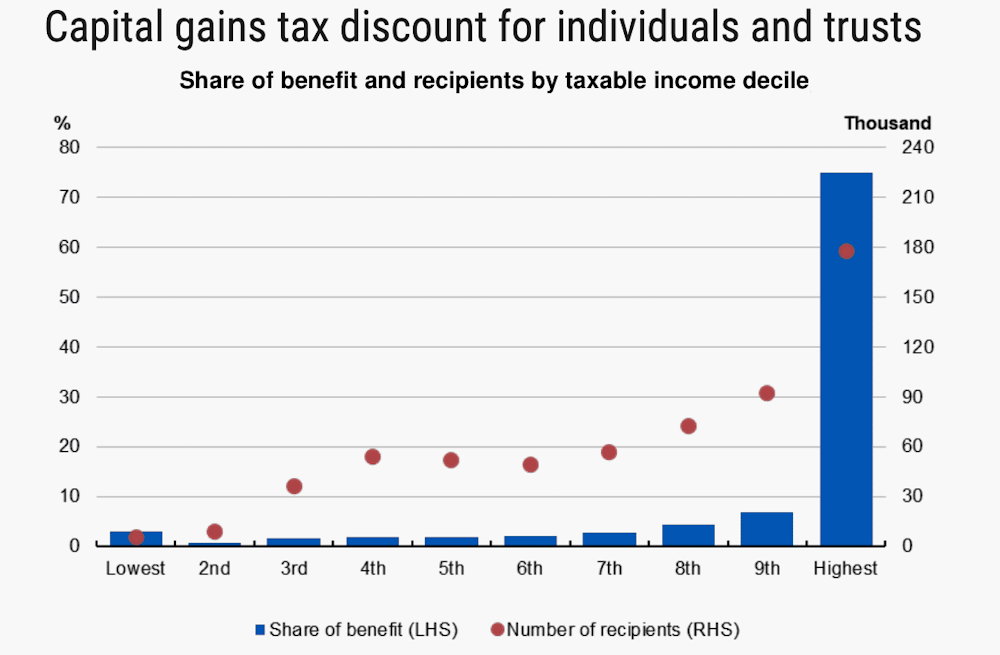 Commonwealth Treasury, 2022-23 Tax Expenditures and Insights Statement
And guess whether men or women get the biggest tax expenditures.
Again, you got it! There are more men in the highest tax brackets than women, so men get the lion’s share of tax expenditures.
All of which points to three dangers in interpreting the tax expenditures statement.
Big expenditures needn’t mean unfairness
The first danger is to conclude the large tax expenditures show “the rich do not pay enough tax”.
The statement says nothing about how much tax people actually pay.
In fact, Australia has one of the world’s most progressive tax systems. The top 10% pay roughly half of all the income tax collected.
The second (related) danger is assuming an uneven distribution of tax expenditures means an uneven distribution of government support.
Read more:
How to camouflage $150 billion in spending: call it 'tax expenditure'
Tax expenditures tell us nothing about other forms of government support.
Australia also does pretty well in fairness. Most government spending goes to those at the bottom of the income distribution. This is true if you look at cash transfers, and also for in-kind benefits such as education and health care.
Using data from the World Inequality Database, I calculate Australia’s after-tax Gini coefficient – the standard a measure of inequality – is about 30% fairer than its before-tax coefficient. This suggests the Australian system moves money from the more well-off to the less well-off.
It may not do it enough for some and it may do it too much for others, but there is no evidence of gross unfairness.
Abolition might raise less than imagined
The third danger is assuming that abolishing a tax expenditure would raise as much as it notionally costs.
In many cases it won’t, because people will change their behaviour and look for tax breaks elsewhere.
Even where this is not the case, abolishing two tax expenditures together might raise much less than the cost of the two added together. How? Removing one tax expenditure can mean less money for the other expenditure to give away.
The best example of this is in superannuation. If the $23.3 billion tax discount on super contributions was abolished, there would be less super in the funds to apply the discount on earnings. The earnings discount would be less than quoted.
The total of the tax expenditures set out in the statement exceeds $250 billion. Previous statements have warned about adding them together. This one does not.
Expenditures compared to what?
Each tax expenditure needs to be calculated against a benchmark – a standard tax rate that would otherwise be imposed. It isn’t always clear what the benchmark should be.
For income tax, it is assumed to be the standard set of income tax rates. But they may not be the right rates to apply to the taxation of income from savings.
A respectable case can be made for a dual-income tax system, with a progressive income-tax scale (as now) alongside a flat 10% rate on earnings from savings.
Read more:
Yes, some millionaires pay no tax, but crimping deductions mightn't help
The 2017 tax expenditure statement took this idea up and produced an alternative estimate of superannuation tax expenditures using a different benchmark. The cost of the superannuation tax expenditures fell 80%!
One more thing. The use of trusts to avoid taxes isn’t really captured in the tax expenditures statement, in part because it is hard to work out how much tax minimisation takes place through trusts.
Often we do not know who the ultimate owners are. Loans made within trusts are not well-documented or regulated. Nor are property transfers and usage. There’s a case for a Trusts Investment and Insights Statement.
So bravo for the new Tax Expenditure (and Insights) Statement. And bravo for the new information on distributions. But please, use with care.
Authors: Robert Breunig, Professor of Economics and Director, Tax and Transfer Policy Institute, Crawford School of Public Policy, Australian National University
Commonwealth Treasury, 2022-23 Tax Expenditures and Insights Statement
And guess whether men or women get the biggest tax expenditures.
Again, you got it! There are more men in the highest tax brackets than women, so men get the lion’s share of tax expenditures.
All of which points to three dangers in interpreting the tax expenditures statement.
Big expenditures needn’t mean unfairness
The first danger is to conclude the large tax expenditures show “the rich do not pay enough tax”.
The statement says nothing about how much tax people actually pay.
In fact, Australia has one of the world’s most progressive tax systems. The top 10% pay roughly half of all the income tax collected.
The second (related) danger is assuming an uneven distribution of tax expenditures means an uneven distribution of government support.
Read more:
How to camouflage $150 billion in spending: call it 'tax expenditure'
Tax expenditures tell us nothing about other forms of government support.
Australia also does pretty well in fairness. Most government spending goes to those at the bottom of the income distribution. This is true if you look at cash transfers, and also for in-kind benefits such as education and health care.
Using data from the World Inequality Database, I calculate Australia’s after-tax Gini coefficient – the standard a measure of inequality – is about 30% fairer than its before-tax coefficient. This suggests the Australian system moves money from the more well-off to the less well-off.
It may not do it enough for some and it may do it too much for others, but there is no evidence of gross unfairness.
Abolition might raise less than imagined
The third danger is assuming that abolishing a tax expenditure would raise as much as it notionally costs.
In many cases it won’t, because people will change their behaviour and look for tax breaks elsewhere.
Even where this is not the case, abolishing two tax expenditures together might raise much less than the cost of the two added together. How? Removing one tax expenditure can mean less money for the other expenditure to give away.
The best example of this is in superannuation. If the $23.3 billion tax discount on super contributions was abolished, there would be less super in the funds to apply the discount on earnings. The earnings discount would be less than quoted.
The total of the tax expenditures set out in the statement exceeds $250 billion. Previous statements have warned about adding them together. This one does not.
Expenditures compared to what?
Each tax expenditure needs to be calculated against a benchmark – a standard tax rate that would otherwise be imposed. It isn’t always clear what the benchmark should be.
For income tax, it is assumed to be the standard set of income tax rates. But they may not be the right rates to apply to the taxation of income from savings.
A respectable case can be made for a dual-income tax system, with a progressive income-tax scale (as now) alongside a flat 10% rate on earnings from savings.
Read more:
Yes, some millionaires pay no tax, but crimping deductions mightn't help
The 2017 tax expenditure statement took this idea up and produced an alternative estimate of superannuation tax expenditures using a different benchmark. The cost of the superannuation tax expenditures fell 80%!
One more thing. The use of trusts to avoid taxes isn’t really captured in the tax expenditures statement, in part because it is hard to work out how much tax minimisation takes place through trusts.
Often we do not know who the ultimate owners are. Loans made within trusts are not well-documented or regulated. Nor are property transfers and usage. There’s a case for a Trusts Investment and Insights Statement.
So bravo for the new Tax Expenditure (and Insights) Statement. And bravo for the new information on distributions. But please, use with care.
Authors: Robert Breunig, Professor of Economics and Director, Tax and Transfer Policy Institute, Crawford School of Public Policy, Australian National University 

















