

scientists discover a new way climate change threatens cold-blooded animals
- Written by: Lesley Alton, Research Fellow, Monash University
All animals need energy to live. They use it to breathe, circulate blood, digest food and move. Young animals use energy to grow, and later in life, to reproduce.
Increased body temperature increases the rate at which an animal uses energy. Because cold-blooded animals rely on the thermal conditions of their environment to regulate their body temperature, they’re expected to need more energy as the planet warms.
However, our new research, published today in Nature Climate Change, suggests temperature is not the only environmental factor affecting the future energy needs of cold-blooded animals. How they interact with other species will also play a role.
Our findings suggest cold-blooded animals will need even more energy in a warmer world than previously thought. This may increase their extinction risk.
What we already know
The amount of energy animals use in a given amount of time is called their metabolic rate.
Metabolic rate is influenced by a variety of factors, including body size and activity levels. Larger animals have higher metabolic rates than smaller animals, and active animals have higher metabolic rates than inactive animals.
Metabolic rate also depends on body temperature. This is because temperature affects the rate at which the biochemical reactions involved in energy metabolism proceed. Generally, if an animal’s body temperature increases, its metabolic rate will accelerate exponentially.
Most animals alive today are cold-blooded, or “ectotherms”. Insects, worms, fish, crustaceans, amphibians and reptiles – basically all creatures except mammals and birds – are ectotherms.
As human-induced climate change raises global temperatures, the body temperatures of cold-blooded animals are also expected to rise.
Researchers say the metabolic rate of some land-based ectotherms may have already increased by between 3.5% and 12% due to climate warming that’s already occurred. But this prediction doesn’t account for the animals’ capacity to physiologically “acclimate” to warmer temperatures.
Acclimation refers to an animal’s ability to remodel its physiology to cope with a change in its environment.
But rarely can acclimation fully negate the effect of temperature on metabolic processes. For this reason, by the end of the century land-based ectotherms are still predicted to have metabolic rates about 20% to 30% higher than they are now.
Having a higher metabolic rate means that animals will need more food. This means they might starve if more food is not available, and leaves them less energy to find a mate and reproduce.
Read more: Why are bigger animals more energy-efficient? A new answer to a centuries-old biological puzzle
Our research
Previous research attempts to understand the energetic costs of climate warming for ectotherms were limited in one important respect. They predominantly used animals studied in relatively simple laboratory environments where the only challenge they faced was a change in temperature.
However, animals face many other challenges in nature. This includes interacting with other species, such as competing for food and predator-prey relationships.
Even though species interact all the time in nature, we rarely study how this affects metabolic rates.
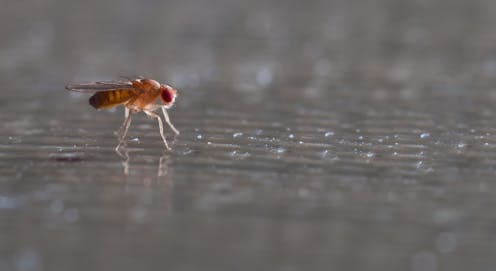
We wanted to examine how species interactions might alter predictions about the energetic costs of climate warming for cold-blooded animals. To do this, we turned to the fruit fly (from the genus Drosophila).
Fruit fly species lay their eggs in rotting plant material. The larvae that hatch from these eggs interact and compete for food.
Our study involved rearing fruit fly species alone or together at different temperatures. We found when two species of fruit fly larvae compete for food at warmer temperatures, they were more active as adults than adults that didn’t compete with other species as larvae. This means they also used more energy.
From this, we used modelling to deduce that species interactions at warmer global temperatures increase the future energy needs of fruit flies by between 3% and 16%.
These findings suggest previous studies have underestimated the energetic cost of climate warming for ectotherms. That means purely physiological approaches to understanding the consequences of climate change for cold-blooded animals are likely to be insufficient.
Read more: Young cold-blooded animals are suffering the most as Earth heats up, research finds
Let’s get real
Understanding the energy needs of animals is important for understanding how they’ll survive, reproduce and evolve in challenging environments.
In a warmer world, hotter ectotherms will need more energy to survive and reproduce. If there is not enough food to meet their bodies’ energy demands, their extinction risk may increase.
Clearly, we must more accurately predict how climate warming will threaten biodiversity. This means studying the responses of animals to temperature change under more realistic conditions.
Read more: Move over, honeybees: Aussie native bees steal the show with unique social and foraging behaviours
Authors: Lesley Alton, Research Fellow, Monash University


















